
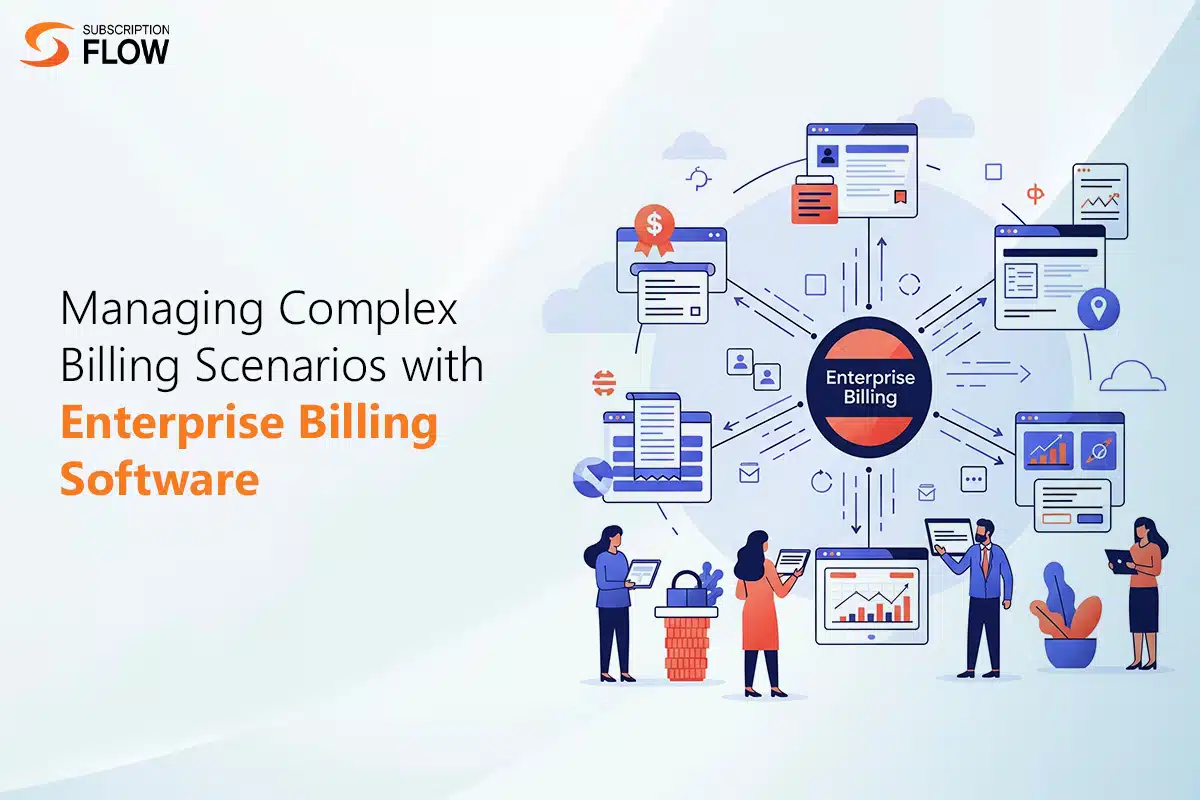
Managing Complex Billing Scenarios with Enterprise Billing Software
Subscription enterprises typically deal with large volumes of invoices. The more the invoices that need to be taken care
of, the more administrative burden. Things get even more complicated if we consider invoicing across borders.
Handling multiple tax regulations, generating thousands of invoices, dealing with complicated billing calculations, all
the while ensuring accurate finances is not an easy task. It requires a billing software purpose-built for the advanced
needs of enterprises.
Traditional billing software is not the solution. It lacks the advanced features and scalability necessary for
high-powered tasks. This is where enterprise billing software comes in. As its name suggests, it is a billing software
designed with enterprise needs in mind.
In this article, let’s explore everything you need to know about enterprise billing software.
What is Enterprise Billing Software?
Enterprise billing software caters to the specific billing requirements of enterprise businesses. These requirements
include automated invoicing, payment processing, subscription management, and more.
Enterprise billing is not like regular billing. It involves more complication, and requires dynamic solutions.
Enterprise billing software offers a comprehensive and advanced feature-kit. These features facilitate enterprises in
handling automated recurring billing for
large payment volumes. They support complex pricing structures, and international subscription operations, allowing
companies to grow beyond borders.
Why is Enterprise Billing Software Needed?
Businesses need to rely on this software due to these factors:
- High-Volume Transactions
Subscription enterprises typically have huge customer bases. All of these customers have to be billed on a recurring
basis, as their subscriptions require. The more invoices there are to be dealt with, the more complicated financial
operations become.
An advanced billing system becomes important as it automates most of the payment processes. For instance, it automates
billing schedule tracking, invoice generation, payment processing, and billing adjustments. By doing so, it relieves a
great deal of administrative burden.
- Multiple Billing Models
Enterprises usually offer a variety of subscription plans and pricing structures. Customers are not restricted to
standard subscription billing only. Advanced billing models such as usage-based billing, tiered and volume
pricing, etc. are employed according to the nature of the subscription service, and customer demands.

Standard billing software only offers traditional billing support. In order to support advanced models, agile billing solutions are required.
- Mid-Cycle Upgrades, Downgrades, and Proration
Customers rarely stay on the same plan for an entire billing cycle. They upgrade to a
higher tier halfway through the month or choose to switch to a lower tier the very next quarter. Common scenarios
enterprise billing software needs to handle correctly includes upgrades mid-cycle, downgrades mid-cycle, seat or
quantity changes, add-ons and one-time charges, and cancellations with the time remaining. Getting this wrong at
scale doesn’t just cost revenue, it creates support tickets, billing disputes, and, for public companies, potential
misstatement of recognized revenue.
- Global Compliance
When dealing with customers from around the world, compliance with global standards becomes necessary. One such standard
is the revenue recognition principle (ASC 606 and IFRS 15).
In order to accurately report their revenue, companies must rely on software that offers easy revenue recognition
management. Adherence to such international financial standards is also compulsory for avoiding heavy penalties.
- Automated VAT, GST, and Sales Tax Calculation
Revenue recognition is only half of global compliance. The other half is charging the
correct tax on every invoice, in every jurisdiction a business sells into. This is one of the most error-prone parts
of enterprise billing, because tax rules vary by customer location, product or service category, registration
thresholds, and exemptions (non-profits, resellers, and certain customer types). Manually tracking this across
dozens of jurisdictions doesn’t scale.
- Multiple Currency Support
Since enterprises cater to a multinational customer base, they need to make pricing fair for all. Customers prefer to be
billed in their local currencies. Paying in a standard currency might seem unfair, and charges might come off as
unexpected. Enterprise billing software resolve this problem by letting companies invoice in multiple currencies.
- Multiple Entity Support
It is common for an enterprise to operate in different locations. It might comprise of different departments or
sub-units, or have sister branches across borders. Robust billing software enables all units of an enterprise to be on
the same page.
It prevents chaotic workflows, and ensures that enterprises remain up-to-date with regards to their financial data and
subscription billing progress.
- Custom Subscription Contracts
Custom subscription contracts are more common in the B2B landscape. Companies create these contracts based on the
special needs of their customers, and negotiate pricing accordingly. This includes Net
30/ 60/ 90 payment terms, multi-year contract with built-in price escalators, milestone-based billing,
purchase-order-based invoicing, and custom billing schedules.
These scenarios can be easily accommodated by flexible billing
software, that bills according to each customer’s unique subscription terms.
Key Features of Enterprise Billing Software
These are the major features that enterprise billing software offers:
- Automated Recurring Billing
This is a must-have feature for ongoing subscription cycles. It involves automating every key aspect of billing for fast
and error-free payments. Companies can sit back and watch as their billing platform handles payments for them
end-to-end.
With enterprise billing software, chances of missed or delayed payments are minimized. The software automatically
charges customers when their subscription
renewal dates arrive. This speeds up the renewal process, and ensures hassle-free operations.
- Automated Revenue Recognition
Revenue recognition must not be performed manually, especially on a large scale. It is simply too error-prone. Billing
software intelligently manages revenue by keeping a track of deferred and earned funds.
Deferred amounts are automatically converted into earned revenue over customers’ subscription lifecycles. This helps
businesses comply with revenue recognition rules easily.
Moreover, this software allows companies to manage their accounts receivable. It converts AR into earned revenue as soon
as customer payments are received.
- Custom Pricing
This feature ensures that companies can price their way. They don’t have to follow rigid pricing rules. In fact, they
can employ the pricing models that resonate the most with their offerings, and their customers. They can even extend
unique prices to special customer segments.
Moreover, they can offer personalized discounts and coupons according to their retention strategy. They can also extend
loyalty rewards, and dynamic pricing
strategies. Agile billing software can handle it all.
- Usage-Based, Credit, and AI-Product Billing
Flat-fee, seat-based billing no longer covers how most modern software is sold. SaaS
platforms now blend subscriptions with consumption, and AI products in particular are billed by tokens, API calls,
compute minutes, or credits rather than a flat monthly fee. Enterprise billing software has to handle this without
forcing engineering or finance teams to build custom logic on top of it.
- Real Time Usage Metering
The system needs to ingest usage events such as API, calls, tokens processed, GB stores,
active seats, compute time) as they happen, not in forms of batches later on. This matters most for AI and
infrastructure products, where a customer’s usage can vary significantly within a single day.
- Credit and Prepaid Balance Systems
Many AI and API-first companies sell credits upfront: customers buy a credit pool, draw
it down as they use the product, and get billed again when it deplete or on a recurring top-up schedule. Billing
software needs to track credit balances per customer, apply different consumption rates to different actions (for
instance: a GPT-4-class call costing more credits than a smaller model call), and trigger low-balance alerts or auto
top-ups automatically.
- Overage Handling and Spend Controls
Enterprise customers, especially finance teams, want guardrails: usage caps, budget
alerts, and the ability to throttle or pause service when a spend limit is hit, rather than discovering a surprise
bill at the end of the month.
- Real-Time Reporting and Analytics
Subscription enterprises require real-time insights into their financial operations and performance. Advanced analytics
offer them increased visibility into their activities and progress. Businesses can measure their revenue over different
time periods (MRR, QRR, ARR etc.).
They can also measure other key subscription metrics such as CLV, churn-rate, and more. The software allows them to
generate customized financial reports to track their performance.
- Integrations with External Software
The software can flexibly be integrated with third-party platforms. Smooth integrations allow businesses to create their
own comprehensive network of tools.
The billing software ensures that the data stays consistent throughout this network. It allows businesses to manage all
their data from one unified platform.
- Dunning Management
Dunning management allows companies to recover their
lost revenue. It prevents revenue leakage that occurs through stubborn payment failures. Advanced software is built with
smart dunning capabilities. These include efficient payment retry mechanisms, automatic payment reminders, and proactive
customer communication.
How to Choose the Best Enterprise Billing Software?
An enterprise’s choice of billing software depends upon its own unique requirements. Generally, companies should look
for these features in a software to know if it is a good match for enterprise billing:
- Scalability
Enterprises grow fast. Their billing software must be able to catch up with their pace. It must be able to process
thousands of transactions in the same day without faltering.
- Advanced Billing Logic
The software must be able to execute billing based on flexible usage-based models. It must support easy application of
customized pricing and discounts. In addition, it should be capable of automating billing adjustments, such as
proration.
- Integration
The billing software must be able to easily integrate with other software in a business’s use. Otherwise billing can be
disjointed. Seamless integrations that don’t involve complicated coding are important for maintaining unified workflows.
- Security and Compliance
Enterprises deal with considerable amounts of customer data. In order to build trustworthy relationships, they need to
be compliant with data security standards, such as PCI DSS. Advanced billing software helps companies stay compliant
with such regulations.
- Global Business Support
Companies operating internationally require features such as multiple payment gateways integration,
multiple-currency support, automated tax management, etc.
Their billing has to be compliant with the tax regulations of the regions they operate in. Enterprise billing software
offers automated, dynamic tax calculations.
Best Enterprise Billing Software for Complex Billing Scenarios
| Platform | Billing Models Supported | Multi-Entity Support | ASC 606 / Revenue Recognition | Usage-Based Metering Depth | Tax Compliance | Best For |
|---|---|---|---|---|---|---|
| SubscriptionFlow | Flat-fee, usage-based, tiered, volume, hybrid, pay-per-use | Yes | Automated | Real-time metering with tiered/hybrid pricing built in | Native Avalara AvaTax integration | Enterprises and SaaS teams |
| Zuora | Subscription, usage-based, hybrid, one-time | Yes | Yes | Strong, but typically requires dedicated configuration for complex metering | Not native — paired with a third-party tax engine | Large enterprises |
| Chargebee | Subscription, tiered, usage-based, negotiated B2B pricing | Yes | Core billing is ASC 605 level; full ASC 606 compliance requires a separate RevRec add-on | Solid, though less deep than usage-first platforms | Built-in tax calculation | Global B2B teams |
| Maxio | Subscription, usage-based, contract-based | Weaker at scale — multi-currency accuracy is a known limitation | Yes | Moderate | Limited native tooling; often paired with a separate tax engine | Finance-led B2B SaaS teams |
| Recurly | Subscription, usage-based, hybrid | Available on advanced/enterprise editions | Yes | Moderate | Tax calculation available, but the business remains responsible for compliance | High-volume B2C or PLG subscription businesses |
| Orb | Usage-based, hybrid (subscription + usage) | Not a core focus of the platform | Limited | Very strong | Paired with an external tax engine | Engineering-led teams with complex, high-volume usage |
How SubscriptionFlow Powers Enterprise Billing
At SubscriptionFlow, we cater to the unique billing needs of the subscription enterprises. These are some of the
intelligent billing features we offer:
- Multiple Billing Models
Businesses can flexibly bill the way they want. They can invoice according to dynamic billing models, such as volume and
tiered pricing, usage-based billing, hybrid billing, and more.
SubscriptionFlow offers smart metering capabilities, and measures customer usage in real-time. This allows for the
creation of accurate invoices with detailed breakdown of subscription charges.
- Custom Invoices and Billing Workflows
Businesses can create unique invoices with deep customizations. They can change invoice layout, themes, data fields, and
more. They can save these custom templates, and re-use them automatically.
Moreover, businesses can set up batch invoices to process large transaction volumes in one go. They can flexibly
configure their billing workflows to suit their needs—all without complicated coding.
- Customer Self-Service Portals
SubscriptionFlow offers convenient self-service
portals that allow customers to monitor and manage their own subscriptions. These portals can be personalized
according to customers’ preferences.
They enable customers to modify and cancel their plans, view invoice history, update account details, and more. With
this, the portals not only boost customer engagement, but also reduce administrative burden.
- Automated Renewals
Billing is fully automated, and so are the customer renewals. Businesses can also leverage one-click renewals and
subscription re-activation. They can also offer flexible grace periods to customers to boost renewal rate.
- Advanced Subscription Management
Customers can freely modify their subscription plans. Whether they upgrade, downgrade, or cancel their plans,
SubscriptionFlow prorates their charges precisely. In the event of cancellation, refunds are calculated and issued
efficiently. Manual interference is kept to a minimum.
- Smart Integrations
SubscriptionFlow offers a variety of integrations with external software such as accounting platforms, CRMs,
communication tools, contract management tools, e-commerce platforms, and more.
We also support a wide range of payment gateways, and
payment methods, including both global and regional options. Businesses can access these integrations seamlessly with
only a few clicks.
Companies can build their own tech-stack to automate tax compliance, revenue recognition, complicated accounting, and a
lot more. SubscriptionFlow ensures that their data stays consistent across all platforms, powering smooth workflows.
Enterprise billing doesn’t have to complicated. Book a
demo with SubscriptionFlow today to leverage advanced billing that is simplified and automated.
FAQs
What is the best enterprise billing software for SaaS companies?
You need to evaluate the best suitable option on the basis of what your SaaS company
actually sells. In general, SubscriptionFlow stands out as the best enterprise software for SaaS companies as it
manages complex hybrid pricing models, automates revenue recognition, and handles advanced dunning management
without any need of custom engineering.
What features should the best enterprise billing software include in 2026?
In 2026, enterprise billing software must have real-time usage metering, native ASC 606
revenue recognition, built-in tax compliance, automated running, multi-entity support, and a real developer API.
Another thing worth considering is fast implementation and pricing that doesn’t scale as a percentage of
revenue.
What is the difference between enterprise billing software and regular invoicing tools?
Enterprise billing software automates complex recurring revenue models, usage-based
consumption, and automated financial compliance like ASC 606 across massive account volumes. Regular invoicing
tools, by contrast, are built for manual, one-off bill generation and basic payment tracking. While invoicing tools
handle simple flat fees, enterprise platforms integrate deeply with your CRM and ERP to manage subscription
lifecycles, smart dunning, and multi-currency ledgers at scale.
How much does enterprise billing software cost?
It ranges widely depending on transaction volume, number of billing models used, and how
many integrations are required. Common enterprise billing software such as SubscriptionFlow runs flat fixed-fee
plans from $99-$299/ month, Recurly at around $249/month + 0.9% of volume, Chargebee ~$424-599+/ month plus
0.65-0.75% overage). Most of the platforms offer custom rates for enterprises depending on the billing
complexity.

POPULAR POSTS


Think Business!
Related Posts
 AI Billing Solution for B2B Businesses, Smart Payment & Revenue Management
- What is the Role of Billing Software for Alarm Companies?
 Learn How RevOps is Helping Companies Achieve Business Goals and the Role of Invoicing Software for Enterprises
- Transform the Way You Do Business with a Flexible Billing Platform
- Everything You Need To Know About Xero Recurring Invoices