
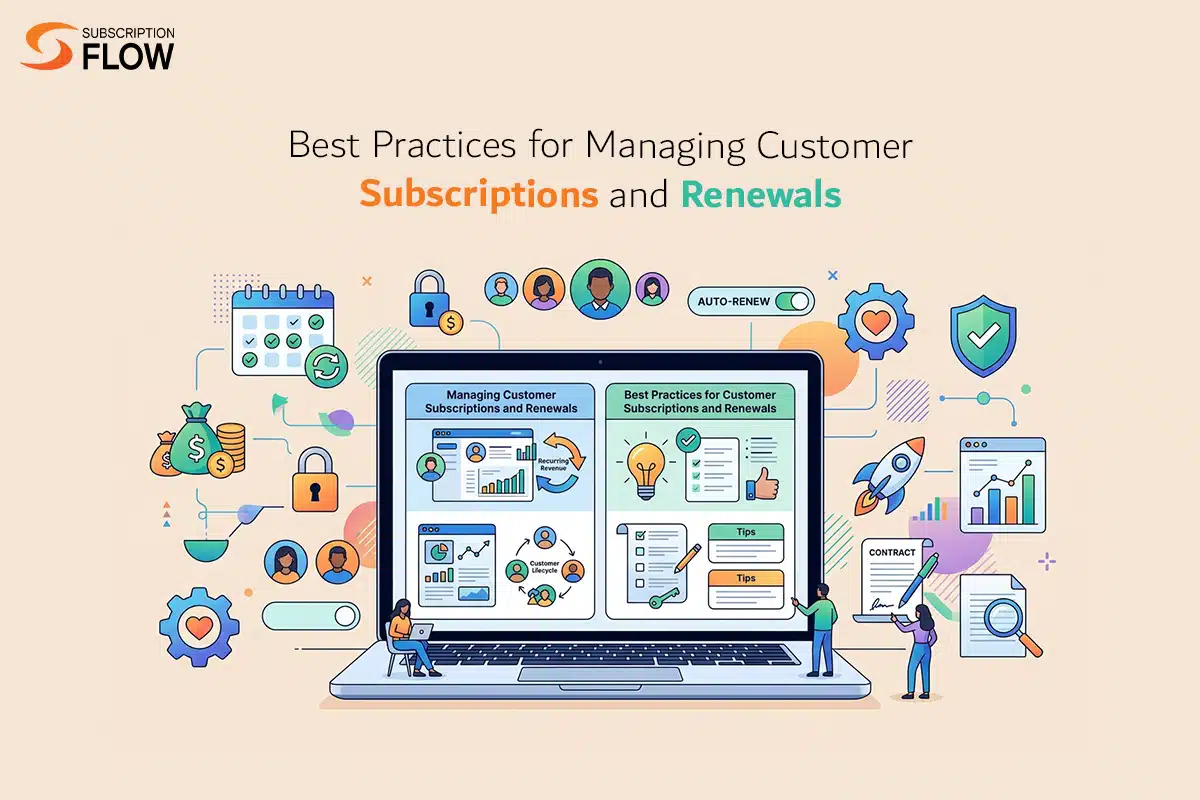
Best Practices for Managing Customer Subscriptions and Renewals
The success of a subscription business relies majorly on two factors: how many customers renew, and how much friction stands between a customer and their next billing cycle. Customer acquisition is only the first step. The real value of a subscription model is unlocked over time via renewals, upsells, and long-term retention.
However, some companies still treat subscription management as an afterthought bolted onto their billing system, instead of a core discipline that touches finance, product, and customer experience alike. This blog breaks down some of the best practices that you can follow to manage subscriptions and renewals effectively, reduce churn, and build predictable recurring revenue.
Why Subscription and Renewal Management Matters
Every subscription business, whether it’s SaaS, media streaming, e-commerce boxes, or B2B services, depends on a healthy renewal rate to sustain growth. A slight improvement in customer retention can lead to a substantial increase in profits. Moreover, renewals are also far cheaper to secure than new customers; acquiring a new customer can cost five to seven times more than retaining an existing one.
Poor renewal management leads to involuntary churn (customers who wanted to stay but left due to payment failures or overwhelming processes), voluntary churn (Customers who leave because they didn’t see value), and revenue leakage from missed upsells or incorrect billing. Getting renewals right isn’t just an operational add-on; it’s a direct lever on revenue.
Subscription and Renewal Management Best Practices
Not every customer renews the same way, and treating all renewals with a one-size-fits-all strategy is one of the most common mistakes subscription businesses make. The right renewal model, and the right practices around it, depends on who the customer is, how they buy, and how much friction they’re willing to tolerate. Here are major renewal types, the audience it best serves, and the practices that make it run efficiently.
Automatic (Auto-Renewal) Subscriptions
It is best suited for consumer subscriptions, SMB SaaS, streaming services, and high-volume, low-touch customer bases where convenience drives loyalty.
Auto-renewals work because they remove decision fatigue. The customer doesn’t have to remember to renew, so the business avoids the revenue dips that come from forgetfulness rather than dissatisfaction. To make this model efficient rather than a source of disputes:
- Send renewal reminders at 30, 15, and 7 days out, clearly stating the date, amount, and pricing changes.
- Build in one-click cancellation and self-serve plan management, since regulations like the FTC’s “click-to-cancel” rule and the EU’s consumer protection directives require it.
- Use card-updater services and automatic payment retries to prevent involuntary churn from expired cards or failed cards.
Manual Renewals
Ideal for B2B contracts, entire software, agencies, and high-value services where the renewal decision involves negotiation, budget approval, or a relationship beyond a simple charge.
Manual subscription renewals put control in the customer’s hands, which builds trust with buyers who need to justify spending internally. But they also carry higher risk of lapsing if not proactively managed. Efficiency here comes from process, not automation alone:
- Assign an account manager and start outreach 60-90 days before contract expiration for enterprise deals.
- Frame the renewal conversation around when delivered and outcomes achieved, not just a transactional invoice.
- Use internal task reminders and pipeline tracking so no manual renewal is left to fall through the cracks near quarter-end.
Usage-Based (Consumption-Based) Renewals
Works well for cloud infrastructure, API platforms, and products where value scales directly with consumption (compute, storage, transactions, API calls, etc).

Usage-based renewals change the core philosophy from “will they renew?” to “will they keep using it?” This means the renewal work happens throughout the billing cycle, not just at its end. To keep this efficient:
- Monitor consumption trends continuously and flag accounts with declining usage as early churn risks, well before the renewal date arrives .
- Send proactive consumption alerts to customers approaching plan limits, turning potential overage complaints into an upsell opportunity.
- Make usage data visible to the customer directly (via dashboards), so there are no surprises when the bill reflects their consumption.
Tiered and Hybrid Renewals
Suitable for mid-market and enterprise SaaS companies offering a base platform fee plus usage-based add-ons, or business transitioning customers from flat pricing to consumption-based pricing.
Hybrid models serve customers who want predictable baseline costs but flexibility to scale. The efficiency challenge is tracking multiple renewal triggers at once:
- Separate the calendar-based renewal of the base subscription from the continuous tracking of usage-based components.
- Ensure invoices clearly itemize fixed and variable charges so customers understand exactly what they’re renewing and what they’re consuming.
- Automate proration and billing adjustments when customers change tiers mid-cycle, rather than handling these manually.
Evergreen Contracts
Works best for enterprise vendor agreements, legal and compliance services, and long-term B2B partnerships where continuity is expected but terms are periodically revisited.
Evergreen contracts renew automatically for successive terms unless notice is given within a defined window, a model that favors continuity but can backfire badly if mismanaged:
- Track notice periods rigorously; missing a cancellation window can lock a customer into another full term and seriously damage trust.
- Set internal alerts well ahead of the notice deadline, not just the renewal date itself.
- Revisit terms periodically even when the contract auto-renews, since stale pricing or outdated SLAs erode goodwill over time.
Opt-In Renewals
Optimized for trust-sensitive industries, premium or high-touch services, and businesses prioritizing transparency over retention-by-default. Here, the subscription lapses unless the customer explicitly opts back in, placing the full burden of retention or proactive communication:
- Launch re-engagement campaigns well before the lapse date, reminding customers of value delivered and what they eventually lose.
- Make the opt-in action as frictionless as possible with single-click, pre-filled forms, etc. This reduces accidental churn from inertia rather than intent.
- Use this model deliberately as a trust-building differentiator in markets where auto-renewal has damaged brand reputation.
Freemium-to-Paid Conversion Renewals
Best suited for product-led growth (PLG) companies where free-tier users self-select into paid plans based on usage or need. This isn’t a traditional renewal, but the same principles apply once a user converts and enters their own renewal cycle:
- Track feature usage and engagement signals that indicate a free user is ready to convert, and time upgrade prompts accordingly.
- Once converted, treat the first renewal with extra care as customers at the early lifecycle stage churn at higher rates than tenured ones.
- Use in-app messaging rather than email as the primary channel, since this audience engages with the product directly.
Cross-Cutting Practices That Apply to Every Renewal Type
Get Your Subscription Data Model Right From the Start
Before subscription management, you need clean, structured data behind it. This means every subscription record should clearly capture the plan, billing frequency, contract term, proration rules, discounts applied, and renewal date.
For this, a centralized subscription management system should be there, acting as a single source of truth for customer entitlements, usage, and billing history. When sales, support, and finance teams all look at the same record, discrepancies disappear, and renewal decisions are based on accurate information rather than guesswork.
Trigger Renewal Outreach From Customer Behaviour, Not the Calendar
The default approach is mechanical, which includes sending a notice 30 days before the billing date, regardless of who the customer is or what they are experiencing. This is arbitrary, and it treats every account the same when they actually are not.
A smarter system ties renewal outreach to what is actually happening in the account. A message that lands right after a customer hits a usage milestone, finishes onboarding a new feature, or gets a strong resolution from support converts far better than one dictated purely by a date on the invoice. The same logic applies to renewal type: auto-renewing customers need early transparency to avoid surprise-charge disputes, while manually renewing customers need a longer runway and a stronger call to action, since there’s no fallback if they do nothing.
Catch Payment Failures Before They Happen
Most dunning strategies start after a card has already been declined. By that point, the customer has usually already been notified by their bank, and you are playing catch-up on a problem that could have been avoided.
The smarter strategy is to check card health before the renewal date arrives. Account updater services and card network data can flag an expiring card weeks in advance, enabling you to prompt a quiet, low-pressure update request before anything actually fails. This avoids the declined charge, the retry sequence, and the risk of the customer noticing a problem before you do.
Tier Your Response by Account Value
Treating every account identically at renewal time is efficient but not smart. Your highest-value customers deserve a different level of attention than a small self-serve account.
In practice, this means routing failed payment on high-value accounts to a real person for immediate outreach, rather than letting them sit in an automated retry queue where a five-minute personal touch could have protected the revenue instead. It also means building tenure into your pricing logic: customers who have renewed multiple times should have a path to price protection, a loyalty tier, or bundled features at renewal, instead of facing the same blanket price increase as a brand-new customer.
How SubscriptionFlow Helps
SubscriptionFlow is built to make these best practices operational rather than aspirational. It works by sitting at the center of your billing, CRM, and accounting stack, pulling subscription, usage, and payment data into one engine so renewals, invoicing, and dunning run automatically instead of through manual tracking. It connects natively to HubSpot, NetSuite, QuickBooks, and payment gateways such as Stripe, PayPal, Authorize.net, Adyen, and tax engines like Avalara; some existing tools don’t need to be replaced, just linked through API and webhook connections.
On top of this, it automates recurring invoicing, payment retries, proration, and revenue recognition, while syncing renewal and customer data bidirectionally with systems like NetSuite for real-time financial visibility. It supports distinct renewal workflows for auto-renew and manual-renew customers, tenure-based pricing rules, and configurable dunning tiers so high-value accounts can automatically route to a team member while routine accounts move through automation. Cancellation flows capture structured reason data that feeds back into your reporting, and flexible proration tools make it possible to stagger renewal dates and smooth out contract anniversary clusters.
By giving subscription teams the data and workflow flexibility these practices actually require, SubscriptionFlow turns renewal management from a fixed, one-size-fits-all process into a system that adapts to how each customer actually behaves, protecting revenue at the moments that matter most.
Unlock Long-Term Recurring Revenue Growth
Subscription revenue is won or lost in the details of how renewals, payments, and customer behavior are managed day to day, not in a single billing cycle. Businesses that build these practices into their process see steadier renewal rates and fewer avoidable losses over time. If you’re ready to put this into action without relying on spreadsheets and disconnected tools, SubscriptionFlow can help. Book a free demo and see how it fits into your existing systems.

POPULAR POSTS



Think Business!
Related Posts
 Optimize Quote Management for Enterprises & Lock Maximum Subscription Business Deals
 This Is Your Definitive Guide to Surviving Subscription Billing Challenges during COVID-19 and Make Successful Strides in the Future
- How to Implement an Effective Membership Program with WooCommerce for Business Growth
- Memberful Alternatives: Top 5 Picks for Membership Businesses
- 14 Key Metrics For Subscription Growth to Monitor & Track In 2022