
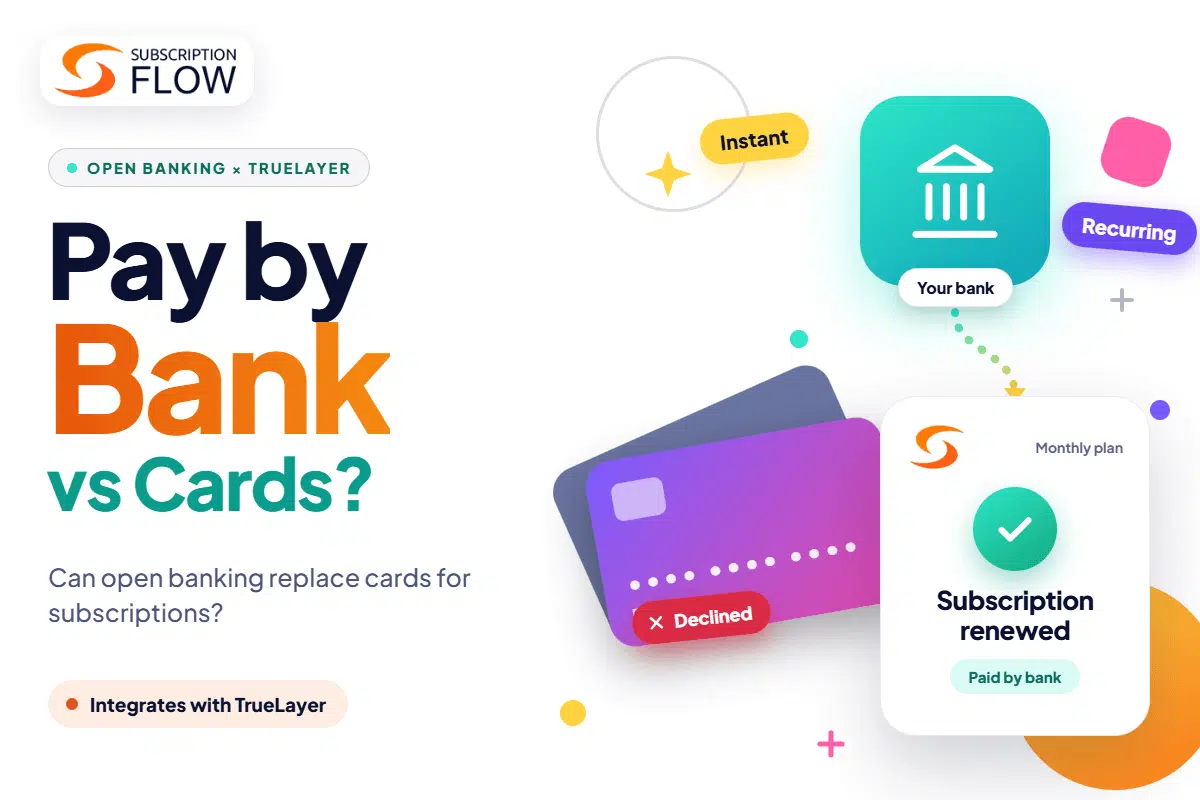
Pay by Bank: Can Open Banking Replace Cards for Subscriptions?
Key Takeaways
- Pay by bank is an online payment method enabled by open banking. It lets subscribers authorize payments once and pay straight from their bank accounts, with no card numbers, expiry dates, or card-network fees.
- The main advantages of Pay by Bank for subscription businesses are retention and cost. Bank authorized payments avoid card expiry and reissue failures, reduce fraud and chargeback exposure, and convert strongly among returning users.
- Integrating open banking infrastructure like TrueLayer into billing platforms like SubscriptionFlow enables automated recurring bank transfers, instant real-time settlements, biometric authentication, and higher subscriber retention.
The checkout experience is the backbone of subscription-based businesses. Whether you are running a SaaS platform, a streaming service, a digital magazine, or a box subscription, keeping customers engaged month after month is hard enough. But losing a loyal customer not because they want to cancel, but because their credit card expired, is frustrating.
To overcome this issue, subscription businesses have started to adopt Pay by Bank, which is a digital payment method that enables users to pay for things online or in apps directly from their bank account without using any debit card, credit card, or manually typing in card numbers. It is powered by open banking, a secure, regulated technology framework that lets your bank safely connect to the merchant’s payment system. In short, Pay by Bank is what you use at checkout, and open banking is the engine under the hood that makes it work securely.
Despite having substantial benefits, the underlying question remains: can open banking, and Pay by Bank in particular, take over from cards for recurring payments? The short answer is that it can, in the right markets and for the right customers. However, it depends on how Pay by Bank works, where its adoption stands in your targeted market, and how it fits into your billing stack.
Why Cards Struggle With Recurring Payments
Cards remain the default for digital payments. Cards are familiar, and that familiarity is why they dominate. But they carry structural weaknesses for subscription businesses.
Involuntary Churn From Expiry and Reissue
A card number is only valid for a limited time. Cards expire, get lost, are replaced after fraud, hit spending limits, and each of those events can cause a failed renewal that has nothing to do with whether the customer still wants the product. This causes involuntary churn and is frustrating for merchants because it costs them a loyal customer. Account updater services and retry logic help, but they patch the problem rather than remove it. A bank account, by contrast, rarely changes, so authorized payments continue even when a physical or virtual card has been replaced.
Fees, Chargebacks, and Fraud
Card payments involve multiple intermediaries, each taking a cut. Chargebacks add operational cost and risk. McKinsey’s Global Payments Report estimates global losses from payment card fraud are expected to reach $400 billion over the next ten years, and authorized push payment fraud alone is projected to grow at an 11% CADR from 2023 to 2027. Bank-authenticated payments reduce several of these exposure points because the customer approves each mandate inside their bank’s own secure environment.
Authentication Friction
Strong customer authentication requirements can cause drop-off on card payments. They require users to type in 16-digit numbers, expiry dates, CVVs, and navigate multi-factor authentication pop-ups from banking apps. Every extra field added to a checkout form increases cart abandonment rates and lowers conversion at the sign-up stage.
Soft Declines from Fraud Filters
Recurring card transactions often get rejected because security systems flag the payment as potentially suspicious. They occur due to sudden changes in transaction amounts, velocity limits, cross-border processing, or stringent strong customer authentication (SCA/3DS) rules requiring cardholder verification. While these security filters protect against unauthorized charges, they often generate false positives for legitimate recurring bills, creating unnecessary payment failure and friction.
How Pay by Bank Works
Pay by Bank is a payment method that lets customers pay directly from their bank account, authorizing the payment inside their own banking app. Instead of typing a card number at checkout, the shopper selects “Pay by Bank,” is redirected to their bank for approval, and the money moves from account to account.
This works through open banking, a system that lets licensed providers connect to banks securely, with the customer’s permission. Payment initiation providers such as TrueLayer sit between the merchant and the bank, so a business can request a payment without handling sensitive banking credentials.

When making a purchase via Pay by Bank, this is how the system works:
- The customer clicks the “Pay by Bank” button at checkout.
- Open Banking technology opens the mobile banking app automatically.
- The customer approves the transfer with Face ID or fingerprint.
- Open Banking instantly moves the money from the bank account to the merchant.
On the merchant’s end, Pay by Bank works by:
- When the customer selects Pay by Bank at checkout or when a scheduled subscription billing date arrives, the merchant’s platform calls an open banking API like TrueLayer, passing the transaction amount, currency, and beneficiary bank details.
- The provider generates a secure, one-time payment URL or deep-link for customers.
- The customer is safely redirected to their banking app to authenticate via biometrics, bypassing merchant PCI compliance.
- The customer’s bank executes an instant account-to-account transfer over real-time rails.
- The open banking provider fires a real-time status webhook back to the merchant confirming the transaction.
- The merchant’s billing system automatically marks the invoice as paid, updates inventory/ ERP records, and grants service access.
One-off payments are only half the picture. Subscriptions rely on what open banking calls Variable Recurring Payments or VRPs. In plain terms, the customer gives a business permission to collect payments from their account within limits they agree on, such as the maximum amount and how often it can be taken. The customer sets up the mandate once, then later payments run without further authentication, while the customer can view and cancel the mandate in their banking app at any time. This model supports fixed monthly fees, usage-based billing where the amount varies, and top-ups, all within parameters the customer controls.
Benefits of Pay by Bank for Subscription Businesses
With the basics in place, the benefits become easier to see, because they connect directly to the problems cards create.
Fewer Failed Renewals
Because the payment comes from a bank account instead of a card, the expiry and reissue problem largely disappears. Bank accounts rarely change, so the arrangement keeps working even when a customer’s physical card is replaced. That directly reduced involuntary churn, one of the highest hidden costs in subscription revenue.
Customer Retention and Re-engagements
The strongest evidence for Pay by Bank comes from what happens after the first payment. TrueLayer reports that the merchants see 85% or more of their Pay by Bank transactions coming from returning users, and that its average UK conversion rate for returning users exceeds 95%. Customers who have used it once tend to keep using it.
Lower Costs and Faster Cash
Fewer middlemen mean fewer fees. Merchants using Pay by Bank can avoid card interchange fees, and payments sent over instant rail make funds available faster, which helps cash flow. Fewer chargebacks and less fraud reduce the hidden costs as well.
Quicker Refunds
Refunds are where customers form lasting opinions. Pay by Bank allows instant refunds, which cards generally can’t match, so a billing mistake becomes a chance to build trust instead of losing it.
Better Conversion
High returning-user conversion, no long card numbers to type, and a one-time mandate setup all reduce friction at the points where subscribers are most likely to abandon.
Implementing Pay by Bank with TrueLayer and SubscriptionFlow
Technology rarely decides whether subscription businesses adopt a new payment method; operations do. A payment rail only creates value if it connects cleanly to invoicing, dunning, revenue recognition, and customer management, because a payment method only helps if it fits into the way you already run your subscriptions.
What TrueLayer Brings
TrueLayer is a leading open banking payment provider offering Pay by Bank, recurring payments, and account data services. For subscription use, its main strengths are wide bank coverage across major European countries, a large user network, and high returning-user conversion. It also offers a sign-up option that combines account creation with a Pay by Bank payment in one step, which cuts friction for new subscribers.
Why the Billing Connection Matters
This is where SubscriptionFlow comes in. Its TrueLayer recurring payments integration links open banking to a full subscription billing platform, so your team can offer Pay by Bank without building a separate process or juggling extra tools. Billing, renewals, and payment follow-up stay in one place, whichever method a customer picks.
A Simple Way to Get Started
- Look at your current payment mix. Check card fees, failed renewals, and lost customers by market.
- Choose an initial pilot segment. Start with UK or European customers, or a specific plan tier.
- Add Pay by Bank at checkout. Present it clearly next to card options.
- Set up mandates and limits by choosing amounts and timing that match your pricing.
- Prepare reminders and retries for low balances or cancelled arrangements.
- Compare completion rates, failed payments, and cost per payment with cards, then grow what works for your subscription business.
Limitations and Considerations
Pay by Bank is not a universal replacement yet, and honest planning means accounting for the gaps.
- Geographic coverage: VRP maturity varies by country, so check availability in your key markets.
- Consumer awareness: The highest adoption is in the UK (more than 25 million Pay by Banks payments a month), but many customers outside the UK have never used it, and U.S. adoption is still limited.
- Bank API quality: Performance differs across banks, and even some banks or account providers do not support open banking networks or regions. This means merchants still need to offer alternative payment methods for customers whose banks aren’t integrated.
- Failed payment handling: Insufficient funds and revoked mandates still happen, so you need dunning and retry logic designed for bank payments.
- Consumer protections: Dispute and chargeback rules differ from cards, which affects both customer expectations and your policies.
Pay by Bank, Cards, or Both?
Open banking does not replace cards overnight, but for subscription businesses it is a strong complement and, in some markets, a credible alternative. Pay by Bank reduces fees, cuts involuntary churn, and gives customers a faster and more secure way to pay.
The practical move is to start now: pilot Pay by Bank in your strongest markets, measure the impact against cards, and scale what works. To explore how it fits your billing workflow, see how SubscriptionFlow supports TrueLayer recurring payments.

POPULAR POSTS



Think Business!
Related Posts
 Introducing the Multicurrency Support for Recurring Billing and Payment Processing in SubscriptionFlow—All You Should Know About Solutions & Implementation
 Integrate Authorize.Net With SubscriptionFlow To Streamline Subscription Payments
- The Ultimate Guide to Handling SaaS Failed Payments
- The Online Payment Security Obstacles—Learn How SaaS Businesses Can Easily Overcome Them
- PayPal vs Braintree: Choose Your Ideal Processor