
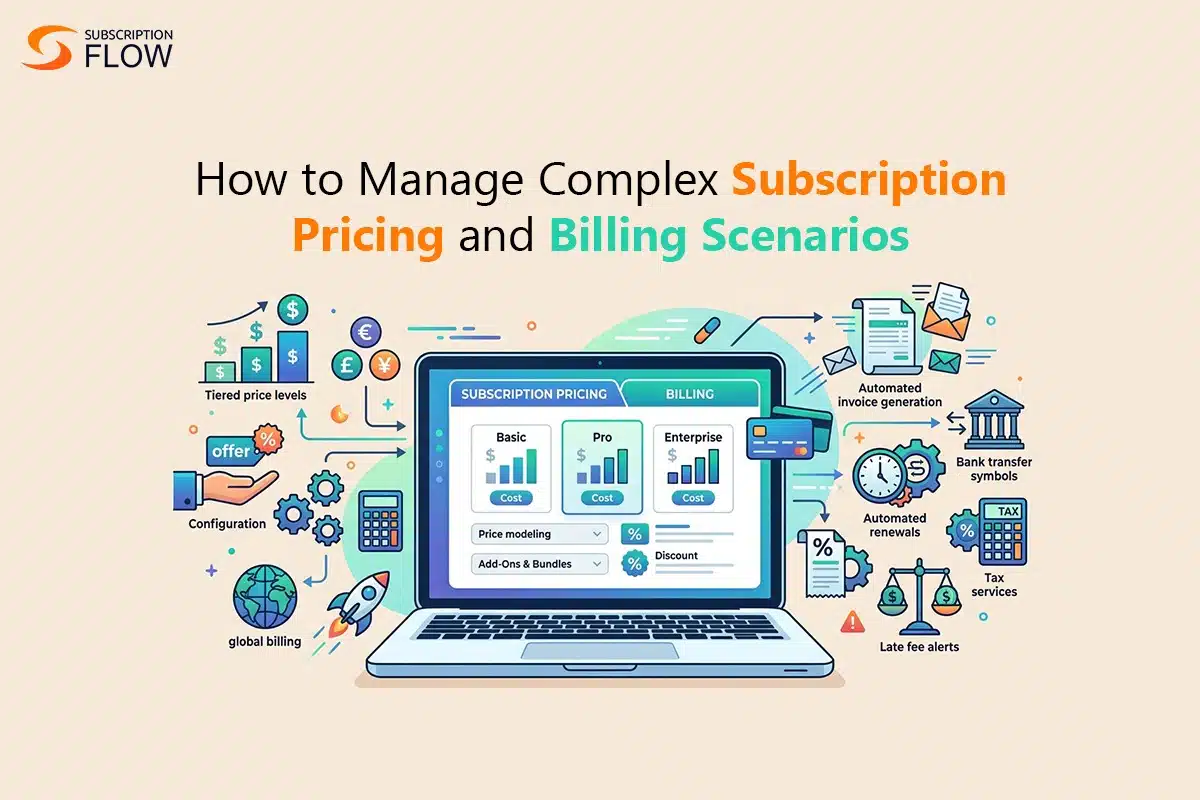
How to Manage Complex Subscription Pricing and Billing Scenarios
Subscription businesses rarely implement complex plans at the start. Mostly, there’s only one plan at inception. But as companies expand to explore more revenue opportunities, they experiment with pricing, billing, and features, which increases complexity in subscription management.
This is where most subscription businesses start to feel the pain. Manual processes break down, revenue leaks through the cracks, and customer trust erodes when invoices don’t add up. The good news is that complex subscription pricing and billing isn’t unmanageable, it just requires the right systems, structure, and automation.
Below are the most successful ways to manage complex subscription pricing and billing scenarios.
What Makes Subscription Pricing Complex
At its core, subscription pricing is complex because it isn’t static. A one-time purchase involves only one transaction. A subscription, however, involves a continuous relationship where the price, usage, and terms can change at almost any point in the customer lifecycle.
The following factors contribute to this complexity:
- Multiple pricing models operating at the same time
- Mid-cycle changes like upgrades, downgrades, and cancellations that need proration
- International operations catering to a global audience with different currencies, tax rules, and payment methods
- Promotional pricing that must expire, stack, or convert correctly
- Recurring failed payments that need retry logic and dunning workflows
- Multiple products or add-ons bundled under a single account
- Compliance requirements around invoicing, tax reporting, and revenue recognition
Each of these elements interacts with the others. A single customer may be on a discounted annual plan, using usage-based add-ons, paying in a foreign currency, and requesting a mid-cycle upgrade. All these need to be calculated correctly on the invoice. When managed manually at scale, this not only adds to administrative work but also leads to repeated billing errors, revenue leakage, and customer churn.
Common Subscription Pricing Models
Before addressing complexity directly, there’s a need to understand the foundational pricing models that bring the real complexity in subscription businesses.
- Flat-rate pricing: One price for one product, regardless of usage. Simple to understand and implement but restricts monetization flexibility.
- Tiered Pricing: Offers multiple packages (e.g., basic, pro, enterprise) with increasing features or limits at increasing price points.
- Per-user/ Per-seat pricing: Price scales with the number of users or licenses, common in B2B sales.
- Usage-based pricing: Customers are charged based on consumption such as API calls, storage, transactions, or minutes used.
- Hybrid Pricing: A combination of a base subscription fee plus usage or add-on charges.
Instead of sticking to one model, growing businesses also tend towards a hybrid approach. This means applying a combination of models to capture value from both predictable base revenue and variable usage. This shift is exactly where billing complexity begins to accelerate.
Usage-Based and Hybrid Pricing
Usage-based pricing is one of the fastest growing models in SaaS and subscription commerce because it aligns cost directly with value delivered. But it introduces real billing challenges:
- Metering accuracy: Usage must be tracked in real time and accurately attributed to the right customer and billing period
- Threshold and overage calculations: Systems need to apply allowances, then calculate coverage charges automatically
- Mixed Invoicing: A single invoice may need to combine a flat subscription fee with variable usage charges, each calculated differently
- Real-time visibility: Customers highly expect to see live usage dashboards before the invoice arrives to avoid billing surprises
Hybrid pricing adds this further by requiring the billing engine to reconcile a base fee, usage charges, and often add-ons or discounts, all within the same billing cycle. Manually managing this in spreadsheets is virtually impossible past a handful of customers. This is precisely the kind of scenario that automated billing platforms like SubscriptionFlow are designed to handle since they can meter usage, apply pricing rules, and generate accurate invoices without manual intervention.

Handling Promotional Pricing, Coupons, Discounts, and Special Offers
Businesses usually offer discounts and promotional pricing as a growth lever. But they are also one of the most common sources of billing errors. Complexity arises from:
Time-Bound Discounts
They are special lower prices or promotional deals that are only active for a specific, limited period. They have a clear start time and an exact expiration date or time. Their main purpose is to create urgency, making buyers feel a rush because the deal expires soon. Examples of time-bound discounts are flash sales, holiday and seasonal sales, and first-purchase expiration.
Volume/ Tiered Discounts
Applicable when a customer crosses a specific threshold. They lower the unit price as the customer buys more items or higher quantities, motivating bulk orders. Volume discounts usually follow threshold quantity models (1 to 40 units=$30 per unit, 41 to 80 units=10% discount, 80+ units=20% discount on all units) and wholesale bulk bracket (buy 1-29 items at $20 each, 30-59 items at $18 for the whole batch, 60+ items at $15 for the whole batch).
Stacked Promotions
In this case, multiple discounts are applied to the same customer. Stacking works by sequential application, meaning discounts apply one after another on the item or cart subtotal. For instance, a 20% off coupon combined with free shipping or a fixed dollar-off reward.
Percentage-Based Discounts
Minimizes the overall price of an item based on a fixed percentage (e.g., 20% off), creating a strong psychological value for higher-priced goods. A single percentage rule is applied to all items of different prices, such as a flat 20% off or different percentages allotted to individual items, such as up to 50% off.
Fixed Amount (Dollar-Off) Discounts
Subtracts a flat cash value from the total or item price (e.g., $20 off). This is applied to persuade lower-prices impulse buys. It can also be applied as a flat rate per unit/ item or subtracted from the entire cart of order total depending on the e-commerce platform settings.
Referral and Loyalty Discounts
They are applied to reward customers and drive sales based on their behaviour. A referral discount is offered to existing customers who bring in new people through word of mouth, and the new customer who gets onboarded by using the referral code. Loyalty discounts, on the other hand, are offered to reward customers for repeatedly buying from a business over time.
Without an automated rules engine, there are more chances of incorrect application of promotions, fail to expire on schedule, or create inconsistent pricing across customer segments. A subscription billing platform should let you define discount rules once and have them apply consistently and automatically, irrespective of how many customers or plans are involved.
Managing Upgrades, Downgrades, and Prorations
Changes of plans are a routine part of the subscription lifecycle, but they are also one of the trickiest billing scenarios to get right. When a customer upgrades or downgrades mid-cycle, the system needs to:
- Estimate the unused portion of the current plan
- Credit that unused amount against the new plan
- Charge the prorated difference immediately, or apply it to the next invoice
- Adjust future billing dates if the cycle changes
Get proration wrong, and customers either get overcharges (causing complaints and chargebacks) or undercharges (leading to revenue leakage). Best practice is to define clear proration policies upfront. For example: Whether upgrades take effect immediately with prorated charges, or downgrades take effect only at the next renewal, and let your billing software handle the calculations automatically and consistently.
Evaluating Trial Structure and Introductory Rates
To minimize entry barriers, businesses introduce free trials and special rates for new customers. Although they help in customer acquisition, they carry their own billing nuances:
- Trial-to-paid conversion: The system needs to convert trials to paid status smoothly by calculating charges from the correct date
- Card required vs no card trials: Both need to be distinguished clearly, as they process on entirely different logic for handling failed conversions or unauthorized cards
- Introductory pricing periods: Discounted prices for the first few billing cycles that need to revert to basic pricing without manual action
- Trial extensions: Sometimes granted for support or sales reasons, needing flexible date adjustments without breaking the billing schedule
With a reliable billing system, businesses can configure trial length, conversion behaviour, and promotional pricing at the initial period, then apply them automatically across every new signup.
Expanding Multiple Subscriptions and Add-Ons
Many subscription businesses don’t sell a single product; they sell a core plan plus optional add-ons, or multiple independent subscriptions under one customer account. This creates additional billing considerations:
- Consolidated invoicing: Combining charges from multiple subscriptions or add-ons into a single, clear invoice
- Independent billing cycles: Handling cases where an add-on is purchased mid-cycle and needs its own proration
- Bundle pricing: Applying discount when certain products or add-ons are purchased together
- Cross-subscription dependencies: Ensuring that cancelling a core plan correctly handles any dependent add-ons
In the absence of a centralized billing system, tracking these relationships manually across multiple subscriptions per customer quickly becomes unmanageable, especially as your product catalog grows.
Navigating Multi-Currency, Localization, and Tax Rules
Selling subscriptions globally means navigating a patchwork of tax regulations and currency requirements:
- Tax calculation: VAT, GST, and sales tax rates vary by country, state, and sometimes even product type
- Tax compliance: Requirements like the EU’s VAT rules or US state-level economic nexus thresholds must be tracked and applied correctly
- Multi-currency billing: Charging customers in their local currency while accurately reporting revenue in your base currency
- Regional pricing: Adjusting price points for purchasing power differences across markets
- Currency conversion timing: Deciding whether prices are fixed in local currency or converted at the time of billing
Miscalculations of tax and mishandling currency aren’t just a customer experience issue, it can create real compliance and legal risk. Automated billing platforms that integrate tax engines and multi-currency support remove much of this burden, applying the correct tax and currency rules based on customer location automatically.
Failed Payment, Retries, and Dunning
Failed payments are inevitable in any subscription businesses such as expired cards, insufficient funds, or bank declines, all of which happen gradually. How you handle them directly impacts your revenue retention. A strong failed-payment strategy includes:
- Smart retry logic: Automatically retrying failed charges at optimized intervals instead of a single fixed schedule
- Dunning email sequences: Notifying customers of failed payments and prompting them to update billing details
- Grace periods: Enabling continued access for a short period while payment issues are resolved
- Automatic card update tools: Syncing updated card details from card networks to minimize failures caused by expired cards
- Involuntary churn tracking: Differentiating between customers who cancel intentionally and those lost due to payment failures
Involuntary churn from failed payments is one of the most overlooked sources of revenue loss in subscription businesses. Automating retries and dunning communication can recover a meaningful percentage of failed payments without any manual follow-up.
Invoices, Credits, Refunds, and Adjustments
Even with well-designed billing logic, exceptions happen, and the way they are handled carries a significant value for both compliance and customer trust:
- Accurate, itemized invoices: Clearly breaking down base fees, usage charges, discounts, and taxes
- Credit notes: Issued for billing errors, service outages, or goodwill adjustments, without needing to reverse an entire invoice
- Partial and full refunds: Handling refund requests in line with your policies while keeping accounting records accurate
- Manual adjustments: Occasionally needed for one-off customer situations, but should still be logged and auditable
This can be done efficiently via a billing system that automatically generates compliant, itemized invoices, and makes it convenient to issue credits or refunds without manual recalculation, saving major time for both finance and support teams.
Core Principles for Managing Complex Billing Scenarios
Four core operational principles help to overcome operational friction to manage complex billing scenarios.
Decouple Billing Systems from Core Product Logic
The moment pricing rules get hardcoded into the application itself, every new plan or pricing tweak turns into an engineering ticket and a deployment. That’s not sustainable. Pricing changes far more often than your product does (new tiers, updated usage rates, a sales team that wants to test a new bundle), so it needs to live somewhere it can change without a code release. The fix is a dedicated billing engine that sits outside your core app, holds the pricing rules, and just listens to usage data coming in as events.
Implement Real-Time Event Metering Infrastructure
Usage-based pricing lives or dies on how good your metering is. There’s a need for a pipeline that is capable of managing volume and, most importantly, doesn’t double-count. For this purpose, the pipeline has to get it right:
- Idempotency: Give every raw usage event as a unique ID so a retry or resent payload doesn’t accidentally bill someone twice. This sounds like a minor detail unless a network hiccup costs you real money or a customer compliant
- Aggregation logic: Usage data isn’t useful raw. You need flexible rules (sum it, take the max, count distinct events, grab the last value) applied over a defined window like an hour, a day, or a billing month
- Late-arriving events: Data doesn’t always show up on time. Decide upfront how you handle the usage that trickles in after a billing cycle has already closed, instead of figuring it out mid-crisis
Automate Proration and Co-Terming Logic
Mid-cycle changes are inevitable once you’re selling to enterprise customers. Therefore, you need a system to:
- Figure out how much of the original plan or seat count is unused
- Prorate the cost of the new seats for the remaining days
- Line up the renewal date of the new addition with the existing contract’s end date (co-terming), so the customer gets one clean invoice rather than two billing dates fighting each other
Continuous Revenue Recognition (ASC 606/ IFRS 15 Compliance)
Collecting cash or sending an invoice isn’t the same as recognizing revenue. Under current accounting standards, revenue only gets recognized as you actually deliver on your obligations to the customer, over time.
That means for a typical hybrid contract – say, an upfront setup fee, a prepaid annual base fee, and monthly usage overages on top – your billing engine can’t just track what’s been invoiced. It needs a clear line between what’s cash (accounts receivable) and what’s deferred revenue still waiting to be earned.
Best Practices for Managing Complex Billing
Irrespective of which platform you use, a few best practices consistently separate subscription businesses with clean billing operations from those consistently firefighting errors:
- Define clear policies before you need them: Decide in advance how you handle prorations, refunds, and failed payments, rather than deciding case by case
- Centralize billing logic in one system: Avoid spreading pricing rules across spreadsheets, custom code, and payment processor settings
- Automate wherever possible: Manual invoice generation and proration calculations don’t scale and are prone to human error
- Make usage and billing data visible to customers: Transparent dashboards reduce support tickets and billing disputes
- Audit regularly: Periodically review invoices, discounts, and tax calculations to catch errors before they compound
- Plan for global growth early: Even if you’re not selling internationally yet, choose a billing system that supports multi-currency and tax compliance from the start
The Bottom Line on Complex Subscription Billing
Complexity in subscription pricing can be managed well if you invest early in transparent policies and reliable automation, instead of solving problems manually as they scale. Whether you’re dealing with usage-based pricing, prorated charges, multi-currency invoices, or failed payment recovery, the underlying principle is the same: define your rules clearly, and let automated billing software handle everything automatically. Subscription management platforms like SubscriptionFlow are built to handle exactly this kind of complexity, so your team can focus on exploring new revenue opportunities rather than manually reconciling invoices.

POPULAR POSTS




Think Business!
Related Posts
 Usage-Based Billing for AI Services: Promoting Flexibility and Fair Pricing
 SaaS Billing: The Digital Transition of Businesses to the Cloud
- Quotation and Billing Software for Efficient Quote-to-Cash Processes
- Dynamic Billing Strategy for Revenue Optimization
- Migrating from FileMaker Pro to a Billing Platform: The How’s and Whys