
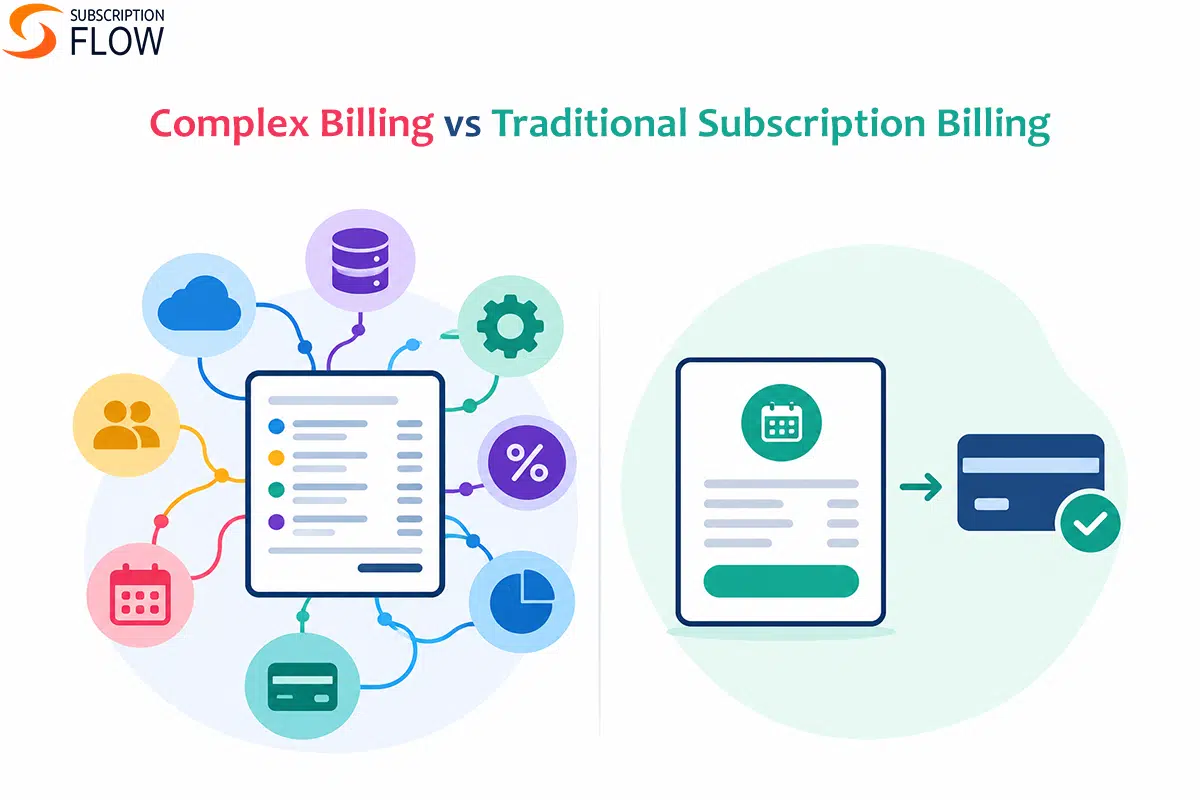
Complex Billing vs Traditional Subscription Billing: What’s the Difference?
Key Takeaways
- Traditional subscription billing charges customers a fixed amount on a fixed schedule. For instance, $49 per month for one product tier, billed automatically until the customer cancels.
- Complex billing refers to billing logic that can change on the basis of usage volume, contract terms, multiple pricing dimensions, entities, currencies, and special discounts.
- Traditional billing only estimates “how much and how often,” while complex billing tells you “how much, based on what happened during this period, for this specific customer, under these specific terms.”
As subscription businesses grow, it is difficult to keep your growing subscriber base stick to single pricing. This is where one plan, one price, one date billing logic starts to break down as customers demand usage-based pricing, personalized plans, changes mid-cycles, etc. To meet their demands, businesses switch from traditional billing to complex subscription billing. It’s an architectural shift in how pricing, invoicing, metering, and revenue recognition actually work under the hood.
What is Traditional Subscription Billing?
It is the simplest form of billing where subscribers are charged a single amount at a fixed interval. It can be monthly, quarterly, or annually. For instance, a project management tool charging $12 per user each month with no usage limits or a streaming service charging $15.99 per month regardless of how many hours you have watched. Another common example is a newspaper charging $2 per month for early access to news articles. The simplicity here is intentional to keep the billing process simple to understand for customers and to process for the teams. It is also known as flat-rate or recurring billing.
How Traditional Subscription Billing Works
The recurring billing logic works by:
- A customer selects a plan: The customer picks a plan from a fixed set of options like starter, pro, enterprise etc., each with a predetermined price and feature list.
- Recurring charge triggers automatically: On the renewal date, the billing system automatically charges the stored payment method for the plan’s fixed price.
- An invoice or receipt is generated: An invoice is generated immediately after the charge, showing the flat plan price for that billing period.
- The subscription renews or lapses: The subscription automatically renews at the same price for the next cycle, continuing indefinitely until the customer upgrades, downgrades, or cancels.
Businesses That Typically Use Traditional Billing
Traditional subscription billing dominates in:
- Early-stage SaaS companies
- Content and media subscriptions
- B2C apps
- Any product where consumption is roughly uniform across the customer base
Advantages of Traditional Subscription Billing
Predictability for the Customers
A customer signing up for a $49 per month plan knows what exactly they are charged every cycle, which reduces support tickets and billing disputes. Customers face no surprise charges and have a streamlined billing cycle.
Easy to Forecast MRR
Revenue is easy to forecast with recurring billing. If a company has 500 subscribers at $49/ month, businesses receive a predictable next month’s recurring revenue of $24,500 before churn, with no usage variance to model.
Low Operational Overhead
Flat-rate billing eliminates the need to build and maintain complex pipelines for tracking real-time usage metrics or per-seat adjustments. Fixed invoices drastically reduce customer support tickets, billing disputes, and the accounting complexity arise from variable consumption.
Fast to Launch
Standard subscription platforms support flat-rate structures natively, requiring zero custom logic or billing state machine development. Product teams can define a single price point and go live in days, bypassing intricate feature matrices and lengthy sales quoting tools.
Disadvantages of Traditional Subscription Billing
Usage-Mismatch Limitation
If two customers use wildly different amounts of a metered resource, one sending 10,000 emails a month and another sending 10 million, a flat-rate model either overcharges the light user or undercharges the heavy one, since both are forced onto the same price regardless of actual value received.
No Mechanism for Negotiation
There’s no mechanism for enterprise-style negotiated terms. Minimum commitments, volume discounts, or custom contract lengths simply don’t fit into a rigid recurring-charge structure, so a company struck on pure traditional billing eventually leaves revenue on the table with heavy users while pricing itself out of reach for smaller ones.

Understanding the Complex Billing Process
The complex billing works on a billing architecture where the billing includes on the different variable that can change independently of the base subscriptions. These variables include usage volume, contract-specific rules, multiple pricing models, discounts, credits, or prorations, etc. Instead of one fixed charge repeating every cycle, the system computes a new number each time, driven by data.
Why Businesses Need Complex Billing
Complex billing becomes necessary when a single fixed price can no longer represent the value a customer receives or the terms a customer negotiated. A cloud infrastructure provider can’t charge customers the same flat fee when one customer uses 5-GB of storage, and another uses 50 TB, because the cost structure and the value delivered are fundamentally different per customer. Once sales teams start negotiating custom enterprise deals, a minimum annual commitment with overage charges, or a hybrid of seat count and API calls, no static plan can capture that in a spreadsheet-friendly way. Complex billing exists to let pricing follow reality rather than forcing reality to fit a fixed plan.
How Complex Billing Works
The underlying mechanism of complex billing is:
- Meter and capture usage: The billing system ingests raw usage events in real time in batches. Each event is timestamped and tied to a specific customer account, forming the raw data that everything downstream depends on.
- Apply rating and pricing rules: Raw usage is converted into amounts by running it through each customer’s specific pricing logic.
- Aggregate charge into one invoice: All rated charges are combined into a single invoice per billing period. This step also handles proration for mid-cycle changes and reconciles usage against any prepaid or committed spend.
- Collect payment and recognize revenue: The finalized invoice is charged to the customer’s payment method. At the same time, finance recognizes the revenue as per the accounting standards like ASC 606.
Businesses That Typically Use It
- Telecommunications companies
- SaaS and Cloud providers
- Utility providers
- Financial institutions and Fintech
- Healthcare and medical billing providers
- Logistics and supply chain enterprises
Advantages of Complex Billing
Closer Alignment Between Price and Value
It matches pricing with exact consumption, eliminating the risk of under or overcharges. For instance, a data infrastructure company billing by volume processed captures more revenue from its largest customers without forcing them into an artificially high flat-rate tier that smaller customers would never accept, so price scales with the value each customer actually receives.
Supports Enterprise Sales
Complex billing offers the structural flexibility needed to close high-value deals by accommodating unique procurement demands. A company can close a $250,000 annual contract with custom minimum commitments and volume discounts, revenue a rigid $299/ month plan structure could never capture in the first place.
Reduces Pricing Cliffs for Customers
Billing models like tiered or usage-based pricing smooth out financial jumps by scaling costs incrementally alongside consumption. For example, instead of a customer jumping from $99 to $299 for exceeding a 100GB limit by a single gigabyte, usage-based pricing charges a few extra cents, which feels fairer and reduces churn triggered by arbitrary thresholds.
Captures Revenue from Expansion Automatically
As a customer’s usage grows, their bill grows with it, without requiring a renegotiation or upsell conversation, so revenue tracks account growth in real time rather than only at renewal.
Disadvantages of Complex Billing
Increased Operational Complexity
More code paths and edge cases mean more places for bugs to hide. A proration bug that miscalculates a mid-cycle upgrade can silently under-or over-bill hundreds of customers before anyone notices.
Heavier Implementation and Maintenance Load
Metering pipelines have to be accurate and auditable, rating engines have to handle retroactive corrections, and every new pricing model sales wants to launch becomes an engineering project instead of a configuration change.
Revenue Less Predictable Per Customer
Forecasting shifts from “known plan price times subscriber count” to modeling usage trends, which makes short-term revenue projections noisier even if total value captured is higher.
Common Complex Billing Models
Usage-Based Billing
Charges customers according to metered consumption such as API calls, compute minutes, gigabytes stored, or messages sent. For example: A cloud storage service charges you $0.05 for every gigabyte of data you store past your initial free limit.
Tiered Pricing
Offers distinct packages with predefined feature sets and usage limits, allowing customers to upgrade as their needs expand. For instance, the basic plan of a software tool with limited access is available at $50/ month and a pro plan with unlimited access is available for $80/ month.
Volume-Based Pricing
Applies a single rate retroactively to the entire volume once a threshold is crossed, rather than pricing each band separately. A data provider may charge $0.02 per record for the first 100,000 records, but drop to $0.015 per record across the entire volume once total usage exceeds 100,000.
Hybrid Pricing
Combines a fixed base fee with a variable usage component. The extra charges that scale up depend on how much the customer consumes, such as extra user seats, data storage, API calls, or AI tokens. Businesses use it to ensure revenue predictability, fair scaling, and risk mitigation.
Per-Seat Plus Usage Models
Layered metered charges on top of headcount-based pricing. A collaboration tool may charge per user for access but also meter storage or automation runs consumed by that team, so two equally-sized teams can end up with different bills.
Minimum Commitments
Guarantee the vendor a baseline invoice irrespective of actual usage. A customer may commit to $5,000 per month in usage credits, and if actual metered usage comes in under that, they’re still billed the committed minimum.
Complex vs Traditional Subscription Billing: Key Differences
| Factor | Traditional Subscription Billing | Complex Billing |
| Price Flexibility | No | Yes |
| Billing Rules | One rule set applied uniformly | Rules can vary per customer, per contract, or per entity |
| Usage Measurement | Not required | Core requirement |
| Customer Contracts | Standardized, self-serve terms | Custom negotiated, enterprise-grade terms |
| Invoicing | Same line items every cycle | Dynamic line items reflecting usage, overages, credits, proration |
| Revenue Predictability | High, easy to forecast | Lower per customer, but often higher overall value capture |
| Scalability | Scales well for uniform, high-volume self-serve customers | Scales well for diverse, high-value enterprise customers |
| Implementation Complexity | Low | High |
| Automation Requirements | Minimal | Extensive |
How to Choose Between Complex and Traditional Subscription Billing
Check Usage Variance First
Ask whether usage varies meaningfully across your customer base. If the heaviest and lightest users of your product consume roughly the same amount, complexity buys you little.
Look at Sales Motion
Self-serve, credit-card driven signups rarely need custom contract logic, while a sales team closing six-figure annual deals almost always requires complex billing. So this alone can tip the decision.
Count Your Billing Exceptions
Tally how many invoices last quarter required manual adjustment outside your billing tool. A rising number is the clearest quantitative signal that your pricing has outgrown your infrastructure.
Weigh Engineering Capacity Honestly
Complex billing requires extensive implementation capability. In case you don’t have the right tools, complex billing does more damage than expanding revenue opportunities. Without a dedicated team and mature internal tooling, teams risk billing errors that frustrate customers and eat productive hours.
Common Mistakes Businesses Make When Moving to Complex Billing
Most businesses often do such mistakes:
Building Metering Logic Directly Into the Core Application
This works fine until a pricing change requires a code deployment instead of a configuration update, and until finance needs to reconcile invoices against raw usage that’s tangled up inside application logs.
Under-Investing in Customer-Facing Usage Visibility
A company that switches to usage-based billing without shipping a real-time usage dashboard leads to more customer queries of “why is my bill higher than last month” because customers have no way to anticipate charges before the invoice arrives.
Failing to Plan For Proration and Mid-Cycle Changes Early
Teams usually build the “happy path” of a stable monthly charge and only discover the complexity of partial-period upgrades, downgrades, and cancellations after a customer complaint forces the issue.
Understanding Revenue Recognition Implications
Usage-based and contract-driven billing often doesn’t align cleanly with the period in which revenue should be recognized under accounting standards, and bolting compliance after the fact is far more painful than designing for it from the start.
How SubscriptionFlow Helps Companies Move to Complex Billing Efficiently
Transitioning to advanced pricing models can easily overwhelm engineering teams. SubscriptionFlow removes this operational friction by providing advanced automation to seamlessly deploy usage-based, tiered, and hybrid billing structures without draining development resources.
One Engine For Every Pricing Model
SubscriptionFlow unifies recurring subscriptions, tiered consumption, usage overages, custom discounts, tiered consumption, usage overages, custom discounts, and multi-currency taxes into a single automated invoice, so a business doesn’t need a separate tool every time its pricing evolves.
No-Code Plan Configuration
New plans, promotions, and pricing changes can be designed and launched directly from the dashboard without engineering involvement, which eliminates the bottleneck where every pricing experiment becomes a development ticket.
Automate Proration and Mid-Term Changes
Upgrades, downgrades, and mid-cycle plan swaps are prorated-handled automatically, addressing one of the most common sources of manual billing corrections that finance teams end up doing by hand in spreadsheets.
Integrated Reporting and Consumption Insights
Dashboards and analytics track subscription KPIs and consumption patterns, giving finance and product teams visibility into customer behavior using metered features, insight that’s hard to get once billing data lives outside the core application.
Built-in Dunning and Payment Recovery
Failed or declined payments are automatically retried with reminder notifications, which becomes more important under complex billing since variable invoice amounts make failed payments harder to predict and recover manually.
Looking Ahead
The choice between traditional subscription billing and complex billing isn’t about which model is better; it’s about which model matches the shape of your customer base and your pricing strategy. Traditional billing suits predictable, self-serve businesses, while complex billing captures value when usage and contracts vary widely. With SubscriptionFlow, growing businesses can transition to advanced billing models smoothly through deliberate infrastructure choices and automated workflows.

POPULAR POSTS



Think Business!
Related Posts
 Customer success vs customer support vs account management: Understand the Roles in Customer Success
- Women of Today: The Leader in Tech
- Freshbooks vs QuickBooks vs Xero: A Comparison
- Enhance User Experience—Boost Customer Loyalty with Reward Redemption in SubscriptionFlow
- Subscription Durations to Maximize Monthly Recurring Revenue