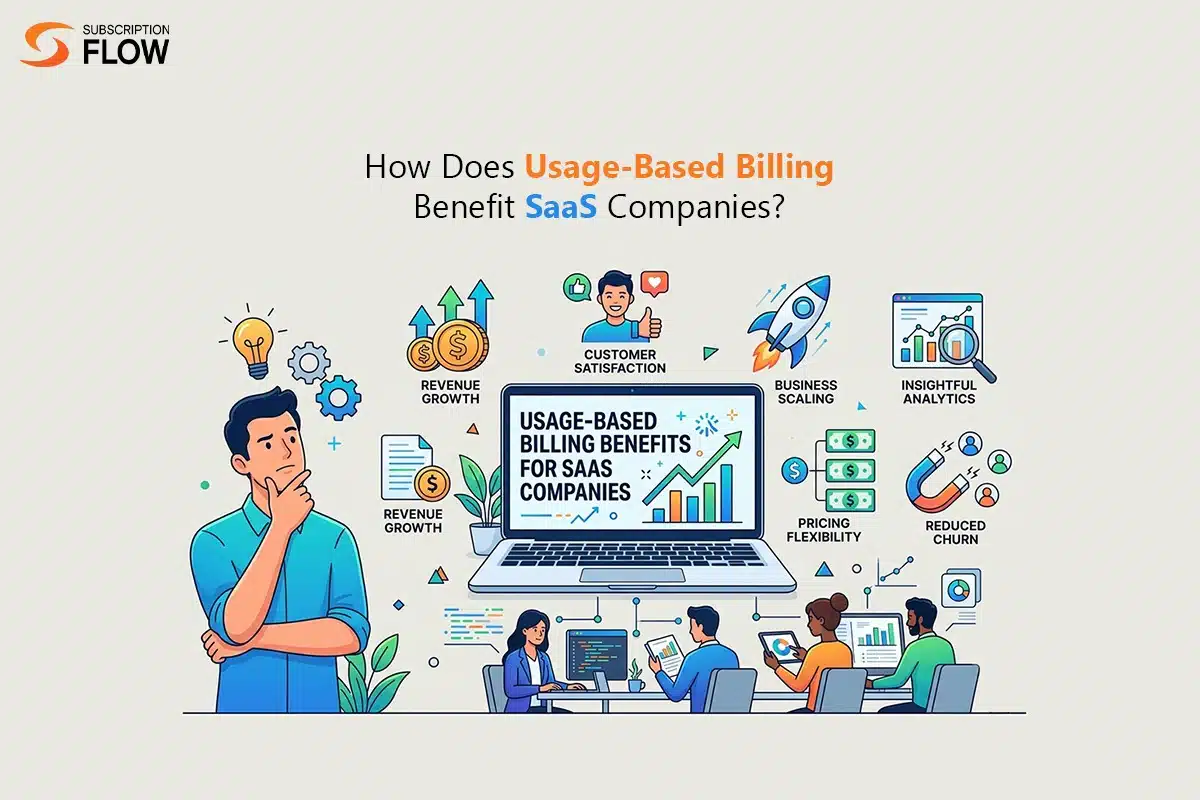
How Does Usage-Based Billing Benefit SaaS Companies?
SaaS companies typically use seat-based tiers and grow revenue by upselling more seats. However, this strategy has become outdated as the way a product’s value is perceived has changed. If your platform processes API calls, moves data, runs AI inference, or automates work, charging by per-user actively starts working against you. This is because the better your product performs, the fewer seats a customer needs, and the more revenue shrinks just as the customer gets more value.
This mismatch is why usage-based billing (UBB) has moved from a niche pricing experiment to a mainstream SaaS strategy. In usage-based billing, a customer pays for what they actually consume. Consumption metrics include API calls, compute time, data processed, resolutions delivered, and credits drawn out, etc. This guide explains what usage-based billing actually does for a SaaS company’s growth, revenue, and customer relationships once it’s implemented well.
What is Usage-Based Billing in SaaS?
For SaaS companies, usage-based billing is a monetization framework in which customer charges fluctuate in direct proportion to their consumption of a quantifiable product metric. Usage-based billing measures billable events in real-time and rates as decided by predetermined contract rules.
Types of Usage-Based Pricing Models
There’s not a single perfect usage-based pricing model for SaaS companies. However, common pricing models include:
Typical Pay-As-You-Go
Customers are generated strictly against the consumption metrics without any minimum spend thresholds. Suitable for product-led growth (PLG) entry tiers, developer APIs, and self-serve signups.
Tiered Usage
Unit rate decreases as consumption reaches a threshold (defined volume bracket). For instance: $0.10/ unit for first 1,000; $0.07/ unit afterwards. It works well for mid-market accounts with predictable growth curves.
Volume-Based Pricing
Crossing a usage cap applies a single discounted rate across all consumed units during that billing cycle. High-volume enterprise accounts seeking economies of scale should opt for it.
Prepaid Drawdown Credits
Customers require buying upfront funds or credits. The balance is then maintained as per usage. SaaS companies that need upfront cash flow predictability can use this model .
Hybrid (Base + Overage)
A combination of pricing models (often a fixed fee on top of another usage-based model). It is suitable for enterprise B2B SaaS balancing ARR predictability with expansion upside.
How Usage-Based Billing Empowers SaaS Growth
Revenue Grows Automatically as Customers Succeed
The single biggest structural benefit of usage-based billing is that it removes the need for your sales team to manually chase expansion revenue. Seat-based models don’t ensure more revenue while receiving more value. Teams have to notice, initiate a negotiation, and get the customer to agree to a higher tier manually. That takes time, and it puts your revenue growth at the mercy of your sales team’s bandwidth.

With usage-based billing, growth and revenue are mechanically linked. If a customer’s transaction volume doubles, their API call count triples, or their data processed grows tenfold, the invoice reflects that automatically at the next billing cycle. There’s no need for a contract amendment, no upsell call, and ultimately no friction. This is why usage-based SaaS companies consistently report stronger net revenue retention (NRR) than pure subscription businesses. This means existing customers expand your revenue simply by using the product more, which is exactly the behaviour you want to encourage in the first place.
Lowers the Barrier to Entry, Easing Onboarding
Flat monthly or annual fees force a prospect to commit to a number before they’ve proven the product works for their specific use case. That upfront commitment is a real psychological and financial barrier, especially for smaller teams, early-stage startups, or buyers evaluating your product against a free or cheaper alternative.
Usage–based pricing collapses that barrier. A prospect can start consuming your product for a few dollars, see the results, and scale their spend only as their own usage grows. This is a major reason API-first and developer-facing products gravitate towards consumption pricing. It lets the product sell itself before a purchasing decision is ever formalized. For SaaS companies running product-led growth (PLG) motions, this lower barrier to entry directly shortens the gap between signup and paid usage.
Turns Customer Growth into Mutual Value
Seat-based and flat-fee pricing create artificial ceilings. A customer may avoid adding a new team member because it triggers a jump to the next pricing tier, or they may under-provision a feature because using it more heavily doesn’t change what they’re already paying. Either way, the pricing model is actively discouraging the customer from getting more value out of your product, which is the opposite of what you want.
Usage-based billing removes that ceiling. Customers can grow their consumption at whatever pace fits their business, and the bill scales proportionally rather than in step-function jumps. This matters especially for products with genuine marginal costs such as compute, storage, messaging, and AI inference, where usage-based pricing also nudges customers toward efficient consumption rather than over-provisioning resources they don’t need, which keeps your own cost-to-service in a healthier ratio to revenue.
Expands Market Reach Without Monetization Gaps
One of the hardest pricing problems in SaaS is serving both a five-person startup and a thousand-person enterprise with the same plan structure. Price too low and you leave enterprise revenue on the table; price too high and you shut smaller customers out entirely. Usage-based billing sidesteps this trade-off because the price scales with the customer rather than being fixed at a tier boundary.
A small customer can run a modest volume of transactions and pay accordingly, while a large customer scales into a proportionally larger bill without ever needing a custom contract renegotiation just to keep using the product. This means your total addressable market effectively widens on both ends; you can serve the smallest self-serve customer and the largest enterprise-account with the same underlying pricing mechanism, adjusting only the rate card, volume discounts, or committed-use terms for the largest buyers.
Retains Customers Through Transparent Value Metrics
Churn in a flat-fee model often has less to do with product quality and more to do with a customer feeling like they’re paying for capacity they aren’t using. A team that goes through a slow quarter, loses headcount, or simply uses less of your product in a given month is still stuck paying the same fee. This mismatch between cost and value is a common, quiet driver of cancellations.
Usage-based billing removes that specific reason to churn. When a customer’s usage drops, their bill drops with it. They don’t need to cancel to control costs, as the pricing model already does that for them. This keeps low-usage customers on your books rather than pushing them to cancel outright, and it gives them room to scale back up later rather than disappearing entirely.
Turns Product Usage into Actionable Revenue Insights
Once you’re metering consumption at the event level, that data isn’t just a billing input; it’s a real-time signal about customer health that most seat-based SaaS companies don’t have visibility into. For instance, a customer who’s consistently bumping against their tier ceiling is a strong signal for an upsell conversation before they even ask. Similarly, a customer whose usage is quietly declining month over month is an early churn-risk flag that can help your customer success team to act on before a renewal conversation goes sideways.
A sudden, unusual spike or drop in consumption can flag a billing anomaly, an integration problem, or a change in how the customer is using your product, all of which are worth investigating before they become a support ticket or a dispute. This turns your billing infrastructure into a feedback loop between product usage and revenue strategy, something a flat monthly invoice simply can’t provide.
Supports Hybrid Models, Not Just Pure Consumption Pricing
Usage-based billing introduces complexity as revenue becomes harder to forecast month to month and enterprise buyers sometimes want a fixed number for budget approval rather than a variable one. To address this issue, most SaaS companies blend usage-based billing with a subscription fee, minimum commitments, or prepaid credit bundles.
This hybrid approach gives you the revenue floor and forecasting stability of a subscription while still letting revenue scale with actual consumption above the baseline. This is why hybrid models have become the most common pricing across the SaaS market.
Implementing Usage-Based Billing for SaaS Products
Implementing usage-based billing includes the following steps:
- Define your usage metrics: Devise your consumption metrics that reflect the customer’s usage. Common metrics include API calls, GB of storage, compute seconds, or AI tokens. For successful onboarding, keep consumption metrics simple and transparent.
- Instrument metering in your code: Monitor events in real-time by updating your application code to emit usage events whenever a billable action occurs.
- Choose and configure a billing engine: Connect your consumption data to a billing platform to aggregate events. Set your pricing tiers, billing rules, or prepaid credit system.
- Automate invoicing and provide visibility: Connect your payment workflows and sync your rate usage data with automated invoice generation and payment processing.
How SubscriptionFlow Facilitates Usage-Based Billing
Usage-based billing is only as good as the infrastructure tracking and rating that usage. This is exactly what SubscriptionFlow is built for. SubscriptionFlow lets SaaS companies configure usage-based, tiered, volume, and hybrid subscription-plus-usage pricing without custom engineering work, so you can launch or adjust a pricing model as your product and customer base evolve. It captures usage events reliably, applies your rate cards and commitments automatically, and turns that data into accurate, itemized invoices your customers can actually understand. Meanwhile, it also gives your finance team the automated dunning, payment collection, and revenue reporting needed to keep a variable revenue model predictable in practice, not just in theory. If you’re evaluating whether usage-based billing is the right move for your SaaS business, SubscriptionFlow is designed to handle the operational complexity so you can focus on the pricing strategy itself.
Transform Billing into a Growth Engine
Opting for usage-based billing is no longer just a pricing experiment; it is a strategic necessity for modern SaaS companies looking to maximize retention, expand NRR, and align revenue directly with customer value. However, managing backend metering, complex rate cards, and revenue recognition internally can quickly stall operational growth. Let SubscriptionFlow streamline your contract-to-cash workflow, so your team can focus on building exceptional products while putting expansion revenue on autopilot.

POPULAR POSTS