

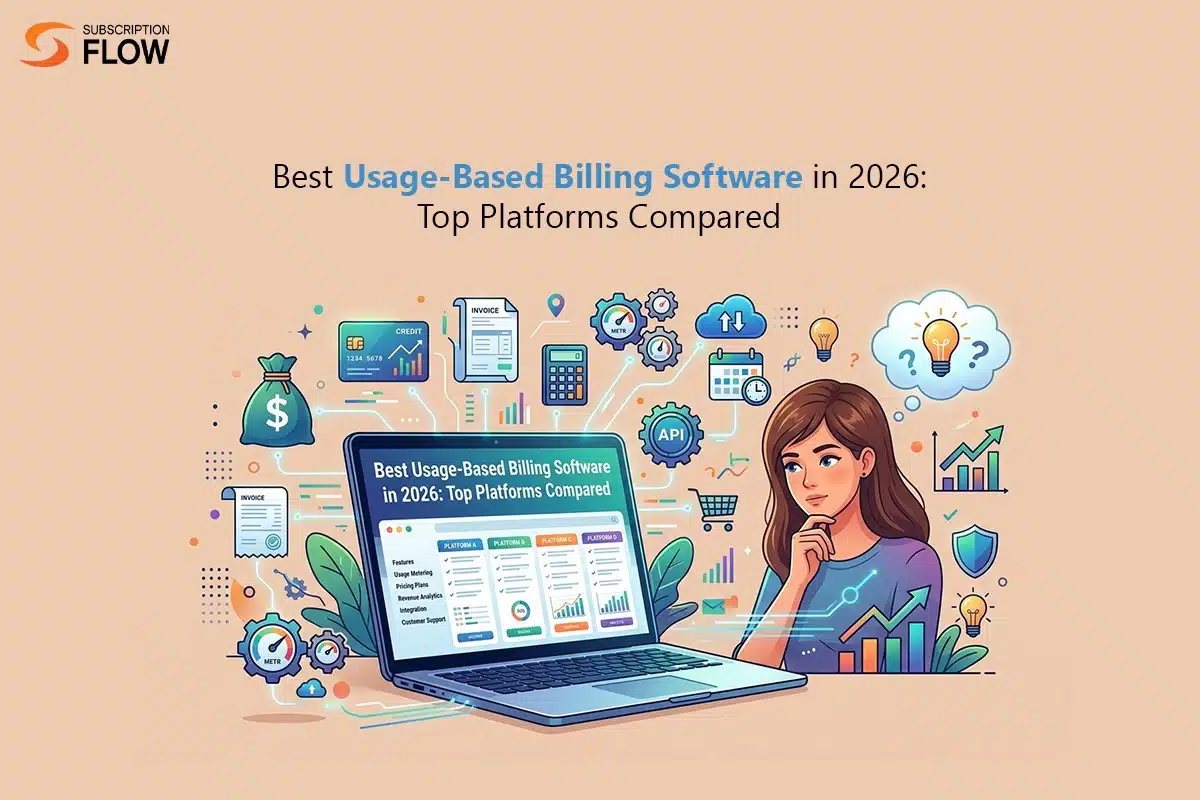
Best Usage-Based Billing Software in 2026: Top Platforms Compared
Finding the right usage-based billing software comes down to three non-negotiable questions: Who owns the system day-to-day? How natively does it handle real-time metering? And what happens to your bill when your revenue scales? Modern usage-based billing engines promise to solve every billing challenge, but often crack under the complexity of real-world business needs. Therefore, it’s important to understand core trade-offs first to avoid costly migrations later.
This guide compares the best usage-based billing software so you can compare the features, strengths, limitations, pricing models, and ideal deployment scenarios for each platform to select the best-suited software for your business.
SubscriptionFlow
It is best suited for growing SaaS companies that need dynamic usage tracking, automated payment recovery, and flexible pricing without percentage of revenue penalties.
Features
- Real-time metering (usage updates continuously, not just at month-end)
- High-throughput ingestion (thousands of events/ second) via streaming API
- Automatic deduplication and chronological event aggregation
- Multi-metric support: API calls, seats, GB, AI tokens, transactions
- Real-time usage roll-up by customer, product, and metric
- Flexible pricing: pay-as-you go, tiered, volume-based, prepaid, hybrid
- Customer-facing dashboards showing live usage plus projected invoice
Strengths
SubscriptionFlow enables flexible usage-based billing by enabling real-time metering for consumption metrics like API requests, AI tokens, active seats, and storage, along with live data aggregation so accounts can be monitored mid-cycle. It supports pay-as-you-go, tiered, volume-based, and hybrid pricing, automated line-itemized invoicing, and instant mid-cycle plan or rate adjustments without requiring a system redeployment. It also includes smart dunning with machine-learning optimised recovery timing for failed payments.
Limitations
The platform doesn’t have a free trial period for flexible usage-based billing, making it harder for customers to assess before actually committing.
Pricing
- User-based plans start around $30 per user/month
- Revenue based start at $149/ month with user limits
- Enterprise or custom plans start around $200+ depending on scale
Lago
It is appropriate for engineering-led teams that want full control over the billing engine and are willing to trade convenience for customization.
Features
- Event-based architecture
- High-throughput ingestion, upto 15,000 billing events per second
- Billable metrics defined on raw events, usable for direct charges or credit consumption
- Hybrid pricing support
- Open-source core (AGPLv3), self hostable for full data control
- Custom SQL metrics for advanced aggregation logic
Strengths
Lago is an open-source, self-hosted billing engine, which means it is highly customizable if your pricing logic is structurally unusual enough that you need to modify the engine itself. It efficiently covers rating, metering, and invoicing for teams where engineers are in charge of billing. It also offers a forever-free open-source tier for teams that want to try it without commercial commitment.
Limitations
The flexibility comes at a real engineering cost. Initial setup usually takes 2-3 sprints while ongoing maintenance consumes 14-30% of engineers’ time permanently. Moreover, Lago does not offer free trials for its premium (cloud or self-hosted) plans.
Pricing

- Free open-source self-hosted tier for core billing features
- Paid plans are tiered by company stage (early, scaling, enterprise), including a usage-based dimension on top
Metronome
Metronome works best for enterprise-scale usage volumes with complex credit and contract handling, run by an engineering team.
Features
- SQL-base billable metrics, query raw events without pre-aggregation
- Streaming metrics with ultra-low-latency fraud/ abuse alerting
- High-throughput architecture processing billions of events/ month
- Centralized rate cards, commits, and credit models
- Pricing simulation against real historic usage before deploying
- Accoutn hierarchy for multi-entitiy or sub-account billing
- Postpaid usage billing, no real-time pre-authorization or gating pipeline
Strengths
Metronome features a top-tier credit system for complex contract drawdowns, real-time usage alerting, and native integrations with GCP marketplaces. It also offers embeddable billing dashboards even on its starter tier.
Limitations
It is highly-priced, therefore, not suitable for businesses that are looking for cost effective solutions.
Pricing
- For the starter tier, billing volume is billed at 0.8%, with events volume billed at $0.04/1k ingested events
- For customer tier, the pricing varies but includes invoicing integrations, data warehouse exports, and enhanced SLAs
Orb
Orb fits for companies requiring flexibility, API driven usage calculation, and engineering processes from developer-oriented software businesses.
Features
- Raw-event, query-based architecture (pricing applied as a layer on ingested events)
- Custom SQL metrics plus dimensional price groups for multi-dimensional pricing
- Frequent rollups (approx every 30 seconds) for near real-time usage data
- Historical recalculation support without re-ingesting data
- Threshold billing, mid-cycle invoices once usage crosses limits
- Credits and allocation management (balances, refunds)
- Combines seats, usage, credits, minimums, and commitments on one invoice
Strengths
Well-designed REST APIs, ease of implementation, and robust API-first usage calculations with clean engineering workflows.
Limitations
Paywall pricing strategy; costs increase exponentially as per the amount of usage. No built-in financial reporting controls.
Pricing
- Fully gated pricing
- Core plans historically start around $720/month up to $3,450/month base fees
Stripe Billing
Best for businesses that have simple and low-volume usage-based billing needs, especially if they are already relying on Stripe for payments.
Features
- Meters API (event-based reporting separated from subscription creation)
- Aggregation limited to sum, count, or last
- Idempotency keys prevent duplicate usage events
- AI-supported metering for tokens, model calls, agent tasks, workflows
- No-real time balance enforcement (meters usage but doesn’t gate access)
Strengths
Stripe Billing offers flexible payment models including pay-as-you-go, tiered, and hybrid pricing, automatic aggregation of usage data, and automated invoicing with smart dunning. For teams with heavier needs, Stripe also offers Metronome as an add-on for complex contract management and high-cardinality metering.
Limitations
Users report that Stripe works well until billing becomes part of the product. Once a business adds credits, rollovers, prepaid balances, or custom enterprise contracts, teams often end up building an internal billing layer on top of Stripe anyway, because product, finance, and engineering all need visibility into usage billing status and plain Stripe doesn’t provide that shared view out of the box.
Pricing
- Pay-as-you-go usage-based billing costs 0.7% of billing volume with no recurring platform fee
- Scale/ monthly plan starts around $620/month for higher volumes
- Standard card processing fees (around 2.9% + 30¢ per transaction) still apply on top of any billing platform fee
Chargebee
Chargebee is suitable for established SaaS companies that have strong existing audit-reporting features and can tolerate slower support.
Features
- Metered features linkable to usage-based pricing
- Configurable usage limits, thresholds, and entitlements
- Automatic overage billing when usage exceeds allowances
- Usage and recurring charges combined on one invoice
- Centralized usage data aggregation with transparent charge breakdowns
Key Strengths
Flexible ingestion with custom SQL to process complex rating logic. Capable of generating hybrid invoices that blend flat fees, usage charges, and one-time costs. It also provides audit-ready reporting aligned to ASC 606/ IFRS 15 revenue recognition standards.
Limitations
Slow response times with basic operations needing CSV imports and exports instead of direct UI actions. Users report that it doesn’t work well when usage is mixed with subscriptions. Moreover, there’s a high (0.75%) overage fee that becomes costly when business scales.
Pricing
- Starter plan is free for the first $250,000 in cumulative lifetime billing with a 0.75% overage fee
- Performance plan costs $599/month ($7,188 annually) that covers up to $100,000 in monthly billing, with the same 0.75% overage fee beyond that
- Enterprise pricing is custom-negotiated
Side-by-Side Comparison of Leading Usage-Based Billing Engines
| Software | Best For | Usage Metering | Hybrid Pricing | Complex Pricing | Invoicing | Pricing Model |
|---|---|---|---|---|---|---|
| SubscriptionFlow | Growing SaaS companies that require real-time metering with flexible, instant pricing changes | Yes — real-time, live aggregation | Yes | Yes — supports tiered, volume, and stair-step | Automated, line-itemized | Flat per-user or revenue-based plans, with no revenue-percentage overage |
| Lago | Engineering-led teams wanting full control via open-source, self-hosted billing | Yes | Yes | Yes — requires custom dev work to modify the engine | Automated, for subscriptions, usage, or hybrid | Free open-source tier, plus paid tiers by company stage with a usage-based add-on |
| Metronome | Enterprise-scale usage volumes with complex credit systems | Yes | Yes | Yes | Automated | Percentage of billing volume (0.8%), plus a per-1k-event ingestion fee |
| Orb | Engineering teams needing a clean API for complex usage calculations | Yes | Yes | Yes | Automated | Tiered base fee, plus billing-volume percentage and event ingestion fee (now custom-quoted only) |
| Stripe Billing | Simple or low-volume usage billing, especially for existing Stripe users | Yes | Yes | Limited — breaks down with credits, rollovers, and custom contracts | Automated | Percentage of billing volume (0.7%), plus standard card processing fees |
| Chargebee | Hybrid subscription and usage billing with compliance reporting | Yes, but not native — the customer must report usage back via API | Yes | Limited — rigid when subscriptions are mixed with usage | Automated, though many tasks require CSV workarounds | Free tier up to $250K lifetime billing, then percentage overage |
Which Usage-Based Billing Software You Should Actually Pick?
There’s no single winner here. The right platform depends entirely on who owns billing at your company and how complex your pricing actually is. But if you want real-time event aggregation, dynamic hybrid pricing, intelligent dunning, and full financial activity without paying compounding percentage fees as you scale, SubscriptionFlow is the clear choice. Book a personalized demo with SubscriptionFlow and discover how easy it is to launch, automate, and monetize your consumption models.

POPULAR POSTS


Think Business!
Related Posts
 How to Reduce Checkout Abandonment in Shopify
- How to Set Up Recurring Billing in Business Central with SubscriptionFlow
- Subscription Durations to Maximize Monthly Recurring Revenue
- Scaling Online Payments with Authorize.net and Webflow Integration
- What is the Graduated Pricing Model? How Does It Work for Subscription Businesses?