
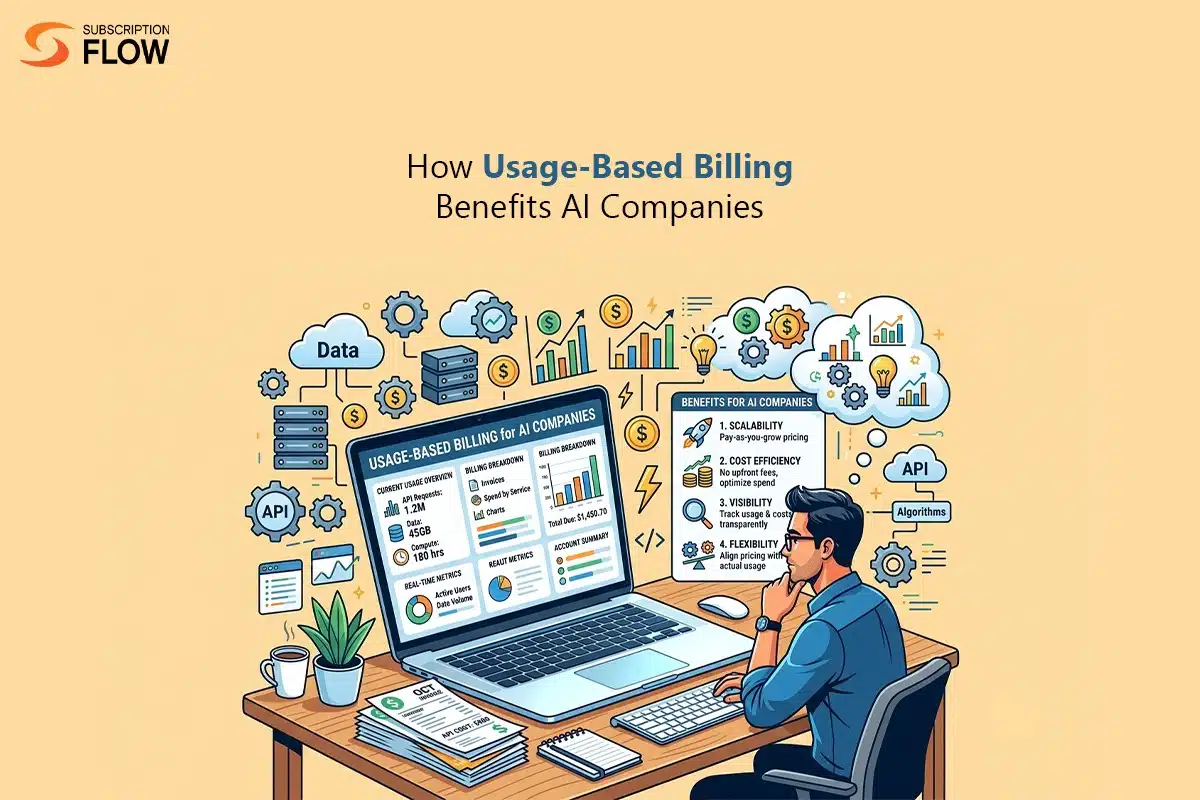
How Usage-Based Billing Benefits AI Companies
From initial planning to final execution, AI streamlines operational workflows, boosting efficiency, accuracy, and overall output. However, AI products don’t behave like traditional software. Every prompt triggers GPU cycles. Every token generated has a real, measurable compute cost attached to it. That’s the reason AI companies are evolving the way they charge their customers. Leaving behind flat-rate subscriptions, AI companies are now rebuilding their pricing around usage-based billing. This is not a mere passing pricing trend; it’s a structural response to how AI products actually incur cost and deliver value.
Why Flat-Rate Pricing Breaks Down for AI Products
In a flat-rate model, a company picks a fixed price point and hopes that the average customer’s usage stays profitable. This works when the cost of serving a customer is low and roughly constant. It fails when cost scales directly with consumption, which is exactly what happens with AI.
Consider two customers on the same monthly plan for an AI writing assistant. One generates 20,000 tokens a month. The other, running the tool through an automated workflow, generates 4 million tokens. Both pay the same amount, but the second customer might be costing the company 50x more in inference speed on GPU-hours . Flat pricing forces every other customer to subsidize that outlier, and it caps the company’s ability to capture value from its heaviest users.
This is also referred to as the “COGS problem” in AI pricing. Unlike traditional SaaS, where cost of goods sold is nearly flat, AI has a variable COGS that moves in lockstep with usage. Pricing that ignores this mismatch either loses margin on heavy users or overcharges light users, both of which hurt retention and growth.
How Usage-Based Billing Actually Works
Usage-based billing ties the price a customer pays to a measurable unit of consumption, rather than to a seat or flat monthly fee. For AI companies, this typically means metering one or more of the following consumption metrics:
Token Processed
Input and output tokens for LLM-based products, often billed separately since output tokens usually cost more to generate than input tokens are to process.
API Calls or Requests
Useful for products where a single call may involve multiple downstream model invocations. For instance, a single “generate an image” call that triggers a diffusion model plus an upscaling pass.
Compute Time
Consumption of GPU or CPU seconds, most applied on products that offer fine-tuning, model training, or batch inference.
Output Units
Images generated, minutes of audio transcribed, video frames processed, or documents parsed.
Storage and Revival
Vector database storage, embeddings generated, or retrieval-augmented generation (RAG) queries against a knowledge base.

Deconstructing Usage-Based Pricing for AI Systems
The underlying infrastructure of usage-based pricing involves three connected layers:
Metering
Every action a customer takes is logged as an event (a token count, an API call, a compute-second) and streamed into a usage ledger in near real-time. This requires instrumentation at the application layer that captures granular usage data without adding latency to the AI response itself.
Rating
Once consumption is estimated, there’s a need to convert it into a payable amount with the help of pricing logic. It can be per-unit rates, volume-based tiers, or blended rates for bundled products. AI companies can also offer discounts, cuts, or concessions here after a customer crosses pre-decided thresholds.
Invoicing and Reconciliation
Metered and rated usage is aggregated over a billing cycle, combined with any prepaid credits, minimums, or overage charges, and turn into an invoice. Because usage can be highly variable and sometimes disputed, this layer also needs to support usage audits, credit adjustments, and proration when customers change plans mid-cycle.
An error in any of these three layers leads to undercharges (eroding margins) or overcharges (eroding trust). This is why metering and billing infrastructure has become a genuine competitive concern for AI companies, not just a back-office function.
The Direct Benefits for AI Companies
Margin Protection Against Volatile Compute Costs
Because usage-based billing charges customers in proportion to the compute they consume, it keeps gross margin stable even as usage patterns shift. It means if a customer’s usage spikes 10x in a month, the company’s revenue from that customer scales with it. This is particularly important given that underlying model provider costs can themselves shift due to rate changes, model version upgrades, or infrastructure scaling costs.
Lower Barrier to Entry, Higher Conversion
Flat subscriptions ask a prospective customer to commit to a fixed cost before they know how much value they’ll get. Usage-based pricing lets customers start small and pay for what they actually consume. This removes entry friction and is one of the reasons usage-based pricing has become common in developer-facing AI tools and API products.
Revenue That Grows With Customer Value
In a flat-rate model, expansion revenue depends on convincing a customer to upgrade tiers or add seats. On the contrary, in usage-based models, revenue expansion happens naturally. The bill grows as a customer’s product usage grows without requiring a renegotiation. This is especially valuable for AI companies selling into workflows that are inherently designed to scale, like customer support automation, content generation, or code assistance, etc.
Better Alignment With How AI is Actually Consumed
Because usage-based billing requires granular event-level metering, it produces a byproduct that flat pricing never generates. AI companies can access detailed, real-time data on how customers actually use the product. Teams can see which features drive the most consumption, which customer segments are approaching capacity limits, and which usage patterns correlate with churn or expansion. This data becomes a direct input into product roadmap decisions and proactive customer success outreach.
Reduced Risk From Free-Riding Power Users
Every AI product has a segment of users who extract disproportionate value relative to what they pay. This includes users who automate entire workflows, run bulk batch jobs, or embed the AI feature into their own downstream product. Under usage-based billing, these customers are charged proportionally, which either protects margins directly or surfaces them early as strong expansion or upsell candidates.
Common Pricing Structures AI Companies Use
Despite substantial benefits, usage-based pricing alone may not be sufficient for some AI companies. Therefore, most companies stack usage-based billing with other elements of predictability:
Usage With Included Allowance
Companies offer a base subscription fee that restricts usage until a fixed slab, with overage charges calculated per unit beyond that. In this pricing structure, customers pay a predictable flat monthly or annual fee that bundles a specific quota of units. When the service is used, the system subtracts from your balance in real time.
Credit Systems and Prepaid Bundles
Customers purchase credits upfront and use the credits to use AI features like conducting analysis, writing drafts, generating images, etc. AI platforms usually reset or roll over unused credits based on their policies.
Tiered Consumption Pricing
This pricing model introduces rewards as usage volume increases. This means per-unit charges decrease as consumption increases. This helps to build a loyal high-consumption consumer base .
Hybrid Seat-Plus-Usage Models
Merges a predictable base subscription fee (per seat or per tier) with metered overages or add-on usage blocks once a threshold is crossed. This is best suited for collaborative enterprise SaaS apps adding AI capabilities without abandoning predictable revenue.
There’s no one-size-fits-all pricing model. Factors like customer base, predictability of usage patterns, and how exposed the company is to underlying model provider cost decide which model is best suited for the business.
Master AI Monetization with SubscriptionFlow
SubscriptionFlow provides subscription and billing management purpose-built for usage-based and hybrid pricing models, giving AI companies the metering, rating, invoicing, and revenue recognition infrastructure needed to bill accurately on tokens, API calls, compute time, or any custom usage unit, without having to engineer that complexity in-house.
With SubscriptionFlow, AI platforms can:
Ingest Multi-Dimensional Usage Data
Seamlessly meter API requests, LLM prompt/ completion tokes, GPU processing seconds, and output counts in real-time.
Deploy Custom Pricing Structures
Launch pure pay-as-you-go, prepaid credit systems, tiered volume discounts, or hybrid minimum-commitment subscriptions without writing custom billing code.
Provide Full Customer Transparency
Deliver self-service billing dashboards where end users can monitor their real-time usage, view remaining credit balances, set spending limits, and download audit-ready invoices.
Automate Invoicing and Global Payments
Sync metered usage directly with automated payment gateways and accounting tools to eliminate manual billing reconciliation.
Align Value, Cost, and Growth in AI Era
For AI companies weighing to move to usage-based billing, the pricing model is only half the equation; the other half is having billing infrastructure that can reliably execute it at scale, which is exactly where SubscriptionFlow fits in. Schedule a demo with SubscriptionFlow today to see how flexible pricing can fuel your growth.

POPULAR POSTS


Think Business!
Related Posts
 Automate your Billing with Recurring Invoices
 Billing and Invoicing Software for Changing Consumption Patterns
- Group Billing Software for Stress-Free Subscription Operations
- How to Avoid Business Blunders in your Billing and Invoicing Process
- B2B Billing Automations for 2023 Might Save a Fortune for Small Businesses