
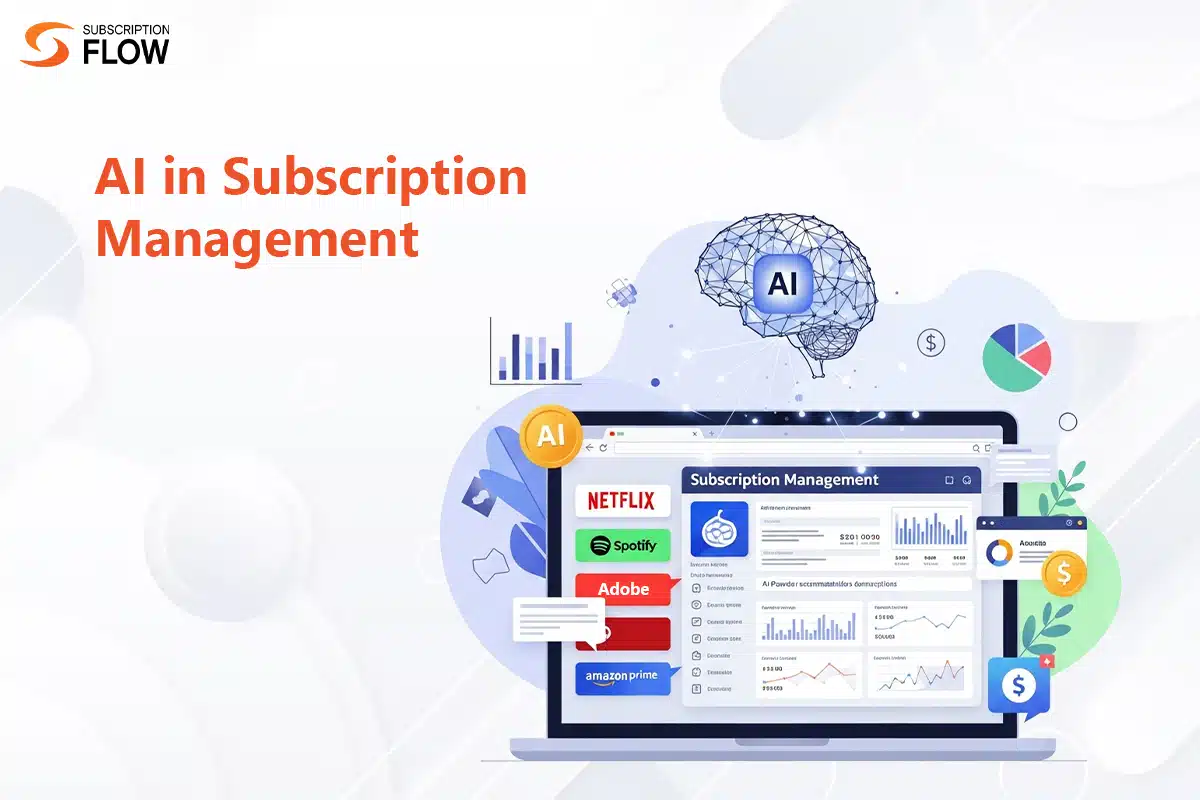
AI in Subscription Management: Emerging Trends of 2026
Subscriptions are now everywhere. Instead of buying something just once, people now prefer to pay a regular monthly or yearly fee for almost everything. From phone plans and streaming apps to boxes of meal prep and skincare products delivered to their products, subscriptions have reached nearly every corner of e-commerce. This shift has built a booming subscription economy, which European Financial Review reports to reach $1.5 trillion by 2025. Additionally, Zuora’s Subscription Economy Index finds that subscription-based companies outperform traditional product-based businesses. Over a 12-year period, companies in the index grew 3.4 times faster than those in the S&P 500, with a compound annual growth rate of 16.5% versus 4.8%. Growth in subscription businesses means more subscribers, plans, pricing models, and payment methods, which ultimately adds to the complexity. So companies across the industry are now adding AI to the subscription stack to do multiple jobs like recovering failed payments, predicting churn, analyzing contracts, personalizing offers, and answering customer questions.
This blog covers the emerging trends of AI in subscription businesses in 2026, explores where the industry is leaning, and tells where AI has actually delivered results.
What’s In, and Where the Industry is Leaning
As per the McKinsey survey data, the clearest and most significant changes in AI usage in 2026 are the growth in enterprise-scale adoption. More organizations are moving away from isolated experiments and scaling AI across the enterprise, with adoption growing from 38% in 2025 to 44% in 2026. This drives a move from static rules to adaptive systems. Fixed retry schedules, one-size-fits-all dunning emails, and month-end spreadsheet reconciliation are giving way to software that watches continuously and adjusts on its own.
Three leanings stand out:
- Consolidation around quote-to-revenue: Vendors are merging pricing, quoting, billing, and revenue recognition into one connected flow. SubscriptionFlow, for example, embeds automated artificial intelligence into its platform to intelligently handle recurring billing cycles, predict customer churn, recover failed payments, and automate complex subscription workflows from end to end.
- Human-supervised autonomy: The winning model is not “AI replaces the billing team.” It is AI executing routine work while people set rules, handle exceptions, and approve high-stakes actions.
- Pricing is changing along with the tools: As AI features become the product, many companies are rethinking seat-based pricing in favor of usage and outcomes, which makes billing itself harder.
Emerging AI Developments in Subscription Management
AI Agents Manage Subscriptions for Customers
A new kind of customer is arriving: the one who never opens your website. Their AI agents do it for them. Agents like Meta’s Muse, ChatGPT, Perplexity, Google AI in Chrome, Custructor, and Rep AI connect to a person’s apps and services and can research, compare, and execute purchases on customers’ behalf. Here, the role of the subscription management platform shifts to be the transaction and lifecycle infrastructure for AI-drive customers.
The AI agent acts as the decision-maker and interface, while the subscription management platform acts as the execution layer that understands the subscription relationship and carries out the requested action. This requires optimization of subscription infrastructure for AI agents, evolving it from simply managing recurring billing into agent-ready commerce infrastructure, providing standardized ways for AI agents to discover, purchase, modify, and cancel subscriptions while maintaining business rules, billing logic, permissions, and customer relationships underneath.
For instance, when an AI agent decides that a customer should switch from one subscription tier to another, the subscription platform can handle:
- Subscription discovery: Expose available plans, pricing, trials, add-ons, and eligibility in a structured format that AI agents can understand
- Plan comparison: Provide accurate subscription and pricing information so agents can compare offerings on behalf of customers
- Purchase and activation: Allow an authorized AI agent to initiate a subscription, downgrade, or add-on purchase
- Lifecycle management: Manage renewals, upgrades, downgrades, pauses, cancellations, reactivations, and plan changes without requiring the customer to visit the website
- Billing and payments: Handle recurring billing, payment methods, invoices, prorations, refunds, and failed-payment recovery
- Merchant controls: Give businesses visibility and control over what AI agents can purchase, change, cancel, or negotiate on behalf of customers
AI Revenue Checks Replace Month-End Leak Hunting
Revenue leakage is the unglamorous problem every subscription business has: a discount applies longer than agreed, usage goes unmetered, or a contract amendment never reaches billing.
Instead of finance teams hunting for leaked revenue at the end of the month, Agentic revenue integrity uses agents to continuously compare contracts, usage data, and invoices, then flag or correct mismatches as they happen. Contract ingestion is a big part of this: AI reads PDFs, Word documents, and emails to extract billing terms and turns them into billing workflows, rather than a person retyping them.
Industry vendors report that usage-based invoice generation, contract-to-cash automation, and revenue recognition entries are among the most common agent use cases in revenue recognition. For teams that bill on complex hybrid contracts, this is where the quiet, compounding savings tend to live.

Pricing That Bills For Work Done
Seat-based pricing assumes that value grows with headcount. AI breaks this assumption: one agent can do the work of ten users, or run all night using nothing but a computer. So vendors are moving to credits (prepaid pools), actions (A price per completed task), and outcomes (you pay only when a result is delivered, such as a resolved ticket).
Subscription billing platforms are rebuilding around this. Chargebee now supports credit, action, and outcome-based pricing in a single catalog, with margin protection controls aimed at agent economics. That matters because an agent’s underlying model costs can swing while your price stays fixed. SubscriptionFlow offers usage billing on tokens and API calls and output-based pricing tied to AI-generated results. It also offers embeddable dashboards that show customers their consumption by model or feature.
The side effect is complexity. More meters mean more invoice lines, and more customers asking what they are charged for. A flat $50 seat is easy to understand but “1,240 actions at tiered rates, minus 300 prepaid credits” is not.
This is where AI earns its place. An explanation agent can read the usage events behind an invoice and answer in plain language. It can flag duplicate or runaway usage before the invoices go out, and warn customers as they approach a credit limit. Questions get answers before they become disputes.
Stimulate Before You Post
In traditional billing, you amend a contract, apply a discount or change an allocation, and discover the consequences later. The invoice is wrong, the revenue schedule shifts, or an auditor asks questions. Simulation reverses that order: an agent shows the financial effect first, and a person approves it second.
Zuora’s April 2026 agents are a clear example. They pinpoint which line items and price change in a complex contract modification and explain the revenue impact before anything touches the ledger. They also propose a side-by-side comparison of current and proposed allocations, with dollar and percentage impact and the exact ASC 606 formulas used. Chargebee takes a related approach on the sales side. Its CPQ add-on enforces discount floors and approval routing automatically, so a risky quote is caught before it becomes a contract. SubscriptionFlow also uses AI detection to correct invoicing errors, flagging anomalies in billing events, and predicting invoices from past billing behaviour.
The benefits are practical. Finance sees fewer credit notes and restatements, month-end close moves faster, and the sales team can promise customers something billing can actually deliver.
Cancellation Compliance Built Into Agent Logic
Retention agents are among the most popular AI use cases. SubscriptionFlow, for example, says it scores customers for churn risk and generates personalized retention offers. But persuasion collides with regulation. The FTC’s 2024 click-to-cancel rule is vacated by the Eighth Circuit as of July 8, 2025, and the agency is conducting a new rulemaking that begins in March 2026. Law-firm analyses say the notice asks about offering incentives instead of promptly honoring a cancellation. Roughly 30 states also have their own automatic-renewal or negative-option laws. One compliance guide notes that Minnesota restricts unsolicited save offers. New York City’s “Click to Cancel” rule officially took effect on October 1, 2026, mandating easy cancellation, clear disclosures, and no forced hurdles.
Therefore, subscription platforms need to separate two jobs. Retention intelligence identifies who is at risk and what may help. Cancellation execution must be simple, prompt, and consistent with local law. Agents can do both, but only if jurisdiction-specific rules are written into their logic: the customer’s location, how they sign up, which notices are sent, and whether a safe offer is allowed at all.
Revenue Recognition and Audit Trails
Outcome-based pricing creates an accounting question that finance leaders can’t ignore “When do you recognize the revenue?” The answer depends on the contract. If a customer buys a specific number of successful outcomes, revenue can follow outcomes delivered. If the customer is buying a standing service, revenue may be recognized over time instead.
Expect more finance teams to put agents to work on compliance as well. Google Cloud’s report anticipates multi-step agent compliance systems in financial services that monitor regulatory changes, identify affected policies, update internal workflows, and create a full audit chain. For subscription finance, the principle is the same: every automated action should leave a trail an auditor can follow.
Proactive, Concierge-style Customer Lifecycle Agents
For a decade, automation has been considered chatbots that deflect simple questions. In 2026, the model is the concierge: an agent that remembers context, sees the customer’s account, and fixes problems the customer complains about. Google Cloud AI agent trends report illustrates this with a scenario that maps neatly onto subscriptions. An agent detects a failed renewal, confirms the cause, reschedules it, applies a $10 service credit in the billing system, and texts the customer, escalating to a human with a full summary if the issue is complicated or emotionally charged.
The practical gains show up in retention. Agents can spot declining usage, offer a pause instead of a cancellation, or fix a billing error before it becomes a support ticket. It is reported that AI-powered apps generate about 41% more revenue per paying customer, but churn roughly 30% faster. Impressive products don’t retain customers on their own. Proactive lifecycle care has to do that work.
How to Start Incorporating AI in Your Subscription Business
If you are a leader deciding where to begin, here are a few initial principles to follow:
- Start where the pain is measurable. Failed payments, billing disputes, and invoice exceptions all have clear baselines and fast feedback loops.
- Fix the data first. Agents are only as good as the contract, usage, and customer data they can see. This is also referred to as “grounding”, anchoring AI to your own verified information.
- Define autonomy levels. Decide in writing what agents can do alone, with approval, or never.
- Measure outcomes, not activity. Track recovered revenue, leakage found, time to close, and churn avoided, not just “tasks automated.”
- Train your people. The human skill of supervising agents is now part of the job.
The Bottom Line
In 2026, AI in subscription management has moved from clever features to working systems: agents that run workflows across billing, finance, and customer teams; pricing models built around outcomes; and customers who may soon bring agents of their own. The opportunity is real, and so are the risks of rushing in without governance.
The businesses that profit from the AI models are not the ones with the most AI but are those that pair capable agents with clean data, clear rules, and people who know how to supervise them. Subscription businesses still depend on trust. AI just changes how you earn it.