
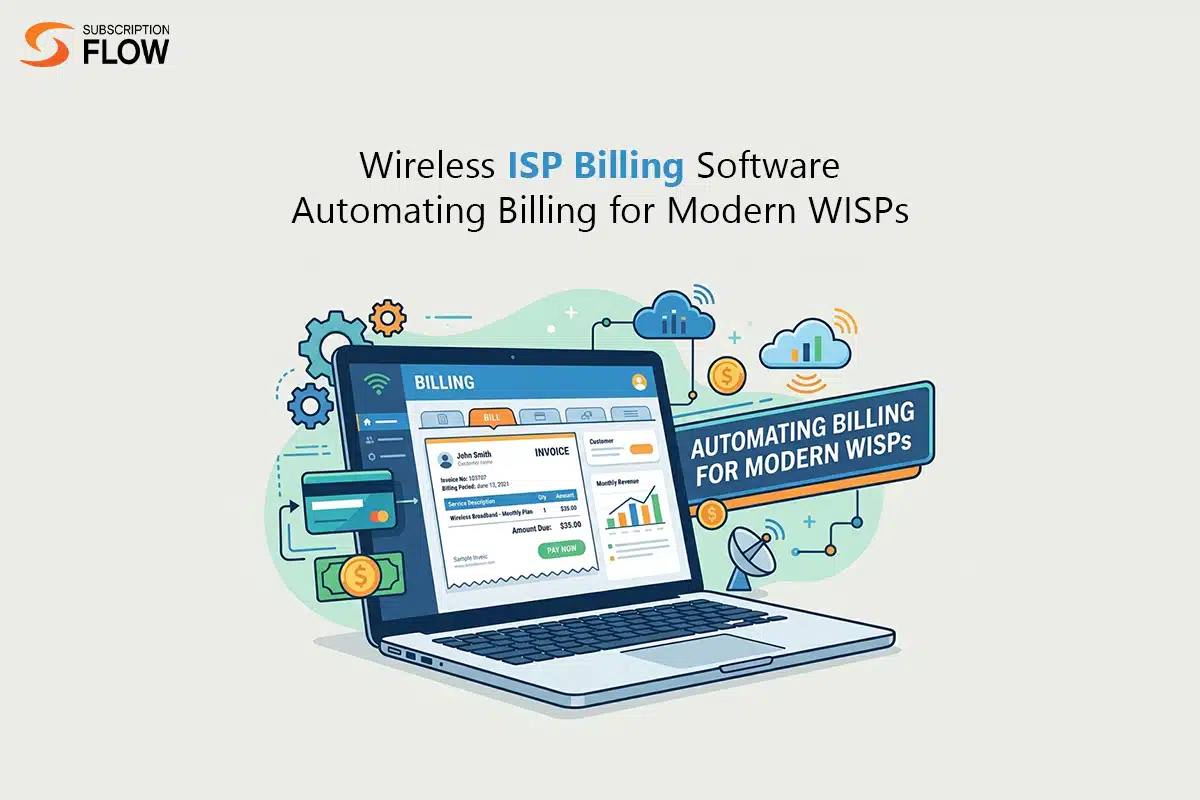
Wireless ISP Billing Software: Automating Billing for Modern WISPs
As a Wireless Internet Service Provider (WISP), your primary aim is to provide fast, reliable and continuous internet service to your community. But as your network grows, your business starts to hit rock bottom instead of scaling efficiently. The primary reason behind this is that most WISPs continue to rely on spreadsheets, disconnected payment systems, manual invoice generation, delayed renewals and inconsistent usage tracking despite an increase in the number of customers.
The basic setup ultimately leads to substantial loss for businesses, causing revenue leakage, subscriber disputes, failed collections, higher churn, accounting delays and overloaded support teams. To overcome these challenges and stay competitive in the modern telecom industry, WISPs need to adopt a modern solution. This is where purpose-built wireless ISP billing software, such as SubscriptionFlow, comes in.
Let’s dig more into how a centralised solution transforms your business to scale seamlessly.
Why Billing Is More Complex for Wireless ISPs
To learn how to build the foundation of a successful WISP, you need to understand how billing works. Many generic billing tools treat subscriptions as fixed, predictable revenue. However, the concept of subscriptions in the telecom industry is far more than merely collecting money.
Recurring Billing Isn’t Standard SaaS Billing
WISP billing is dynamic, unlike an ordinary software-as-a-service (SaaS) subscription, where each user pays one flat rate each month. Providers need to deal with different bandwidth requirements, device rentals (such as routers and antennas), fluctuating usage rates and an assortment of both prepaid and postpaid clients. Additionally, due to mid-month service suspensions and hybrid pricing, the traditional billing application system suddenly starts to crack.
Subscriber Growth Creates Operational Chaos
If your list has only 50 subscribers, it’s easy to keep track of renewals in an Excel file. However, once you start adding thousands of subscribers in several regions, it starts to fall into chaos with manual tracking. The process of managing renewals, chasing overdue accounts, solving invoice-related problems and manually reconnecting with a customer after he/she has paid late consumes a tremendous amount of time and resources.
Network Usage Adds Billing Complexity
Subscribers demand transparency to stay connected for a long-time. If you’re looking to implement data limits, bandwidth tracking, or real-time pricing according to usage time, you need a billing solution that is compatible with your network infrastructure. The accurate calculation of overage charges in real-time is critical to stay profitable without losing customer confidence due to upsetting bill spikes.
Major Billing Challenges Wireless ISPs Face
WISPs often face a number of operational challenges without an automation platform to support them:
Manual Invoice Generation
Billings delays, human errors, duplicate billings and missed billings are the result of manually creating and sending hundreds of invoices via email. It is impossible to scale invoice generation manually.
Failed Payments and Revenue Leakage
Credit cards expire and ACH payments do not always go through. Poor payment retry logic and manual dunning workflows can result in lost revenue and unplanned churn.

Customer Billing Disputes
Unclear invoices, inaccurate usage calculations and confusing calculations for mid-cycle plan upgrades cause disputes. Therefore, customer retention requires transparent, itemized billing.
Managing Prepaid and Postpaid Subscribers Together
A combination of both billing models require the use of multiple, independent software systems, which led to splitting up data and accounting records.
Service Suspension and Reconnection Delays
If the customer doesn’t pay, it takes time to suspend their account manually. Even worse, if there’s a delayed payment, delays in manual reconnection result in customer frustration and a jammed support-line.
Multi-Branch or Regional Operations
Decentralised billing models create siloed subscriber information, disparate collections and compliance challenges as your WISP expands to new areas.
Scaling Without Automation
Increasing subscribers shouldn’t involve doubling up your accounts staff. If you don’t have automation, reconciliation problems and increasing operational expenses rapidly come at your expense.
Manual Taxation and Compliance
WISPs have to deal with a web of local, provincial and national telecom taxes. Implementing different tax rates for residential and corporate accounts, or specific telecom surcharges, can result in billing inaccuracies and potential regulatory violations.
Ineffective Payment Integrations
A frictionless payment experience is expected by customers. WISPs often find challenges in integrating localized payment platforms, automation of payment reminders and real-time payment reconciliation without administrative bottlenecks.
What Wireless ISP Billing Software Should Actually Include
To streamline your operations, your billing software should have the following essential features:
Automating Network and Internet Service Control
Manual service activation and suspension are time-consuming and error-prone.
- RADIUS/BNG Integration: The billing engine should support natively RADIUS server integration so that users not paying are automatically disconnected or shaped in the traffic.
- IP and MAC Binding: Tools that can be used to directly assign IP addresses, MAC addresses and CPEs to customer profiles.
- Automated Package Changes: Real-time speed throttling and data cap enforcement without manual router changes
Billing and Financial Flexibility
- Convergent Billing: Enable prepaid and postpaid billing, one-time billing setup and monthly recurring billing.
- Automated proration: Smart proration for mid-cycle upgrades, downgrades or suspensions.
- Usage-Based Billing and Metering: Your billing engine should process bandwidth consumption data to support usage-based pricing, tiered plans, overage billing and hybrid subscription models.
- Localised Payment Gateways: Automated payment clearance with regional platforms, so payments clear instantly and suspended subscribers are unlocked instantly.
Subscriber Management and Support (CRM)
- Client Self-Service Portal: A customisable web portal or mobile app that customers use to view their usage, pay bills, upgrade speeds and submit complaints.
- Ticketing and Complaint Management: A system for internally tracking tickets and complaints, with the ability to tie the billing data to the current ticket so that teams determine whether a user has paid before arriving on-site.
- Automated Notifications: Send automated SMS, WhatsApp or email notifications when bills are generated, when payments are due and when services are suspended
Reporting, Analytics and Compliance
- Churn and Revenue Analytics: Dashboards to monitor monthly recurring revenue (MRR), subscriber growth and churn rates.
- Tax and Compliance: Automated regional tax calculations and invoice generation to comply with local regulatory and telecommunication requirements.
How SubscriptionFlow Helps Wireless ISPs Simplify Billing
SubscriptionFlow is designed to meet the demanding billing requirements of today’s telecom and wireless companies.
Centralised Subscription Management
SubscriptionFlow is a single source of truth to get accurate information about your WISP. It brings together all your subscriber information, data plans, invoices, payment histories and renewal schedules into a clean, intuitive dashboard.
Flexible Billing Models for WISPs
SubscriptionFlow’s flexible rating engine supports flat-rate unlimited internet, tiered data packages, prepaid vouchers and hybrid Internet usage-plus-base-fee models.
Automated Invoicing and Payment Collection
You need to set the billing rules initially and let the software handle the rest. From scheduling to invoicing, auto-payment to accounting software reconciliation. SubscriptionFlow automates all steps of invoicing and payment collection.
Reduced Churn Through Better Billing Experience
SubscriptionFlow removes friction, prevents billing conflicts and gains customer trust by offering transparent, itemised bills. Moreover, it offers user-friendly self-service portals for subscribers to manage their bills. This helps to build trust in business.
Scalable Infrastructure for Growing Providers
Whether you are a regional WISP with a few hundred customers or a multi-location telecom operator with tens of thousands of customers, SubscriptionFlow’s scalable infrastructure adapts to meet your needs without missing a beat.
Benefits of Using Modern Wireless ISP Billing Software
Top benefits include:
Automated Billing and Collections
All the manual work of data entry is avoided, as invoices are generated automatically, recurring plans are charged automatically and reminders are sent to the customers via SMS or email. This guarantees predictable cash flow as well as lowers defaults.
Instant Provisioning and Suspensions
Automatically provisions network access when payment is made and instantly suspends network access or throttles bandwidth for overdue accounts, eliminating the need to use hardware such as MikroTiks.
Customer Self-Service Portals
Enables subscribers to have their own branded dashboard to access data usage, upgrade internet packages and safely make online payments.
Real-Time Analytics and Reporting
Delivers real-time insights by monitoring important metrics such as monthly recurring revenue (MRR), churn rate and network performance to make data-driven business decisions.
Improved Cash Flow Visibility
By tracking subscription metrics in real-time, modern wireless ISP billing software offers clear insight into revenue performance.
Easier Scaling
Billing automation enables WISPs to grow without an overwhelming operational team.
Signs Your WISP Has Outgrown Manual Billing
There are several indications that your WISP has outgrown its manual billing system.
- You have more subscribers than ever, but your administrative tasks are getting too overwhelming with an increasing number of customers.
- Invoices are always late, which affects your cash flow for the month.
- You have an increasing number of billing tickets and complaints from your support team.
- You don’t have an automated mechanism for failed payments, resulting in high involuntary churn.
- Tracking each data overage on spreadsheets has become impossible and so is the revenue leakage.
- Reconciling your bank statements with your subscriber accounts takes days every month.
Choosing the Right Wireless ISP Billing Software
As you consider which billing platform can work for your WISP, keep the following tips in consideration:
Look For Flexible Pricing Models
The wireless ISP may have a combination of prepaid, postpaid and usage-based customers. The billing software must have the flexibility of multiple pricing models, without the need to make adjustments or custom workarounds.
Prioritise Automation
The ideal platform should automate the mundane tasks of billing, such as invoicing, payment reminders, renewals, suspensions and reconnections. Automation removes chances of human errors, saves time and enhances operational efficiency.
Ensure Payment Gateway Compatibility
Choose software that integrates with the payment methods your customers actually use. Check if billing software supports local and regional gateways. This is necessary to offer a better payment success rate and customer experience.
Verify Usage Billing Capabilities
The problem with usage-based billing is that you need to track bandwidth accurately and calculate it in real time. Verify that the platform is compatible with existing network systems, routers or RADIUS servers to ensure that usage monitoring is reliable.
Evaluate Scalability
Your billing software should also expand with your subscribers without causing operational or financial problems. Find a solution that is able to efficiently support growing customer numbers, transactions and service plans.
Upgrade Your Wireless ISP Billing Today
In the modern telecom era, wireless ISPs can’t scale efficiently or protect their margins using outdated, manual billing systems. Therefore, it is necessary to leave spreadsheets or disconnected tools and start choosing the right wireless ISP billing software. By automating collections, reducing churn, simplifying mid-cycle changes and offering a seamless subscriber experience, you can unlock predictable, scalable recurring revenue.
Ready to automate your WISP billing? Let SubscriptionFlow handle the complexities of your recurring and usage-based billing so you can focus on expanding your network. Book a demo today and see how simple WISP billing can actually be.

POPULAR POSTS



Think Business!
Related Posts
 eCommerce Subscriptions Are Here to Stay—Learn to Optimize Subscription eCommerce Billing & Management to Fuel Stability & Growth in Business
- How to Formulate an Ultimate Onboarding Strategy to Get Happy Customers
 5 Subscription Billing Mistakes You Must Avoid For Your SaaS and B2B Business
- Key Challenges and Solutions of B2B Subscription Management in 2024
- A Definitive Guide: Top SaaS Billing Models for SaaS Businesses