

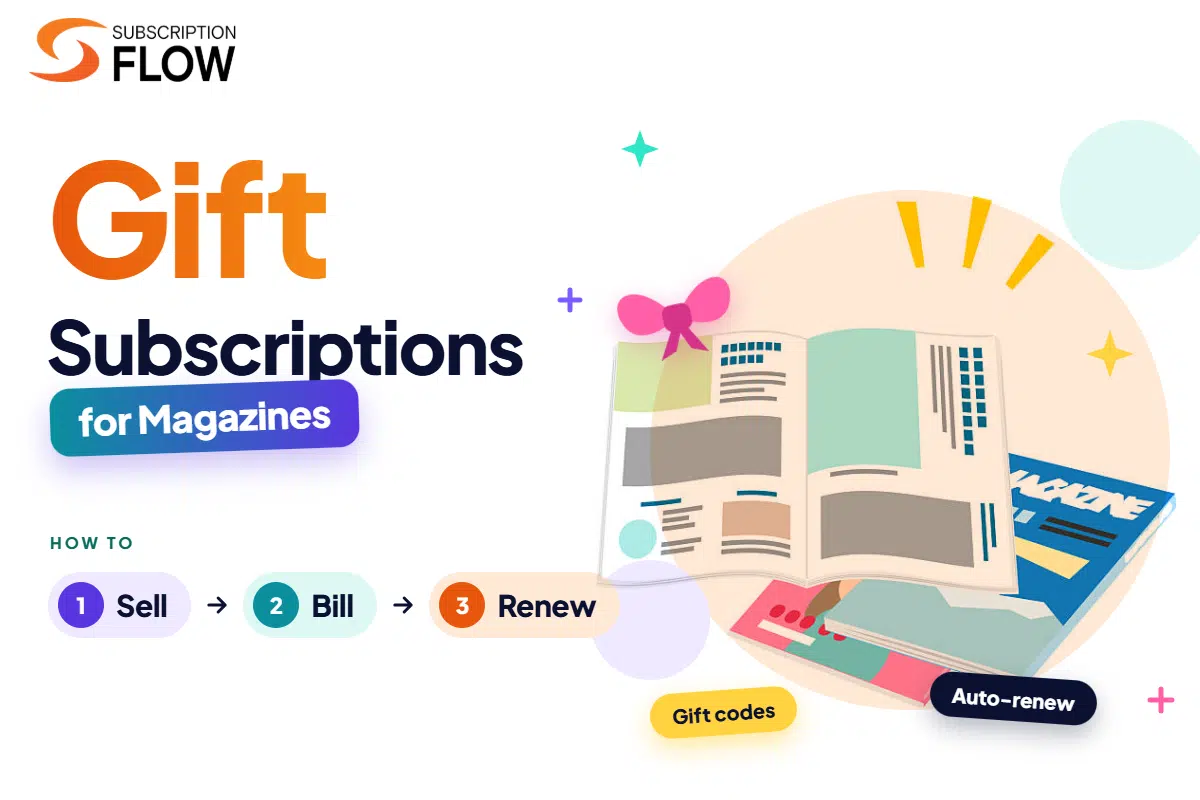
Gift Subscriptions for Magazines: How to Sell, Bill & Renew
The magazine industry is evolving quickly, but its backbone remains the same: subscriptions. The magazine publishing market is valued at approximately USD 91.06 billion in 2026, up from USD 89.05 billion in 2025, and the fastest way to grow is to add readers who never planned to subscribe: gift recipients. When a loyal subscriber buys a subscription for a friend, family member, or colleague, you get a new target reader without spending a dollar on ad campaigns.
However, running a gift subscription program isn’t the same as selling a regular subscription. Instead of dealing with just one customer, you have a three-way relationship: the buyer (giver), the reader (recipient), and the publisher. If handled well, it is an acquisition channel. If handled badly, it becomes a source of failed deliveries, confused invoices, and angry emails.
Why Gift Subscriptions Matter for Magazine Publishers
Gift subscriptions matter because they turn one buyer into two relationships. The giver pays, and the recipient receives twelve or more touchpoints with your brand. Each issue is a sample of your editorial quality delivered to your new potential customer. Publishers get distinct operational and financial advantages that traditional acquisition channels cannot match with gift subscriptions.
They Fund Acquisition Upfront
Gifts are usually paid in advance before the first issue ships, so you collect cash upfront before incurring print, postage, or digital access costs.
They Reach People Outside Your Funnel
A recipient may never have seen your ads, newsletter, or newsstand placement. This fits the niche-title trend, where passionate readers recommend specialist magazines to friends and family, who further have high potential to become loyal subscribers.
They Concentrate in Short Season
Demand clusters around the holidays. Mother’s Day, Father’s Day, birthdays, and graduations. So a well-timed campaign can bring in a disproportionate share of annual new subscribers in a few weeks.
They Create a Conversion Opportunity
When a gift ends, the recipient has already developed a reading habit. Converting that person to a paying subscriber is far cheaper than acquiring a cold lead.
The nuance is that gifts carry two customers, and the usual subscription logic assumes one. The payer and the reader are different people with different email addresses, delivery addresses, and exceptions. The payer wants a receipt and reassurance that the gift arrives on time. On the other hand, the recipient wants a smooth start and, eventually, a reason to stay. Your systems need to track both from the first day.
How to Sell Gift Subscriptions
Selling a gift is a different job from selling subscriptions. The buyer is thinking about a person, an occasion, and a deadline more than the content. Your checkout should also reflect that.
Build a Dedicated Gift Landing Page & Checkout Flow
A dedicated “Give a Gift” page and button, separate from “subscriber,” avoids the most common confusion of buyers accidentally subscribing themselves. Keep the path short, ideally three steps including choosing the term, entering the recipient, and choosing payment.

Collect the Right Data
At minimum you need the recipient’s name, delivery address (for print copy) or email address (for digital copy), gift start date, and giver’s name and email for receipts and renewal questions. There can also be an optional personal message and delivery preference for the gift notice.
Offer Flexible Gift Formats (Print, Digital, and Bundles)
Different givers have different preferences based on age and demographics. Print gifts are perfect for traditional gifting occasions and are of high perceived tangible value. Digital access gifts offer instant delivery, are sustainable, and are ideal for younger digital-first demographics. Bundles access combines physical magazine delivery with immediate digital archive/ app access.
Deliver a Gift Notice
The recipients should receive an email, a printed card, or both, announcing the gift and explaining how to activate digital access. A printed card or a branded PDF is useful for buyers who want to hand something over in person. Let the buyer choose to send it immediately or on a chosen date.
Price for the Occasion
Common tactics include a discounted first-gift rate, a bundle of print plus digital access, or a multi-gift discount for buyers who purchase for several people. Avoid discounting so deeply that gift recipients who convert later expect the same price forever.
Promote at the Right Moments
Run campaigns in the weeks before major gifting dates, and put a gift prompt on order confirmation pages and in renewal emails to your existing subscribers, who are your most likely buyers.
How to Bill Gift Subscriptions
The core principle of gift billing is simple: the giver is the payer, the recipient is the subscriber. Almost every billing problem comes from systems that can’t hold those two roles separately.
Prepaid Term Billing vs. Auto-Renewing Pay-As-You-Go
There are two primary billing models for gift subscriptions. In prepaid non-renewing terms, the giver pays a fixed one-time fee upfront. The subscription is flagged to expire automatically after 12 months unless explicitly renewed. On the other hand, in continuous gift billing (auto-renewing giver), the giver’s credit card is charged automatically every year until they cancel, keeping the gift active for the recipient indefinitely.
Separate Account Holder From Recipient
Create the giver as the billing customer, with the card, invoices, and receipts, and attach a subscription whose delivery contact is the recipient. Receipts and payment emails go to the giver. Issue notices, access links, and delivery updates go to the recipient.
Bill Upfront and In Full
Charge the whole term at purchase. Installment plans on gifts lead to concerns like what happens to the recipient’s issues if the giver stops paying in mid-term. Full prepayment removes that risk.
Revenue Recognition and Unearned Revenue Accounting
Under accrual accounting principles (GAAP/IFRS 15), when a publisher receives $120 upfront for a 12-month magazine gift subscription, that $120 can’t be recognized as revenue immediately. It must be recorded as deferred (unearned) revenue on the balance sheet. Your recurring billing engine must automatically map revenue schedules per issue or billing cycle to maintain financial compliance.
Separate the Payment Date from Start Date
This is a major bottleneck that trips up most teams. A gift bought on October 29 for delivery on January 1 is paid on one date and delivered on another. Revenue accounting follows the delivery term, so recognize the revenue across the issues or months actually served, and hold the unearned amount as deferred revenue until then. Your billing system should show the purchase date, the start date, and the end date as three distinct fields.
Handle Taxes by Recipient Location
Sales tax, VAT, and digital-goods rules often depend on where the product is delivered or consumed. A gift paid for in one state or country and shipped to another can change the tax owed. Record the recipient’s address on the tax calculation, not just the giver’s billing address.
Keep Clean Records for Multi-Gift Orders
A giver buying five gifts should see one invoice with five line items and a start date. This makes expense reporting easy for business buyers and helps your support team answer questions quickly.
How to Renew Gift Subscriptions
Renewal is where gift subscriptions either become real revenue or quietly disappear. The key question is who gets asked to renew, and the answer is almost never to charge the giver’s card again. There are three renewal paths:
- Give renewers as a gift: Contact the giver prior to termination of term and offer to extend the gift. This works for annual traditions, such as yearly presents.
- Recipient converts to a paid subscription: Contact the recipient, starting with a message during the final quarter of the term. This is usually the strongest path, because the recipient has experienced the product firsthand.
- The gift lapses: Some decide not to continue, and that is fine too. Keep the contact in your audience for a win-back offer.
For a publisher, the gift renewal is not one event. It is a short process with two possible customers and a fixed deadline. Here are the steps to follow:
Step 1: Set the Foundation
Decide that gifts are fixed-term and non-recurring by default, and say so in your checkout copy and terms. Add one optional choice: the giver can opt in to an extension reminder. This keeps renewal consent clean from day one. In your billing system, tag each gift subscription as a gift and store its start date, end date, giver, and recipient. Renewal campaigns entirely depend on this data.
Step 2: Build a Timed Renewal Calendar
Count from the start of the delivery, not the purchase date. For a 12-month gift, plan a first message around month 9, a reminder around month 11, a final notice in the last issue, and a short grace window after expiry. Shorter gifts need the same sequence compressed.
Step 3: Deploy Dual Giver and Recipient Outreach
About 60 days before the end, email the giver with the recipient’s name, a thank-you, and a one-click option to extend. This suits annual gifts, such as yearly presents to a parent or a client. Starting in the final quarter, start reaching out to the recipient in parallel. However, do not send an invoice or a vague “your subscription is expiring” notice that leaves them wondering who paid.
Step 4: Provide Frictionless 1-Click Conversions
If the giver extends, add a new gift term and bill the giver. If the recipient converts, create a paid subscription under their own account and payment method. In both cases, carry over delivery details and preferences.
Step 5: Manage Lapses and Track Performances
Track giver extension rate, recipient conversion rate, and lapse rate by campaign and by gift term. Use the numbers to adjust timing, offers, and messaging before the next gifting season.
Common Gift Subscription Mistakes
Most gift subscription problems are predictable and can easily be avoided with additional caution.
Duplicate Gifts
A giver buys for someone who already has subscribers. Check the recipient’s email or address against your subscriber file at checkout and offer to extend the existing subscription, or add an issue-term credit, instead of creating a second one.
Ruining the Surprise
Sending an automated digital order confirmation or welcome email to the recipient immediately upon checkout when the gift was bought 3 weeks before Christmas or a birthday ruins the gift experience. Build an explicit “Scheduled notification date” feature into your checkout system to avoid it.
Auto-Renewing Givers Without Express Consent
Charging a gift giver’s credit card automatically at the end of the gift term without aggressive opt-in and advance notice leads to high chargeback rates, bad reviews, and legal non-compliance under FTC guidelines and California ARL (Automatic Renewal Law). To fix it, send mandatory pre-notification emails and establish check-box opt-ins for auto-renewing gifts.
Confounding Customer Support Workflows
When a recipient calls customer service to update their mailing address or ask about a late issue, agents often struggle if the system indexes accounts solely by buyer payment information. So, ensure your CRM and billing system linked to recipient accounts allow support agents to search seamlessly by either buyer name/ email or recipient name/ address.
How SubscriptionFlow Manages Gift Subscriptions for Magazines
SubscriptionFlow is an agentics subscription billing and management platform that is built around recurring and fixed-term subscriptions. This makes it a natural fit for running gifts alongside your regular magazine plans.
Automated Management of Gift Subscriptions
Handles dual-party data securely with automated delivery scheduling and issue fulfilment without manual tracking. Set smart triggers for deferred revenue recognition and dual-track renewal sequences for both givers and recipients.
Additional Discounts and Coupons
Flexible promotion engines let you launch targeted “buy one, gift one” deals and seasonal holiday coupon codes in seconds. SubscriptionFlow also supports tiered gift pricing and volume discounts for corporate or bulk magazine gift buyers to maximize order values.
Gift Subscription Customization
Empowers buyers to easily select delivery start dates, personalise e-cards, and choose between print, digital, or bundled gift formats. Simple, clean checkout steps eliminate friction by keeping billing information and recipients’ shipping details clearly separate.
Self-Service Portals
Give recipients full self-service control to update their delivery address or redeem gift vouchers without accessing buyer payment details. Track active gifts, update saved payment methods, or extend subscriptions in just a few clicks.
Smooth Global Revenue Expansion
Combines native multi-currency billing, localized tax calculation engines, and international payment gateway integrations. With Avalara integration, process local sales tax, digital VAT, and currency conversions automatically.
Unified Hybrid Bundle Orchestration
Synchronize digital paywall access instantly while managing physical print fulfillment schedules within one system. This removes manual entitlement by linking digital archive rights and physical magazine dispatches to a single profile.
Transform Your Gifting Process with SubscriptionFlow
Gift subscriptions reward publishers that respect their two-customer structure. Get the burden off your team by relying on agentic workflows of purpose-built platforms like SubscriptionFlow. Book a demo to see how a gift workflow configured for your titles.
FAQs
Do gift subscriptions auto-renew?
They shouldn’t, unless the giver explicitly opts in. The best default is a fixed term that ends on a known date.
Can the recipient change the delivery address?
Yes, and they should be able to without contacting the giver. This can be done efficiently via self-service portals.
How do I bill a gift that starts next month?
Charge the giver at purchase and set the subscription to start on the chosen date. The payment and the term are separate events. Record the purchase date, the start date, and the end date, and treat the amount collected as deferred revenue until issues begin delivering.
Can a gift be converted to a regular subscription?
Yes, and it is your best retention opportunity. Offer a transition price during the final months of the gift time so the recipient never feels penalized for converting early.

POPULAR POSTS





Think Business!
Related Posts
 Subscription Billing Platform for Publishers: Smarter Content-Based Revenue Generation
- Paywall Purpose and Advantages: Navigating Digital Content Monetization in 2026
- How SubscriptionFlow Solves Complex Magazine Subscription Models
- Easy Magazine Subscription Renewals, Faster Payments & Happy Readers
- Magazine Subscription Billing Software: Addressing Challenges and Refining Operations