

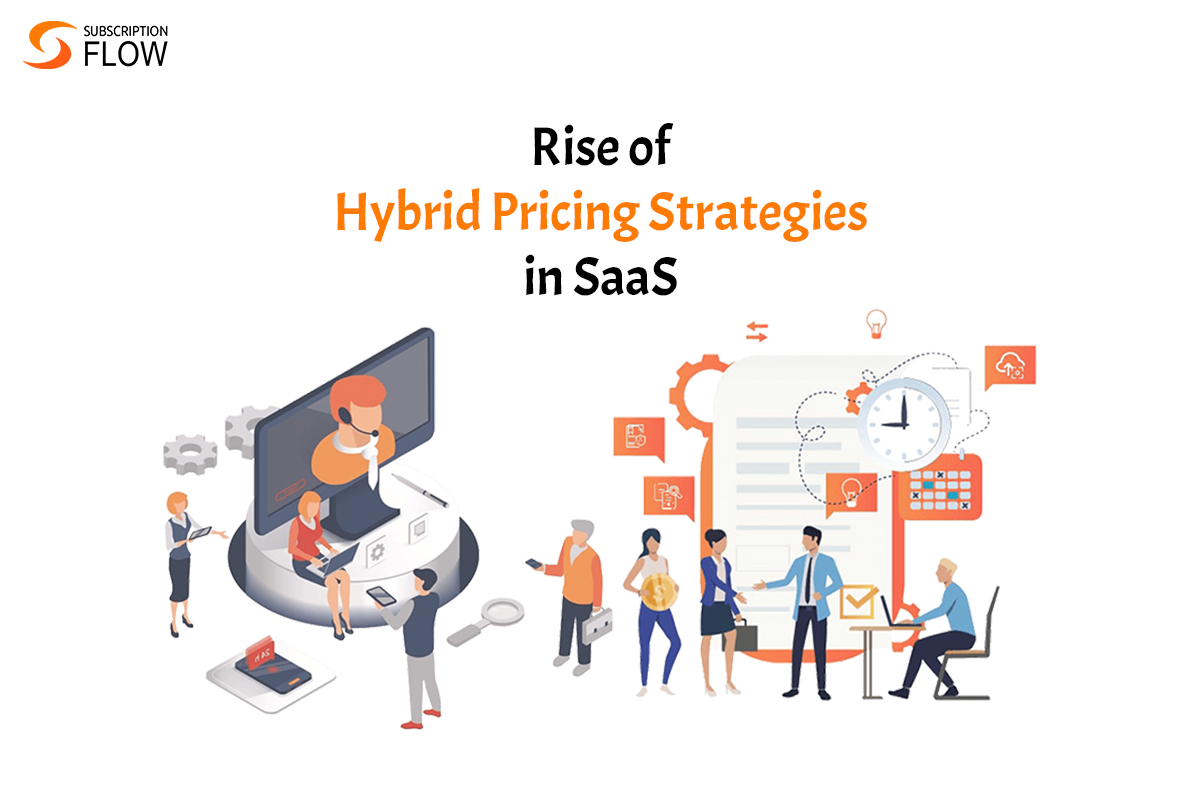
The Rise of Hybrid Pricing Strategies in SaaS – Gain the Attention of Customers
Key Takeaways
- A hybrid pricing model combines a recurring fee (typically per seat or platform) with metered usage, so revenue is predictable while still scaling with value.
- The hardest operational problem is mid-term change: upgrades, add seats, and usage allowances that need proration.
- Prorate the base fees by days remaining and include usage allowances by the same ratio, so the customer isn’t over-or-under billed.
- To get hybrid pricing right, automate with a billing engine that handles metering, rating, proration, and invoicing in one flow.
With the expansion of different pricing models, the need is to find one that ticks off all the requirements. Every business has a different buyer persona, which is why the pricing strategy needs scrutiny and inclusivity as well. For such a case, hybrid pricing works best. A hybrid pricing model combines at least two pricing mechanics on one subscription. The most common pairing in SaaS is a seat-based (flat) subscription fee plus usage-based charges. Customers pay a predictable base, and any consumption beyond an included allowance is billed on top.
This makes hybrid pricing a leading SaaS monetization model. Traditional flat rate pricing struggles when AI features, API calls, or compute drive your costs, and pure usage-based pricing makes revenue hard to forecast and budgets hard for buyers to approve. Hybrid balances both.
Hybrid Pricing Model Examples
Common use cases of SaaS hybrid billing models include:
Seats plus included allowance plus overage
A collaboration tool charges $40 per user per month, including 100,000 API calls per account. Calls beyond that are billed at $0.01 each. This is the classic overage model, and customers keep working without hitting a hard stop.
Platform fee plus metered usage
A data platform charges a $500 monthly platform fee plus $0.15 per GB processed. Seats are irrelevant here, but the predictable base covers fixed costs.
Seats plus feature add-ons plus usage
A communication platform charges per agent seat, adds a flat fee for premium models, and bills SMS or voice minutes by usage.
All use cases have a similar pattern: a recurring component that ensures stability and a variable component that tracks value delivered.
How to Automate Hybrid Subscription Invoicing Without Manual Spreadsheets
To automate hybrid subscription invoicing without manual spreadsheets, build these layers:
Usage Metering and Ingestion
Capture events from your product through an API or webhook, deduplicate them, and aggregate by customer, meter, and period. Idempotency keys prevent double-counting.
Centralized Customer and Plan Data
Keep plans, price books, entitlements, and contract terms in a single system, so pricing changes roll o ut without touching customer records one by one.

A Rating and Proration Engine
The engine should apply tiers, allowances, and overage rates automatically, and calculate credits and charges for any mid-cycle change using your defined proration rule.
Invoice Generation with Combined Line Items
Base fees, prorations, and usage appear together on one invoice, with clear descriptions.
Payments, Dunning, and Revenue Recognition
Automated retries, reminders, and accounting sync close the loop.
Audit Trails and Preview
Let teams preview upcoming invoices and trace every line back to the source events.
Laying the Groundwork for Optimized Hybrid Billing
If you plan on introducing and including the feature of hybrid billing, then it is important to make it optimized enough with a strategy.
For laying the groundwork for optimized hybrid billing, some postulates can help you in setting the prices and selling features for hybrid billing. Let’s look into them.
Market Research
Without market research, no one can step up the chance to win. Therefore, it is important that you conduct market research thoroughly to understand your buyer persona, competitors, pricing, pricing trends, most selling and demanded features, and so on. It is highly recommended to look into the pros and cons of the hybrid billing strategy just to make sure that it suits your business and offers enough profit with marginal costs.
Search For The Best Automated Tools In the Market
There are a myriad of automated tools in the market, however, one has to be extremely picky and choosy while choosing a crucial software for pricing.
While you search for the best-automated tools you need to look into the aspects of pros and cons of using that tool. SubscriptionFlow is one of the automated tools in the market that has been given the award of High performance by G2.
Our SaaS tool provides B2B merchants with different pricing models that they can leverage to extend their services to the customers in the most flexible way. Our hybrid billing model is specifically made to cater to the needs of merchants who want to make their business pricing inclusive of the hybrid billing model.
Centralize the Database
Centralizing the database means relying on automated and cloud-based software and leaving behind all the traditional/manual methods.
When you centralize the data, it gets easier for you to roll out the new pricing without affecting the data. Moreover, by centralizing the customer database, it is easy to locate your data to the SaaS pricing management software so that the database and pricing can be implemented seamlessly.
Common Hybrid Billing Options for SaaS Companies
Hybrid billing strategy is a wide subject and it includes different billing options that companies can choose from. Every billing option helps you decide to choose one that fits your industry and customer needs. Let’s look into them.
Feature-Based Subscription Tiers
Small businesses and startups use feature-based subscription tiers in which there is a hierarchy among tiers based on advanced and basic features. The pricing of those feature-based subscription tiers helps you decide which tier to use along with choosing the pricing that fits your budget.
The benefit of this turbid pricing option is that you can provide your product or service to the customers to have a limited budget and less need for advanced features. Therefore, never miss out on any customer and cash the opportunity with it.
Overage-Based Billing
Overage-based billing is an amalgamation of usage-based billing and flat fee billing. This pricing strategy entails charging customers for other than the flat fee bill when the usage exceeds.
For example, if a customer has a flat fee billing model for certain features and usage consumption and it exceeds then the customer is compelled to pay for the exceeding usage of features or consumption.
It helps in revenue generation and also gives liberty to the users to keep their work going by paying extra charges for that. Overage-based billing helps build a good customer merchant relationship as the services are not cut off directly once the package has been fully utilized.
Freemium
Freemium seems to be an appealing and easiest pricing strategy to offer. However, this is not child’s play, and not every business can jump into offering freemium.
Freemium entails offering some features to the customers for free but not all features are available in a free package. With this being said, for pricing the advanced features it is extremely important to scrutinize the aspects that help in making a freemium strategy.
We offer free trial and freemium management that help customers to manage their free trials or freemiums using our software with a complete database of paid and unpaid users. Explore our features to know how you can turn your unpaid users into paid users.
Common Mistakes to Avoid
- Prorating the fee but not the allowance: Leads to unfair overage charges
- Surprise overages: Notify customers at 80% and 100% of allowance
- Too many meters: Start with one or two that map clearly to value
- Unclear contracts: If proration and rollover rules aren’t written down, disputes follow
- Freemium without guardrails: Free tiers need clear limits and upgrade paths
How to Prorate Base Fee and Usage Mid-Cycle
To do so, use this four-step method:
- Define the proration basis. Most teams prorate by days (days remaining divided by days in cycle). Some prorate by seconds for precision. Pick one, document it, and apply it consistently
- Credit the old base fee for unused time
- Charge the new base fee for the remaining time
- Prorate the usage allowance across the old and new plan periods, and rate usage against the blended allowance
Alternative approaches exist, such as rating usage separately for each period against its own allowance. Whichever you choose, state it in your order form or terms so customers can verify their invoices.
How to Prorate a Mid-Cycle Upgrade on a Hybrid Plan
To prorate a mid-cycle upgrade on a hybrid plan, credit the unused portion of the old plan, charge the remaining portion of the new plan,and split the included usage allowance by the time spent on each plan.
Practical rules that prevent disputes are:
- Upgrades actually take effect immediately and are prorated. Charge the difference right away, or roll it into the next invoice.
- Downgrades commonly are applicable at the next renewal to avoid refund complexity. If you allow immediate downgrades, issue a credit instead of a cash refund.
- Seat additions are prorated from the add date. Seat removals typically apply at renewal, unless your contract says otherwise.
- Committed-usage contracts need extra care. Decide whether unused commitment rolls over, expires, or converts to credits.
- Invoice line items should itemize the credit, the new charge, and the usage calculation, so finance teams on the customer side can approve quickly.
Conclusion
Hybrid pricing gives SaaS companies predictable revenue and a fair, scalable way to charge for value. The successful implementation of hybrid pricing models depends on factors like clear pricing logic, consistent proration rules, and automation that keeps invoices accurate.
Ready to simplify hybrid billing? Book a walkthrough with SubscriptionFlow to see proration, metering, and invoicing automated end to end.

POPULAR POSTS


Think Business!
Related Posts
 SaaS Subscription Business Trends That You Need to Pay Heed To
- A Guide to Convergent Billing System
 5 Subscription Billing Mistakes You Must Avoid For Your SaaS and B2B Business
- How to Choose the Best Billing Software for Your Business
- Optimizing Cross-border Trade: Merchant of Record for SaaS Companies