

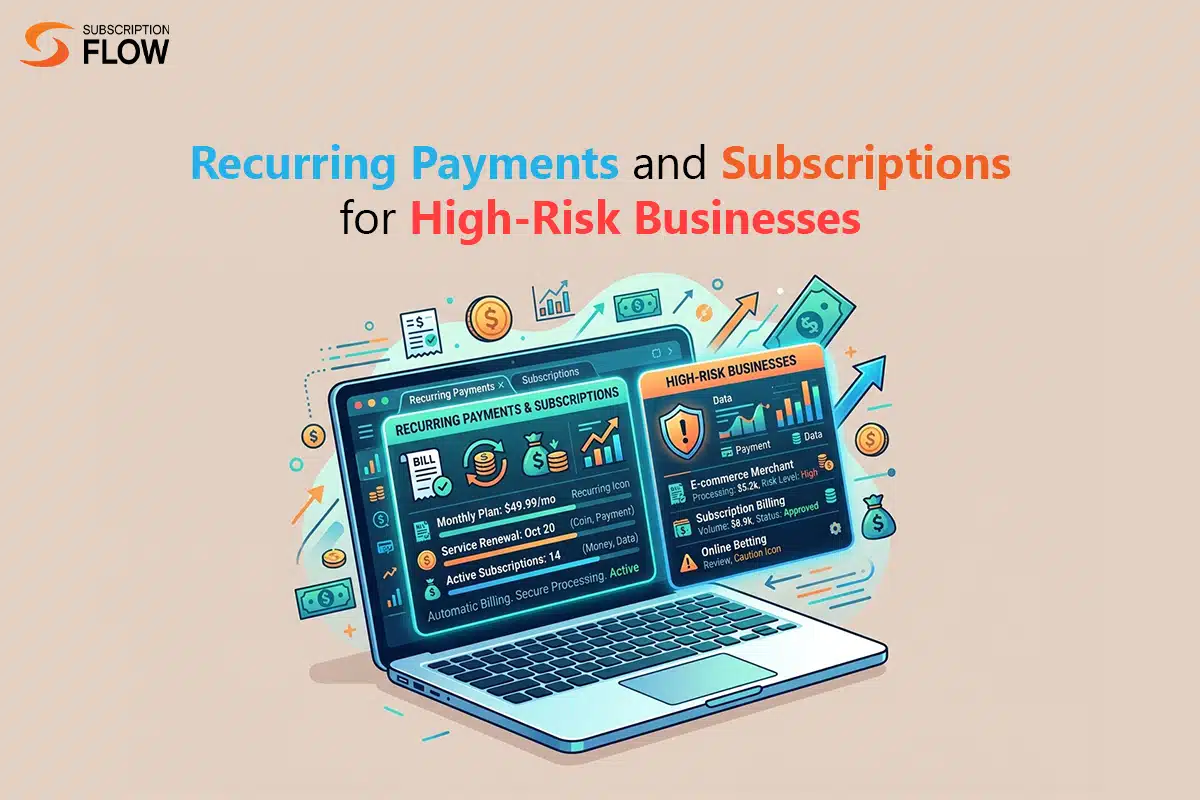
Recurring Payments and Subscriptions for High-Risk Businesses
Recurring revenue is usually referred to as the holy grail of contemporary business. It offers predictability, stability, and builds long-term customer relationships that one-time transactions simply can’t compete with. Although subscription models have revolutionised all sorts of industries, not all sectors can set up recurring payments with ease.
For high-risk businesses, generating recurring revenue reliably is substantially more difficult. With regard to selling CBD products, developing specialised SaaS applications, or manufacturing nutraceuticals, businesses must overcome obstacles that are usually not encountered by most standard businesses.
Traditional financial institutions often view recurring billing in high-risk sectors with skepticism, leading to frozen accounts or rejected applications. Therefore, building a long-term customer relationship in a high-risk sector requires more than a great product. It needs to navigate a landscape of strict oversight, high chargeback risks, and rigorous banking requirements.
The good news? Even high-risk businesses can establish stable, scalable recurring revenue systems with the right tools and strategy. It just requires a more thoughtful approach.
What Makes a Business High-Risk?
The label of “high-risk” does not imply the nature or legitimacy of a business. It simply means that, at a statistical level, such businesses have increased financial or compliance risk. From banks and payment processors’ point of view, a high-risk business is one with a high risk of disputes, refunds, fraud, or regulatory scrutiny. This categorisation is not arbitrary; it relies on past trends, industry data, and patterns of financial behaviour.
Common High-Risk Industries
Some industries are more apt to be categorised as high-risk, including:
- CBD and supplements
- Travel and hospitality
- Online pharmacies
- Pharmaceuticals and nutraceuticals
- IPTV and streaming services
- Digital content and software licenses
- E-commerce and digital subscriptions
These industries frequently involve highly regulated operations, transactions across borders, or changing consumer dynamics. All of these factors contribute to raising red flags for payment processors.
Key Risk Factors
In addition to the type of industry, processors look at a few factors to flag a business as high-risk:
- Chargeback history: A large number of disputes is an indicator of possible issues
- Credit history: Poor financial standing increases perceived risk
- Geography: Operating or selling to high-fraud regions
- Regulation: Industries with high compliance needs
Most of the mainstream payment providers, such as Stripe, PayPal, and Square, tend to focus on low-risk and high-volume merchants. High-risk businesses can face rejection of accounts in the onboarding process, sudden account suspensions, and fund holds or rolling reserves.
This is because such payment platforms are designed to be scalable and are not able to handle the complexities of high-risk transactions. This means that high-risk businesses have to seek specialised solutions.

Why Recurring Payments are Non-Negotiable
Central to the Business Model
Subscriptions are not merely a pricing model for many high-risk businesses; they are the core foundation of the business itself. For customers, recurring payments offer constant engagement, while for businesses, they offer consistent revenue. In the absence of the subscription model, it is very hard to sustain a steady income.
Receive Predictability
The concept of recurring billing enables companies to estimate revenue with more precision. This certainty aids in budgeting, staffing, and the expansion of operations with ease. Consistent revenue streams are highly valuable for high-risk businesses that already have to grapple with uncertainty when it comes to payment processing.
Automation and Cash Flow
Automated recurrent payments remove the manual invoicing and follows-up, assuring consistent cash flow. With scheduled payments, businesses can reduce delays and improve financial stability. The automation also reduces human errors that may otherwise result in billing disputes.
Why High-Risk Businesses Struggle with Subscriptions
Although subscriptions have numerous tangible advantages, high-risk companies face special challenges in adopting them.
High Chargeback Rates
Subscription businesses are most vulnerable to chargebacks due to the fact that customers might not remember recurring payments or fail to recognise them. This normally results in conflicts even in situations where charges are valid. In the case of high-risk businesses, going over chargeback limits may lead to fines or closure of the account.
Payment Processor Scrutiny
Payment processors are always watchful of high-risk merchants, and recurring billing just adds another layer of complication. Billing practices, refund policy, and dispute rates are closely monitored by processors. Any anomaly leads to investigations, fund holds, or service disruptions.
Complex Billing Logic
Subscription billing is about handling different tiers of subscription, pricing, trials, and discounts. Without a solid strategy in place, the process can become overly complicated. Billing mistakes don’t just affect revenue; they also harm client trust.
Regulatory Volatility
High-risk sectors are vulnerable to changes in legislation. A model that is legal today may face restrictions tomorrow. Therefore, mainstream payment processors fear that they can be financially responsible for processing unauthorised or newly illegal transactions.
How to Implement Recurring Billing for High-Risk Businesses
To set up a successful recurring billing infrastructure, high-risk businesses need to stop relying on basic or generic payment tools. The complexity, compliance requirements, and risk exposure involved make it essential to use a specialised subscription management platform.
How SubscriptionFlow Ensures Successful Recurring Billing for High-Risk Businesses
SubscriptionFlow is designed to meet the specific needs of subscription-based and high-risk businesses. It addresses all challenges with features like:
Multi-Gateway Integration
SubscriptionFlow enables for easy integration with multiple payment systems like Stripe, PayPal, WorldPay, Authorize.net, PayFast, Adyen, and many others. This helps business organisations become flexible with their payment processing methods. Besides, it reduces their dependency on any one payment system, thereby raising approval levels. In addition to that, it allows business operations to be conducted confidently throughout the world.
Automated Billing and Dunning
SubscriptionFlow automates billing periods, invoicing, and payment collection. Automation ensures consistency and efficiency. Additionally, its dunning management system is proactive in dealing with failed payments, consistent retries, and communication with customers. This minimises churn and optimises revenue recovery.
Flexible Subscription Models
SubscriptionFlow has extensive support of different subscription models, such as custom billing period and dynamic pricing. The upgrades, downgrades, and promotional offers can easily be managed by businesses. The flexibility eases complex billing situations and improves customer experiences.
Security and Compliance
The SubscriptionFlow system adheres strictly to the PCI and GDPR guidelines, ensuring that customer data is handled confidentially. They use robust encryption and tokenization techniques to minimize any possible risks. This level of strict compliance is necessary in risky industries that operate under regulatory requirements.
Self-Service Customer Portals
Self-service portals give customers the authority to regulate their subscriptions. They are able to change payment options, change plans, or discontinue services without contacting support. With such transparency, customer confusion is minimised while avoiding disputes and chargebacks.
Best Practices for High-Risk Subscription Businesses
Even with the right tools, success highly depends on how the subscription strategy is implemented. Some of the best practices are:
Be Transparent About Billing
Transparency can help reduce conflicts and build trust with clients. Companies should be open and clear when it comes to the amount of fees being charged, schedules, and descriptors on bank statements. There are fewer chances of chargebacks when customers know what they are paying for.
Communicate Clearly
Consistent, clear communication throughout the lifecycle of a customer helps set realistic expectations. Before and after signing up, customers need to be informed about their terms, costs, and policies. Good communication reduces misunderstandings and improves retention.
Use Tokenisation
To store payment data safely without any sensitive card data, tokenisation is required. It substitutes the information on the cards with an encrypted token, minimising the chances of data leakage. This also makes it easy to comply with security standards.
Implement Proactive Dunning
Proactive dunning measures reduce payment problems in the initial stages. Reminders, payment updates, and retries can go a long way in enhancing recovery rates. This reduces loss of revenues and improves customer satisfaction.
Provide Flexible Cancellation Options
To improve trust on business, offer easy cancel or pause subscription plans. This can lead to less frustrated customers, preventing any potential disputes. With improved customer trust, there is less likelihood of chargebacks.
Audit Compliance Regularly
The regulatory requirements are ever evolving. Therefore, compliance audits should be done on a regular basis. Companies should make sure that their billing procedures are in accordance with the existing laws and regulations. Remaining compliant defends against legal risks and enhances long-term sustainability.
Simplify Recurring Billing for High-Risk Business Today
Being labelled as “high-risk” does not imply that your business can’t be successful in terms of subscriptions. It merely means that you have to approach more strategically. Recurring payments provide irrefutable benefits, including predictable income, better cash flow, and enhanced customer relationships.
However, with improper infrastructure, it can become a liability. With SubscriptionFlow, what once seemed like a vulnerable revenue model can become a stable, scalable engine for growth.
Ready to take control of your recurring revenue? Let SubscriptionFlow assist your high-risk business in implementing safe, automated billing and achieving long-term success.

POPULAR POSTS



Think Business!
Related Posts
 Comparing SaaS vs Open Source eCommerce: What to Choose?
- Reviving SaaS Sales Management: Growth & Analytics 2026
- Billing Performance Metrics That You Must Track to Maximize Revenue for Your Subscription Business
- How to Be Creative with Retention and Growth Strategies for Your SaaS with SubscriptionFlow
- OpenCart vs Shopify: Which E-commerce Solution Reigns Supreme?