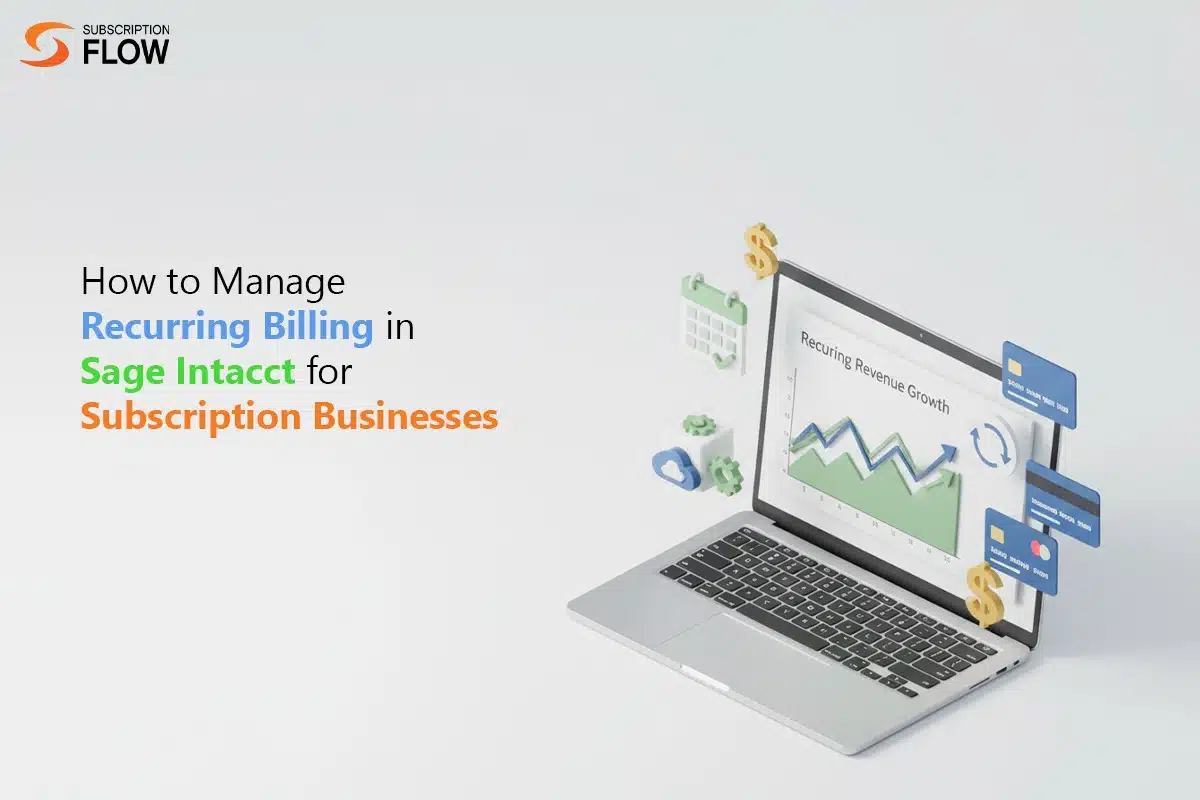
How to Manage Recurring Billing in Sage Intacct for Subscription Businesses
In the modern economy, ownership is rapidly being replaced by access. Whether it is the software you work with at the office or the coffee you order at your doorstep, the subscription model has become the heartbeat of modern business. While the model guarantees predictable income, it also brings growing complexity for finance teams. As your subscription business grows, even the most robust accounting systems can be overwhelmed by the very sheer volume of recurring transactions, mid-month upgrades, and proration.
Financial management tools such as Sage Intacct help finance teams manage revenue recognition and reporting efficiently. However, the “recurring” part of your billing is still a manual marathon. To overcome this challenge, you need a dedicated subscription management platform like SubscriptionFlow to simplify and scale recurring billing operations. The right setup is capable of turning your finance department from a bottleneck into a growth engine.
Understanding Recurring Billing in Subscription Businesses
Recurring billing refers to the process of automatically billing customers at predefined intervals at a fixed rate. Rather than creating invoices manually on case-by-case basis, the system automatically:
- Generates invoices
- Processes payments
- Changes subscription status
- Captures financial transactions
This guarantees a steady flow of cash and less administrative burden.
Common Billing Models
The following payment models are commonly applied to subscription businesses:
- Monthly Billing: Customers are billed on a monthly basis
- Annual Billing: Customers pay a one-year upfront
- Usage-Based Billing: Bills are charges based on consumption
- Tiered Pricing: Different pricing on levels of service
- Hybrid Models: Fixed recurring fee plus utilisation charges
All models add complexity to accounting, particularly when customers upgrade or downgrade, pause or cancel in the middle of the cycle.
What Sage Intacct Offers
As a cloud-based premier financial management system. Sage Intacct offers:
Core Financials
It handles general ledger, accounts payable, accounts receivable, and cash management.
AI-Powered Automation
It features AI tools like “Close Agent” for month-end tracking, “Financial Assurance” for recognising anomalies, and “Financial Intelligence” for generating insights.
Multi-Entry Management
It supports inter-entity transactions automatically and ensures seamless and rapid consolidation of hundreds of entities.

Advanced Reporting and Dashboards
With its real-time dashboards, businesses get dimensional analysis (e.g. by department, project or location).
Industry-Specific Solutions
It offers specialised software depending on the type of industry you operate in (such as software, non-profit, professional service, whole-sale distribution, and healthcare etc).
Cloud Native Platform
It offers a steady, web-based access that helps you get rid of hardware costs, with strong API integrations.
Challenges of Managing Subscriptions Directly in Sage Intacct
While Sage Intacct can manage recurring billing, it has several limitations. These ultimately cause several challenges when businesses attempt to process recurring billing entirely through it.
Manual Invoice Creation
Despite the contract billing features, finance teams need to manually establish billing schedules, change contracts due to plan changes, and manage proration. This adds burden on the administrative task force and may lead to billing mistakes.
Limited Subscription Lifecycle Management
Sage Intacct does not support free trials, promotional coupons, automatic upgrades and downgrades as well as self-service portals. These limitations do not allow flexibility in prevailing subscription models.
Revenue Recognition Complexity
Regardless of the high rate of revenue recognition, mid-cycle adjustment normally requires manual changes of revenue schedules. This may result in wastage of time, reconciliation, and reporting mistakes.
Scalability Issues
The higher the volume of subscriptions, the slower the operations become following stressful month-end closings due to manual procedures. The number of errors increases and financial departments waste more time on solving problems than on growth analysis.
Why Subscription Businesses Need a Dedicated Billing Platform
In order to grow well, subscription businesses require more than accounting automation. Recurring revenue is made easy when there’s a specialised recurring billing platform.
Automated Recurring Invoices
Invoices, taxes, proration and billing notifications are automatically constructed by a specialised system. This helps in saving time and energy as well as enhancing precision without manual intervention.
Proration and Plan Changes
The system automatically charges mid-cycle upgrades and downgrades of customers. Spreadsheets and manual adjustments become unnecessary if a dedicated billing platform is employed.
Dunning and Payment Retries
Automated dunning sends reminders, retries failed payments, and changes the status of a subscription. This protects recurring revenue and minimises the rate of churn.
Subscription Analytics and Reporting
Specialised platforms give MRR tracking, churn analysis, customer lifetime value, and cohort reporting. These insights drive smarter and data-driven decisions.
How SubscriptionFlow Complements Sage Intacct
SubscriptionFlow integrates with Sage Intacct to form a robust subscription and accounting ecosystem. This enables each system to do what it does best.
Seamless Integration
SubscriptionFlow facilitates billing automation, altering of plans, and creation of new subscriptions. Sage Intacct, on the other hand, handles financial reporting, revenue recognition, and accounting.
Automated Invoice Syncing
Invoices generated in SubscriptionFlow do not have to be transmitted manually to Sage Intacct. This avoids the necessity of entering data manually and offers consistency in financial records.
Real Time Financial Data Flow
Information is shared between systems in real-time maintaining ledgers accurate and revenue schedules. This promotes sound and transparent financial reporting.
Reduced Manual Accounting Effort
Repetitive billing and reconciliation is eliminated through automation. Finance teams are able to put more emphasis on strategy, forecast and performance analysis.
How SubscriptionFlow and Sage Intacct Integration Works
The integrated process typically works by:
- Step 1: Create subscription plans in SubscriptionFlow
- Step 2: Automate recurring invoices
- Step 3: Sync invoices to Sage Intacct
- Step 4: Manage revenue recognition
- Step 5: Track payments and reconciliation
Key Benefits for Finance and Operations Teams
Combining SubscriptionFlow and Sage Intacct generates a quantifiable gain of efficiencies in both financial and operational spheres. Accuracy, compliance, and scalability are increased through automation of recurring revenue processes.
Faster Month-End Closing
Automation significantly lowers the rate of manual corrections, spreadsheet reconciliation, and back-and-forth adjustments between systems. With synchronised billing and accounting data, it is easier and more reliable to conduct a reconciliation process. Consequently, finance departments are able to prepare books faster with a high degree of certainty every month.
Improved Billing Accuracy
Proration, tax and renewals, as well as subscription changes are all automated thus eliminating much of the underlying causes of billing errors. This minimises invoice disputes, reduces revenue leakage, and enhances customer trust. Proper billing also leaves the financial records clear and uniform across systems.
Compliance-Ready Revenue Recognition
Sage Intacct helps to take advantage of robust, standards-based recognition of revenue, whereas SubscriptionFlow helps to make sure that correct and formatted billing information is sent to the accounting system. Such alignment minimises the audit risks, avoids discrepancies in reporting, and makes sure that changes in accounting requirements are met without involving too much manual work.
Scalable Subscription Growth
As subscription volume increases, automated systems are capable of handling more transaction loads without the need to add to the administrative load. Firms are able to grow to new markets, introduce new pricing strategies, or bring in more clients without correspondingly growing the number of finance headcount. This financial scalability is a direct contributor to sustainable growth.
Best Practices for Subscription Businesses Using Sage Intacct
When Sage Intacct is employed by subscription companies, the maximum efficiency can be achieved by aligning billing automation with accounting processes. A strategic approach guarantees precision, adherence, and scalability.
Automate Billing Workflows
Eliminate the use of manual adjustments of bills where possible. The automation enhances uniformity and eliminates unnecessary mistakes.
Align Billing with Revenue Recognition Policies
Make sure that the subscription logic and pricing structures align with the accounting standards. This helps to avoid complicated corrections in future.
Monitor Churn and MRR
Track subscription metrics like churn and recurring monthly income with financial reporting. Operational insights is equally important as accounting data.
Ensure Proper System Integration
A clean data synchronisation can be achieved if the integration between SubscriptionFlow and Sage Intacct is well configured. Proper data flow ensures accurate reporting and informed decision making.
Build a Scalable Recurring Revenue Engine
Managing recurring billing in Sage Intacct doesn’t have to be a manual struggle. By combining the deep financial intelligence of Sage Intacct with the agile subscription management of SubscriptionFlow, you can create the most optimal tech stack. Transform recurring revenue from a complex operational challenge into a streamlined engine for sustainable growth.
POPULAR POSTS

Think Business!
Related Posts
 Mastering Product Adoption KPIs: A Roadmap to Sustainable Growth
- 5 Requirements A CRM for SaaS Businesses Should Fulfill
- It Is High Time to Work to Attain a Good NPS Score
- Data-Driven Strategies for Achieving Customer Success as B2B Business
- SaaS Customer Journey with SubscriptionFlow: An All-Inclusive Guide