

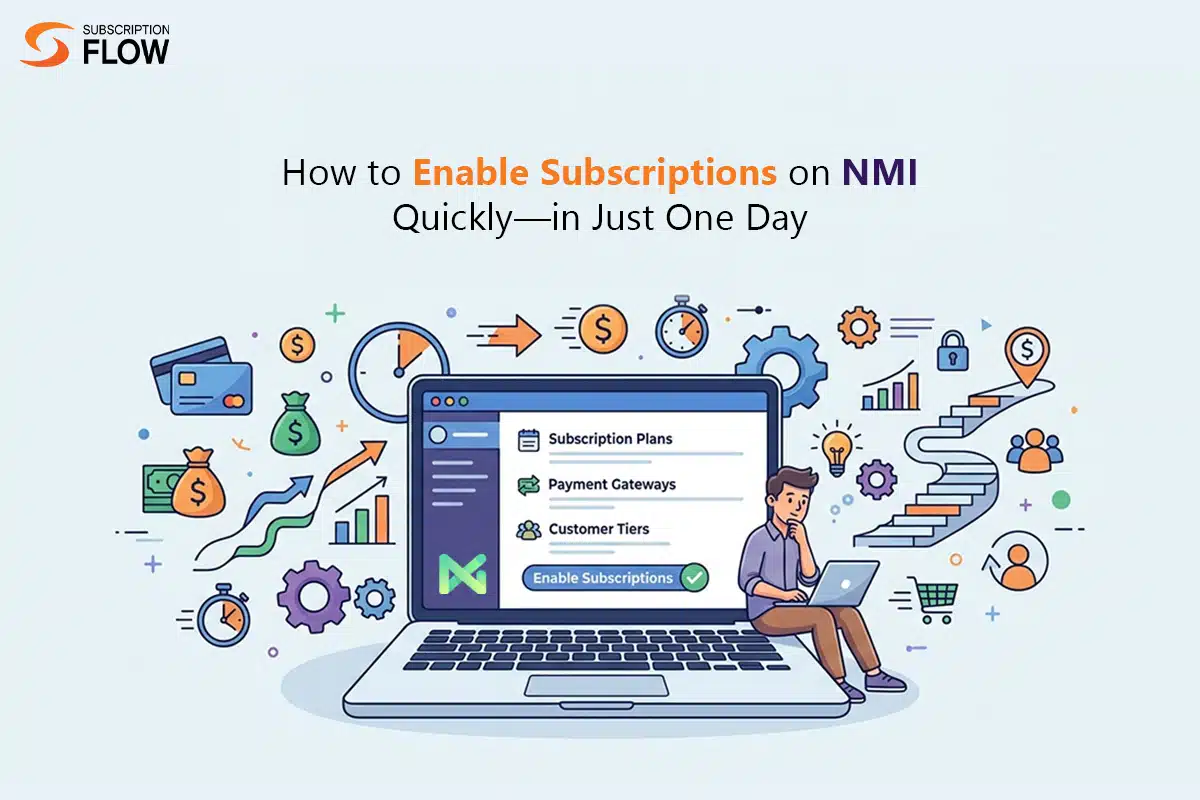
How to Enable Subscriptions on NMI Quickly—in Just One Day
The most efficient and sustainable business model in the digital economy is subscriptions. Although it is an effective mechanism to succeed, businesses still hesitate to launch subscriptions. This hesitation stems from concerns such as payment failures, customer migration, billing logic, and hurdles in technical implementations. So they continue relying on one-time payments and face limited cash flow predictability and high administrative overhead. And while they hesitate, they lose predictable, compounding revenue every single month.
But the truth is all these concerns are avoidable and can easily be resolved by implementing the right approach. If you are using NMI as your payment gateway, you already have the foundational technology needed to support subscription billing. By cracking the right strategy, businesses can enable subscriptions on NMI within a day. Here’s your exact, step-by-step implementation blueprint.
Step 1: Define Your Subscription Model
Before delving into the technicalities on the NMI dashboard, you need to first understand your commercial architecture. Analyse your customer demand and focus entirely on mapping out four core components.
Plans and Pricing Tiers
Determine your subscription plan. Assess whether you want to stick to a single flat-rate recurring fee or offer multi-tiered subscriptions to your customers. Different subscription tiers, such as freemium, usage-based, shared bundles, and hybrid, can be introduced. Assign a specific amount to each plan on the basis of the products/ services offered.
Billing Cycles and Frequencies
Set your billing frequency. Billing frequency refers to the intervals at which the customer pays for products or access to services. In simple words, the interval sets how often a customer receives a bill. Common billing frequencies are monthly, annually, quarterly, or milestone-based. Billing frequencies are set on the basis of the nature of the business or customer preference.
Trial Logic
Some businesses offer free trial periods for marketing or promotional purposes. If you want to introduce a trial period before onboarding a customer, determine the exact mechanics. Set the time period and requirement of the credit card upfront (NMI can authorise a card for certification without deducting any amount). Most notably, explicitly configure the transition from trial to paid subscription to make sure there’s consistent billing execution and avoid any customer confusion.
Upgrade, Downgrade, and Cancellation Rules
Changes in subscription plans are inevitable. Customers want the flexibility to upgrade, downgrade, pause, or even cancel subscriptions. Therefore, you need to establish transparent rules of how changes in plans are assessed and how charges are adjusted. Start with clean, predictable tiers, and then add complexity later.
Step 2: Set Up Billing Automation
Once you have designed your subscription framework, it is time to configure automation. With billing automation, recurring revenue begins to take shape. Manual billing is time-consuming, prone to errors, and is nearly impossible to scale. With growth in customer base, manual systems cause revenue leakage due to missed invoices, create cashflow delays via delayed billing, and lead to administrative bottlenecks. At this step, we configure:
Recurring Billing
With the help of recurring billing automation, customers are charged at set intervals without any manual intervention. Once synced with the plans accurately, subscriptions renew automatically, minimising administrative workload and enhancing operational efficiency. Via automatic recurring billing, businesses achieve a predictable revenue stream.
Proration and Subscription Charges
Customers change subscription plans as per their requirements. They make changes to existing plans, switch to a different tier, or add additional features. These changes can be dealt with accurately with the help of proper proration logic. In the absence of accurate proration, customers may be overcharged or undercharged, which ultimately erodes customers’ trust in the business.

Invoice Generation
Automated invoicing is necessary to ensure successful subscription management. It ensures customers receive accurate records for every transaction without overburdening teams. Via automated invoice generation, you can improve your operations efficiency, and at the same time, can strengthen the customer’s confidence in your billing process. This helps to retain customers and build a loyal consumer base.
Step 3: Implement Dunning and Recovery
At some point, businesses face payment failures due to expiration of credit cards, bank declines, and updates in customers’ bank info, etc. Failed transactions are impossible to avoid. However, how a business responds to those failures is what actually matters. This is where successful subscriptions save revenue.
Smart Retries
Failed payment doesn’t mean you lost a customer. It simply indicates an underlying problem. With the help of intelligent retry logic, you can attempt payment collection again at strategic intervals. Instead of manually tracking customers, smart systems help businesses to prevent involuntary churn, protecting customer lifetime value. On the customer’s end, it prevents unnecessary frustration to log in manually and re-enter their card details for temporary glitches.
Automated Customer Notifications
Customers are often unaware of payment failures. This can be managed via automated notification systems that inform customers about billing issues before they lose access to the services. It helps to improve communication between a business and its customer while increasing the likelihood of successful payment recovery.
Reduce Involuntary Churn
Many subscribers leave due to failed payments and not because they have opted out. Revenue recovery workflows can mitigate this unwanted churn and keep customers from walking away. For a lot of enterprises, payment recovery can be a source of substantial revenue without having to spend more money on acquiring new customers.
Step 4: Transfer Existing Customers
Migration is often the most critical part of the implementation process for those organisations that are moving from a different billing system. Customers’ relationships, payment details, and current subscriptions need to be carefully taken over without disruption. At this, we safely move:
Customer Data
Customer records are key to accurate migration. All of this information with integrity must be transferred, including account information, billing preferences, subscription history, and contact information. This structured migration process helps information to be accurate throughout the PCI-to-PCI data transfer.
Payment Methods
Security and compliance are important considerations for payment credentials. With the help of the right approach, your deployment team can accurately map the corresponding customer account data. Align your internal database user IDs with NMI’s new customer vault IDs.
Active Subscriptions
One of the most important objectives of migration is to maintain active subscriptions. Customer renewal dates, billing schedules, and subscription statuses should not be altered to ensure uninterrupted service to customers. Migration can go virtually unnoticed by the end user when it is done properly.
Step 5: Go Live and Monitor Performance
The last step involves going live and monitoring performance. Once you have launched your subscription system, it is crucial to keep it going. After the subscriptions have been activated, visibility is essential to ensure their success in the long term. You launch with:
Monthly Recurring Revenue Tracking
One of the critical metrics for a subscription business is monthly recurring revenue (MRR). MRR offers valuable insights into growth trends, business performance, and future revenue potential. This real-time visibility enables leaders to make informed decisions.
Churn Analysis
Retaining customers is as significant as customer acquisition. By tracking the rate of churn, businesses can discover trends, uncover retention opportunities, and fix problems before they affect growth. Any kind of small drop in churn can have a huge impact on the long-term profitability.
Revenue Analytics and Optimisation
Subscription companies generate beneficial data that can be utilised to boost performance as time passes. By analysing customer data, revenue analytics enable businesses to better understand customer behaviour, optimise pricing strategies, and identify expansion opportunities.
What You Avoid By Taking the Right Approach
A well-designed subscription implementation can prevent a lot of the pitfalls that often stall subscription programs. Organisations can deploy proven processes to address technical complexities without risk, enhance efficiencies, and accelerate time to launch. This leads to a smoother path towards implementing successful subscription billing with fewer operational disruptions.
Months of Internal Deployment
Subscription projects are often started for the first time by an internal development team within an organisation, where people expect to implement the project without any hassle. But in reality, these projects can turn into long, windy cycles of planning, developing, testing, and troubleshooting. A time period of days is achievable with a proven structure, but can be extended into months with in-house development.
Broken Billing Logic
Subscription billing is a process that should be managed carefully for recurring charges, plan changes, trial periods, payment failure, and customer lifecycle events. Even small mistakes can result in billing inaccuracies, unhappy customers, and support calls. A tried-and-tested subscription system assures reliable billing from the outset.
Revenue Leakage
One of the most overlooked by products of an incorrect setup of a subscription system is revenue leakage. Over time, failed renewals, missed billing events, incomplete recovery processes, and manual errors can all have a negative impact on recurring revenue. Considering these vulnerabilities in implementation helps to maintain profitability and ensure sustainable growth.
What You Gain
The advantages of a well-designed subscription model are far beyond automated recurring payments. Businesses can enjoy greater operational efficiency, better visibility of revenues, and a basis for long-term scalability. These benefits ensure real profitability, and as the number of subscribers rises, so do these benefits.
Faster Time to Revenue
The quicker it is available as a subscription, the quicker the business starts generating revenue from it. Faster implementation timeframes offer organisations revenue opportunities without long development cycles. This faster path to market can positively impact your business right away.
Operational Efficiency
Recurring billing, generating invoices, collecting payments, and managing renewals can be performed with little or no manual effort. This allows teams to focus on strategic efforts instead of on day-to-day operations.
Better Business Predictability
One of the most prominent advantages of implementing successful subscription is a greater degree of financial visibility as compared to one-time transactions. Subscriptions ensure consistent revenue that guarantees improved forecasting accuracy, cash flow management, and informed strategic planning. For growing businesses, this predictability becomes a major competitive advantage.
The Real Cost of DIY
Many businesses opt for DIY implementation, considering it is cost-effective. However, it appears to be a false economy. On paper, it appears as a saving, but the total cost ends up being higher due to:
- Three to six months of deployment
- Engineering resources
- QA testing
- Ongoing troubleshooting
- Project management oversight
These costs keep on piling. Meanwhile, the recurring revenue remains delayed.
Why Done-For-You Implementation Wins
Choosing a done-for-you implementation over DIY offers substantial benefits to businesses, including:
- Instant Velocity: Skip months of API mapping and webhook testing to go live in days
- Zero Technical Risk: Prevent broken billing logic, double-charging errors, and compliance risks
- Resource Efficiency: Keep your team focused entirely on your product, not payment infrastructure.
One such done-for-you implementation can be leveraged by SubscriptionFlow. Integrating NMI with SubscriptionFlow enables you to automate recurring billing and manage customer subscriptions from a single platform. This unlocks automated payments, customisable checkout pages, self-service portals, and advanced fraud prevention right out of the box, offering you an optimised, smooth billing flow without the technical headache.
Ready to Turn On Predictable, Recurring Revenue?
Stop letting technical concerns delay your business growth. Every week you spend debating payment architecture costs, you lose on MRR. With the help of SubscriptionFlow, you can seamlessly connect your NMI merchant account to an advanced billing engine. Let us handle API configurations, webhook mapping, and security compliance so you can launch an efficient subscription infrastructure within seven days. Ready to scale? Schedule a demo today.

POPULAR POSTS



Think Business!
Related Posts
 Improve Customer Retention and Sales Revenue for Magazines Using Subscription Management Software
- Quote-to-Cash Cycle Made Efficient by Streamlining B2B Processes
- Venmo vs Revolut: Choosing the Best App for Recurring Payments
- Grow Your Business Exponentially Through a Winning B2B Customer Acquisition Strategy
- Your Strategy to Boost Digital Magazine Subscriptions