

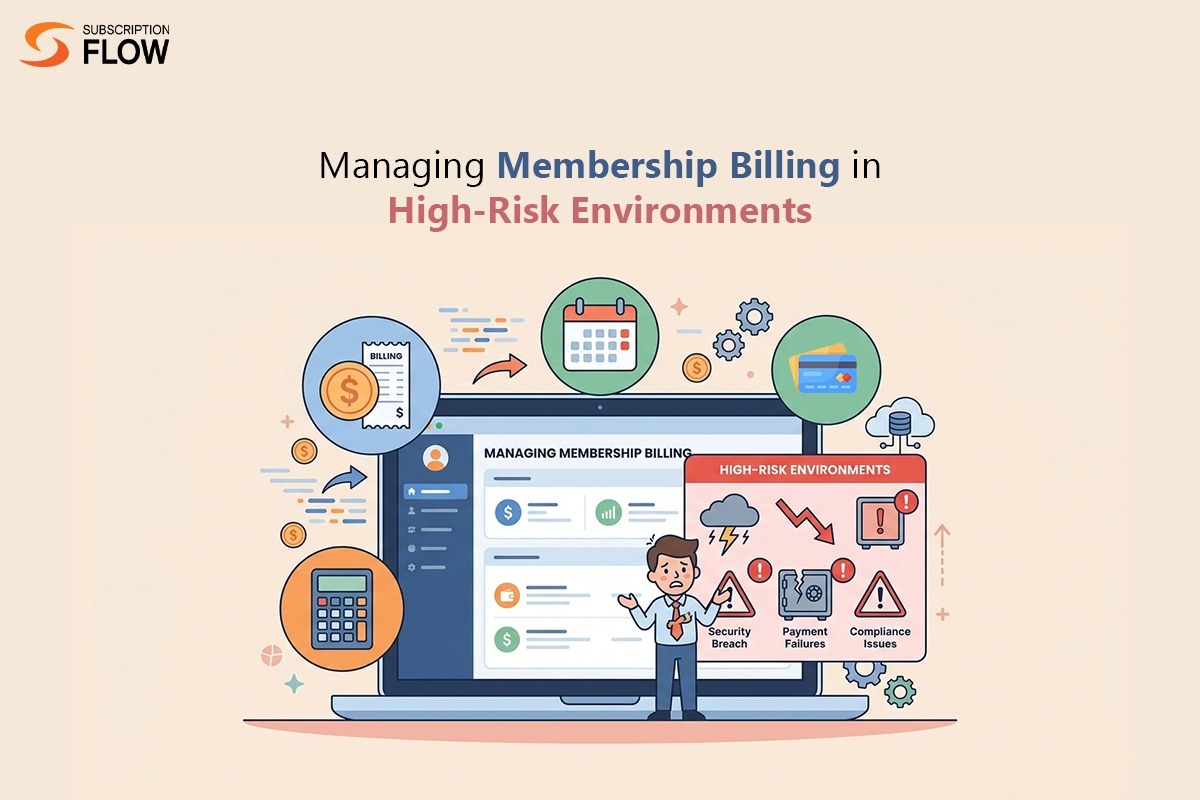
Managing Membership Billing in High-Risk Environments
One of the most effective ways to build a predictable and scalable stream of recurring revenue is to build a subscription-based business. Although it promises substantial benefits, not every subscription model comes with ease. If you operate in a “high-risk” category, you need an efficient merchant risk management system to operate efficiently.
In the subscription world, a “high-risk” environment does not mean that the business involves illegal or unethical practices. Instead, it refers to the business categories that banks and payment gateways flag at imminent risk of financial volatility, that face high chargeback rates, or strict regulatory scrutiny.
If you operate in a similar environment, you require specialised subscription lifecycle management and robust billing orchestration to thrive. Platforms like SubscriptionFlow help high-risk businesses operate smoothly, eliminating the risks of recurring subscription disruptions that trigger payment service providers to flag, restrict, or suspend merchant accounts.
What Makes a Membership Business High-Risk?
To understand how to survive in a high-risk environment, you need to first understand why the financial ecosystem considers a business cautious.
Industries Commonly Considered High-Risk
- Nutraceuticals: Involves dietary supplements, functional foods and beverages, herbal/ natural products, etc.
- Online Coaching and Digital Memberships: These span personalised mentorship platforms, cohort-based paid sessions, content/resource libraries, mini-courses, training videos, progress tracking interactive dashboards, etc.
- Gaming Communities: Includes membership passes to games, organised gaming tournaments, access to paid streams, etc.
- Forex and Crypto Memberships: Includes signal groups providing direct copy-paste trade alerts, premium trading education platforms, and expert mentorship, etc.
- Telehealth Subscriptions: access to healthcare professionals via phone, video,or secure messaging, talkspace for mental health problems, chronic condition management, and direct primary care (DPC) etc.
Why Payment Providers Flag These Businesses
Although every business is different in its nature, payment processes usually flag them on the basis of financial risk exposure. Common driving factors are:
High Chargeback Ratios
Customer dissatisfaction can lead to the initiation of a reversal of credit or debit card transactions. This ultimately hurts business’s reputation and its relationship with payment gateways. Resultantly, merchants’ accounts are restricted or, in the worst cases, get suspended.
Customer Disputes
In subscription-based businesses, customer disputes occur due to vague or unclear policies, opaque billing terms, and unexpected renewals. Excessive disputes trigger dispute monitoring programs from payment processors, which put merchants’ accounts at risk.
Refund Frequency
An increased number of refunds is considered a major financial and compliance risk. Frequent returns indicate a possible fraud, poor customer satisfaction, or undelivered goods etc forcing payment gateways to flag the business as high-risk.
Regulatory Concerns
Industries like nutraceuticals and crypto, etc., often face changing regulations. Due to the continuous updates in terms and conditions, payment gateway usually hesitate to offer their services as it requires them to follow strict compliance standards.
Operational Risks in Membership Billing
Beyond external regulatory threats, membership-based businesses face several internal billing operational frictions as well. These factors play a key role in making subscription-based businesses more susceptible to identify as high risks. Core operational risks are:

- Revenue Leakage: Failed payments are inevitable in membership billing, which negatively affects recurring revenue over time.
- Fraudulent Signups: Fake accounts and stolen payment methods create financial instability.
- Subscription Abuse: Businesses offer free trials as promotions. Users may exploit trial offers or repeatedly dispute valid charges.
- Failed Renewals: Merchants face passive churn when customers stay subscribed, but banks do not process payment due to overly sensitive fraud filters.
Core Membership Billing Challenges in High-Risk Environments
In comparison to standard e-commerce businesses, high-risk subscription businesses face more billing hurdles. This makes the membership billing even more complex. The following are some commonly faced challenges that can negatively affect business growth and customer retention.
Compliance and Security Requirements
To survive in high-risk environments, businesses need to stay updated with changing terms and conditions. In case a business is operating across more than one country, then it needs to comply with specific regional security standards. In case of failure to meet those standards, businesses can face high fines or even complete loss of processing privileges.
- PCI Compliance: One of the basic standards is safeguarding the customer’s card details. The membership billing system must adhere to the Payment Card Industry Data Security Standards (PCI-DSS) to ensure a successful checkout procedure.
- Data Protection: Different regions bound businesses to follow different data protection regulations. For instance, high-risk businesses operating in Europe need to follow GDPR, while businesses operating in the U.S. (such as California) require compliance with CCPA. To stay legal, businesses need to handle personal user information with strict privacy guardrails.
- Regional Billing Regulations: Beyond user data protection, high-risk businesses also need to manage localised tax compliance (such as VAT or sales tax). Moreover, there are regional authentication laws(such as Europe’s Strong Customer Authentication/ SCA) that add an additional layer of technical complexity.
Limited Payment Gateway Support
High-risk businesses often face suspension of accounts and freeze funds from mainstream payment gateways. Therefore, relying on a single traditional payment gateway is not suitable for high-risk membership businesses.
- Merchant Account Restrictions: Standard processors usually limit or cap the volume of revenue a business may process per month.
- Sudden Account Freezes: Even the slightest increase in chargebacks can lead payment processors to freeze the merchant’s account without any prior warning.
- Rolling Reserves: High-risk processors often hold a percentage of gross revenue in a non-accessible account for up to 180 days to cover potential chargeback liabilities.
Frequent Payment Failures
Banks or payment processors inspect high-risk transactions closely to verify payment or detect any irregularities. This leads to a decline in a high volume of legitimate transactions that hurt businesses’ predictable revenue. Payment failures occur due to:
- Expired Cards: Subscriptions naturally degrade over time as credit cards hit their expiration dates.
- Insufficient Fund: There’s an instant payment failure when a recurring payment is deducted when the user account is low on funds.
- Gateway Declines: Due to the high-risk category, payment gateways employ overly aggressive anti-fraud algorithms that block legitimate recurring payments.
Chargebacks and Friendly Fraud
Friendly fraud occurs when a customer makes an authentic payment but later claims a dispute with their bank directly instead of communicating the problem with the merchant. This usually happens due to:
- Customer Forgetting Subscriptions: Due to the increased number of subscriptions, users may find recurring payments forget the services they have been subscribed to or misread the free trial policies. In such cases, customers may identify the transaction as unknown and instantly opt for a “dispute.”
- Poor Billing Visibility: If the membership invoice does not clearly state when or why a customer is charged, it erodes customers’ trust in the business. Resultantly, customers contact the bank directly instead of the support team of the business.
- Lack of Invoice Communication: It is important to notify customers beforehand while deducting a bigger amount in terms of annual or monthly subscription charges. Failing to notify before their card is charged is a major driving factor for chargebacks.
Essential Features Needed in a High-Risk Membership Billing System
To overcome these challenges, high-risk businesses needed a comprehensive membership billing system that minimises risk and enables more control over revenue. Businesses opt for a subscription model to ensure predictable revenue, but in a high-risk business environment, it is more difficult than ever to receive that guaranteed predictability. To surpass common obstacles of high-risk membership billing, make sure that it has the following features:
Automated Recurring Billing
Automated recurring billing simplifies subscription management by handling renewals, billing cycles, and automated invoicing without any manual intervention. This not only enhances recurring revenue management but also minimises any errors and late payments.
Smart Dunning Management
Smart dunning systems automate the payment recovery process and automatically send out payment reminders. These workflows have proven to be useful in the recovery of customer payments and avoid involuntary churn due to temporary payment problems.
Multiple Payment Gateway Integrations
Relying solely on a single payment gateway is not ideal for high-risk businesses. Integrating multiple payment gateways is useful in minimising operational risks and improving payment processing efficiency across multiple regions. With intelligent routing of transactions via effective billing orchestration, businesses can optimise recurring payments.
Subscription Lifecycle Automation
Subscription lifecycle management enables businesses to automate the upgrade, downgrade, hold, and cancel subscription process. This adaptability can lead to better customer retention strategies and improve customer satisfaction.
Real-Time Reporting and Risk Monitoring
With the help of advanced reporting tools, businesses can easily track failed payments, churn trends, and recurring revenue performances in real-time. These insights can aid merchant risk management and help businesses make quicker billing decisions.
The Role of Subscription Flow in Managing High-Risk Membership Billing
It is difficult for businesses to manage the intricacies of high-risk membership billing alone. Therefore, merchants can simplify the process by adding a billing automation layer instead of a standalone third-party payment processor.
SubscriptionFlow is one such subscription management, recurring billing, and payment processing platform that sits between the business and payment gateways to stabilise billing workflows while enabling companies to continue using their preferred high-risk payment processing providers and merchant accounts.
Flexible Subscription Billing Automation
SubscriptionFlow is a robust, SaaS billing automation software, designed to automate subscriptions, billing cycles, and renewals. This flexibility helps in smoother recurring revenue management in the high-risk sector.
Built-In Dunning and Recovery Tools
It also features payment recovery automation tools to help automate payment retries and sends auto-recovery emails to customers. These attributes can improve payment recovery and help prevent unintended customer attrition.
Multiple Gateways Integration
SubscriptionFlow also provides businesses with a variety of payment gateway integration options that can help minimise payment processing disruptions and help to keep the business stable. This aids in reinforcing optimisation of recurring payments and minimising dependency risk.
Self-Service Customer Portals
The self-service portals enable customers to alter their payment methods, handle their subscriptions, and obtain their billings without needing to contact customer service. These features boost customer retention and offer convenience to members.
Advanced Analytics and Reporting
The platform features live churn and failed payment data, as well as recurring revenue patterns. These analytics can be leveraged for improved merchant risk management and data-driven decision making for billing.
Strategies to Reduce Chargebacks in Membership Businesses
It is important for high-risk membership businesses to focus on how to reduce chargebacks. The following strategies are proven effective:
Maintain Accurate Customer Records
Maintaining detailed billing history, tracking invoices, and consent records helps to provide strong records in customer disputes. Organised customer data also helps to manage customer lifecycles and aids compliance monitoring.
Use Clear Billing Descriptors
Clear billing descriptors enable customers to see subscription charges right away on their bank statements. This helps to minimise infusion, decreases friendly fraud, and aids in better merchant risk management.
Send Automated Renewal Notifications
Automated renewal reminders promote transparency in billing and reduce unexpected billing charges for subscribers. Communication and consistent payment compliance help to build customer trust and consistency.
Offer Easy Cancellation Options
Reduce customer hassle and disagreements by offering easy cancellation procedures. Customers are more likely to be satisfied and retain for a longer time when businesses demonstrate transparency.
Future Trends in High-Risk Membership Billing
AI-Based Fraud Detection
AI-powered systems can easily flag illegitimate payment activities and minimise fraudulent transactions before they even occur. With AI systems, businesses can enhance billing security and strengthen merchant risk management.
Smarter Payment Routing
With smart billing orchestration tools, payment routing is becoming more efficient and intelligent. This helps to enhance authorisation rates and minimise failed payments automatically.
Personalised Billing Experience
Modern billing platforms provide customised payment solutions for customers. Especially in high-risk membership billing, offering subscription plans on the basis of customer behaviour is highly beneficial. This helps high-risk businesses to create a loyal customer base.
Expansion of Alternative Payment Methods
Digital wallets, bank transfers, and offering specific regional payment options are becoming common in digital subscription billing. Providing flexible payment choices enables businesses to improve conversion and customer convenience.
Build a More Stable High-Risk Membership Business
Managing a high-risk membership business requires an intentional, proactive approach to financial operations. Manual processes or entry-level payment tools are insufficient to deal with high chargeback rates, avoid gateway freezes, and fight involuntary churn in high-risk businesses. Therefore, to build a stable and sustainable business, you must build your subscription model on a foundation of automation, payment flexibility, and minimum churn.
By leveraging a sophisticated platform like SubscriptionFlow, you gain access to the precise tools needed to manage a high-risk ecosystem safely. Take the complexity out of high-risk membership billing with a platform built to support secure and scalable business growth.

POPULAR POSTS




Think Business!
Related Posts
 Lifetime vs Recurring Memberships: What’s the Difference and Which is Better for Your Business?
- Optimizing User Lifecycle Management through Automation
- How to Implement an Effective Membership Program with WooCommerce for Business Growth
- Top 5 MemberPress Alternatives in 2026
- Best Membership Recurring Billing Software for Automating Payments