

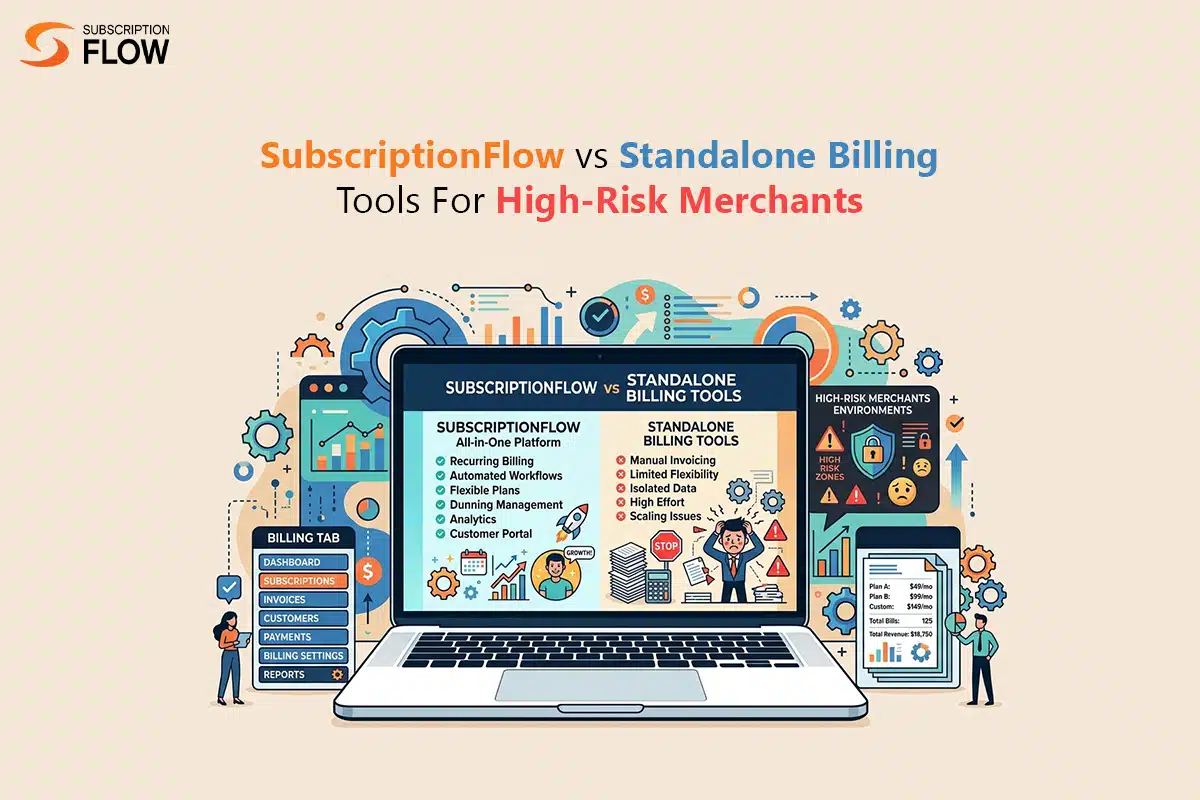
SubscriptionFlow vs Standalone Billing Tools For High-Risk Merchants
Billing is the cornerstone of digital subscriptions. However, for high-risk businesses, it is more challenging to acquire suitable billing software as most tools do not facilitate them. Businesses like nutraceuticals, CBD, online coaching, membership businesses, and digital services are often flagged as high-risk and face unique billing challenges such as high chargeback risks, changing regulations, and strict regulatory scrutiny.
To overcome these challenges, there’s a need for specialized billing tools for high-risk businesses. One such option is SubscriptionFlow, which handles all billing complexities. If high-risk merchants continue relying on standalone billing tools, they face revenue leakage from failed payments, churn spikes from poor dunning logic, and merchant accounts get flagged or terminated without warning.
Let’s compare SubscriptionFlow vs standalone billing tools for high-risk businesses, so you can easily evaluate what’s working the best.
What Makes a Merchant High-Risk?
A high-risk business is not the one who’s selling illegitimate products, involved in fraudulent activities, or has high loss, etc. Rather, they are labelled high-risk from banks, payment processors, and insurers due to their high stakes of financial instability, legal complications, and compliance audit. Here are key characteristics that make a merchant high-risk.
Characteristics of High-Risk Businesses
- Elevated Chargeback Rates: Repeated customer disputes due to subscription confusion, unclear billing schedules, and refund requests lead to increased risk of chargebacks.
- Recurring Payment Models: High-risk business based on subscriptions deals with ongoing billing complexities, including changes in subscription plan, recurring payments, etc.
- International Transactions: Businesses spanning across regions face changing local compliance, currency conversion, and the need to integrate local payment gateways.
- Regulatory Complexity: High-risk businesses working in sectors like CBD, nutraceuticals, and digital health tackle ever-evolving compliance requirements and high scrutiny.
- High Customer Acquisition Costs: High-risk merchants spend thousands on acquiring new customers. Every churned customer due to avoidable billing failures is a huge loss, reducing return on investment.
Common Revenue Risks High-Risk Merchants Face
High-risk businesses face specific recurring challenges that significantly impact their revenue performance:
- Failed Payments: Payments decline due to low balance and expired cards, etc which interrupt subscription payments frequently.
- Subscription Churn: Customer lifetime value (CTV) and recurring revenue are directly impacted by both voluntary and involuntary churn.
- Fraud: The number of disputes increases due to fraudulent activities, which lead to chargebacks and ultimately strict processor scrutiny.
- Merchant Account Instability: High-risk merchants face strict underwriting reviews or unexpected account limitations.
- Revenue Leakage: Small billing inefficiencies can compound over time, leading to substantial revenue loss.
Understanding Standalone Billing Tools
Standalone billing tools are designed to perform straightforward billing. Merchants sync their customer data, connect payment processors, and start conducting billing. For simple startups and small SaaS companies, that’s more than enough.
What Standalone Billing Platforms Actually Do
Standalone billing tools support basic billing features. They are capable of doing:
- Basic recurring billing and invoice generation
- One-time and scheduled payment collection
- Support basic pricing tiers (monthly, annually, etc.)
- Standard email payment receipts
Initially, they prove beneficial for businesses due to their low onboarding charges, easy implementation, and organised tracking.
Where Standalone Billing Tools Fall Short
The moment a business starts to scale, it becomes insufficient to support growing billing needs. Especially for high-risk merchants, they instantly fall short as they are not built to manage complex billing operations. Their limitations include:
- Limited payment gateway flexibility
- Weak dunning logic
- No advanced subscription management
- Minimal customer self-service
- Insufficient analytics
The Billing Challenges High-Risk Merchants Cannot Afford to Ignore
Payment Failures Lead Directly to Revenue Loss
Payment failure doesn’t only mean an incomplete transaction; it is the moment customer churn starts. Failed payments occur due to two types of declines: Soft declines and hard declines. Each of them requires a different approach to respond.

Soft declines include low balance, temporary holds, and bank timeouts. This is usually recovered by retrying the payment after a short interval. It usually takes 3-4 days to recover funds. Hard declines, on the other hand, refers to stolen cards flagged, accounts closed, expired cards, etc., which cannot be retried and need proactive customer outreach to update payment details.
Chargebacks and Disputes Increase Processing Risk
Chargebacks don’t just mean refunded revenue. They carry fees, damage your processor relationship, and if your ratio crosses a threshold (typically 1% by transaction volume), your merchant account can be placed in a monitoring program or terminated entirely.
High-risk merchants face chargeback rates that are structurally higher — often due to subscription confusion, billing descriptor issues, or customer friction. The solution isn’t to accept this as inevitable. It’s to implement proactive dispute prevention: clear billing descriptors, pre-bill notifications, easy cancellation pathways, and fraud screening that flags suspicious transactions before they complete.
Subscription Churn Erodes Customer Lifetime Value
Churn is the spectre of recurring revenue. However, knowing what kind of churn it is allows merchants to know how to overcome it. Voluntary churn is when the customer decides to leave. Needs win-back campaigns, pause options, exit surveys to know and abate. Whereas, Involuntary churn refers to customers who do not leave the service on their own, but rather it was because of a failed payment. This is often preventable via good dunning and card management. Recurring revenue growth is all about subscriber retention. Companies that proactively handle churn tend to generate more recurring revenue and increased CLV.
How SubscriptionFlow Stands Out
SubscriptionFlow is built specifically for subscriptions and does more than just billing. It is primarily designed for businesses with complex subscription models. Here, it is different from traditional standalone billing tools.
Unified Subscription Lifecycle Management
SubscriptionFlow simplifies billing and integrates its entire subscription lifecycle into one system, as opposed to treating billing as a separate process. It implies that every step of the customer journey can be tracked, managed, and automated.
- Subscription creation and modification: Create, upgrade, downgrade, and pause subscriptions anytime during the billing cycle without loss of data.
- Add-ons and bundles: Add layers of add-ons, one-time, and usage-based components to any subscription plan.
- Usage-based billing: Charges for API calls, seats, data usage, or any other model of consumption that can be metered.
Smart Dunning and Failed Payment Recovery
Smart dunning is the most distinguishing feature of the SubscriptionFlow. Dunning (failed payment recovery) is not a loop of retries. It needs logic, timing, and customer communication that is flexible depending on the type of decline, history of the customer, and the value of the subscription.
SubscriptionFlow’s automated retry logic dynamically changes the timing based on the reason for the decline. Card updater services automatically update the new card details for the participating banks before retrying again. Alerts are sent to the customer in order of increasing urgency (reminder to final notice) and include a link to the self-service portal where they can update payment details. The entire revenue recovery workflow can be customised for each plan and segment.
Customer Self-Service Portal
Each time a customer calls to change the payment method or suspends their subscription, it’s a cost. Scale it up to hundreds of customers, and it becomes a structural operational burden. SubscriptionFlow’s customer portal puts common actions right in the hands of its customers:
- Allow to update payment methods without reaching support
- Make subscription changes, such as upgrading, downgrading, or cancelling them on their own.
- View billing history and download invoices
- Sign up for several subscriptions in a single location.
Why Payment Flexibility Matters for High-Risk Merchants
Payment flexibility is not just a convenience for high-risk merchants; it is a key risk management approach. Recurring revenue businesses must have several payment options for payments and payment processing without interruptions.
Gateway Diversification Reduces Risk
Having only one payment processor can put an operation at risk without necessity. Revenue collection can be impacted on the spot if there are unexpected service disruptions, changes in the policy, or restrictions placed on an account with a processor. Merchants can increase their payment acceptance rates, optimise routing, and ensure continuity with the use of multiple gateways through processor redundancy.
Expanding Customer Payment Options
In the current era, customers have set the expectations that businesses are able to accept a range of payment choices. Credit card, ACH payments, digital wallets, and global payment options make the checkout process smoother, and make customers happy. Payment flexibility can also boost conversions and help grow international business.
Reducing Merchant Account Dependency
Relying heavily on a single merchant account may lead to a single point of failure that can compromise recurring revenue. Having multiple payment sources helps businesses diversify their risk and have a steady flow of cash available. This way, if there’s an unforeseen processor problem, nothing is lost.
How SubscriptionFlow Enhances Payment Flexibility for High-Risk Merchants
SubscriptionFlow offers extensive payment flexibility via integrations with multiple national and international payment gateways. It features smart payment routing that aids in automatically redirecting transactions to a backup gateway in case there’s an issue with the selected processor. This ultimately limits payment failures and churn. Multi-currency support enables customers to view prices and pay in their local currencies, which enhances the checkout experience. The platform also offers a custom checkout that supports multiple payment gateways simultaneously. Supported gateways include Stripe, PayPal, Braintree, NMI, Authorize.net, iyzico, MyFatoorah, and Peach Payments, etc.
Head-to-Head Feature Comparison
Here’s how SubscriptionFlow stacks up against typical standalone billing tools across the features that are non-negotiable for high-risk merchants.
Which Solution is Right for Your Business?
Standalone Billing Tools
Standalone billing tools are not bad software; they are just insufficient for high-risk businesses. They are built for different purposes. Rely on standalone billing tools if:
- Your business requires basic, simple, and fixed-price invoicing without any complex subscription tier variation
- You have a small customer base and are not looking forward to scaling significantly
- There’s only one payment processor in your billing infrastructure
- Your merchant category is standard, with minimum chargeback rates
SubscriptionFlow
Merchants should choose SubscriptionFlow when standard billing tools fall short, and they need a software that goes beyond the basics. SubscriptionFlow is an excellent choice if:
- You have a recurring revenue model with complex subscription tiers
- You are flagged as a high-risk merchant by payment processors
- You require multiple billing models, including subscriptions, usage-based, hybrid, etc
- You are more likely to expand, and you need a billing platform to scale with you
- Your main priorities are failed payment recovery and churn reduction
Ready to Upgrade Your High-Risk Business Beyond Basic Billing
To stay profitable and competitive in high-risk categories, merchants need more than basic recurring billing tools. High-risk businesses often find traditional billing systems insufficient due to a lack of managing payment failures, inability to handle billing complexity, and absence of multiple gateways.
If your high-risk business is ready to move beyond limitations and build a more stable revenue system, explore SubscriptionFlow today. Schedule a demo and see how you can streamline billing, reduce churn, and scale with confidence.

POPULAR POSTS



Think Business!
Related Posts
 How to Start an eLearning Business with SaaS (Part 3): Management
- Best Billing System for One-Time and Recurring Payments
- SubscriptionFlow Launches Its Own App on Wix, Subscription Management Becomes More Seamless Than Ever
- Mastering Customer Renewal Rate Calculation for Unlimited SaaS Success
- Why Choose Paystack WebFlow Integration for e-commerce Business