
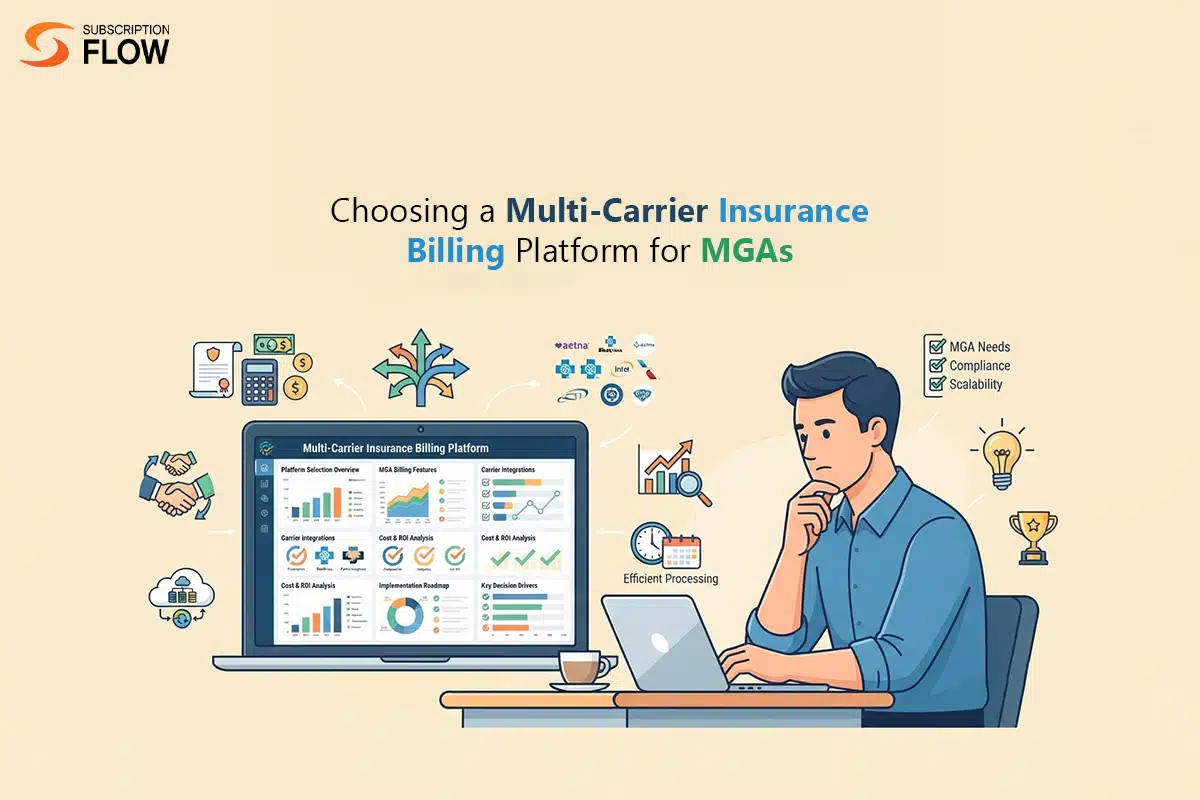
Choosing a Multi-Carrier Insurance Billing Platform for MGAs
For an MGA running multi-carrier programs, billing isn’t just an accounting afterthought; it’s a financial backbone that drives underwriting operations, carrier reporting, agent commissions, and cash flows. Choosing the right insurance billing platform becomes a strategic advantage that lets you onboard new programs and carriers without adding headcount.
Let’s explore what to look for when evaluating MGA insurance billing software and understand how billing functionality should work in a multi-carrier environment.
The Billing Challenges of Multi-Carrier MGA Programs
When an MGA works with a single carrier, billing logic is relatively simple: one set of rules, one commission structure, and one remittance cycle. However, when a second, third, or multiple carriers enter the picture, that simplicity disappears. Each carrier natively has its own billing cycles, commission schedules, override structures, reporting formats, bordereaux requirements, payment plans, cancellation rules, and fiduciary requirements per state.
Without specialized software built primarily for insurance billing for MGAs, you face severe friction points such as:
Different Billing Terms and Schedules
Each carrier program can carry its own billing frequency, grace periods, and installment structures. Tracking these manually across programs invites missed due dates and inconsistent enforcement of late-payment rules.
Fragmented Payment Collection
Different programs may need different payment methods, currencies, or collection workflows such as direct debit for one carrier’s book, credit card processing for another, invoiced terms for a third. Managing all of this without a unified system means duplicate data entry and a higher chance that payments fall through the cracks.
Carrier-Specific Remittance and Reporting
Carriers expect premium remittances and financial reporting in their own preferred format and on their own schedule. Manually assembling this data from spreadsheets or disconnected billing tools is slow and error-prone, and it puts the MGA’s standing with the carrier at risk.
Complex Commission Structures
Commission agreements rarely look the same from one carrier to the next. Tiered rates, carrier overrides, sub-producer splits, and contingent commissions all have to be calculated correctly and tracked separately, or the MGA ends up either overpaying producers or spending hours reconciling discrepancies by hand.
Core Insurance Billing Features to Look For
When shortlisting options, look past the front-end portals and look deeply into the back-office ledger. At a minimum, the platform should support:
Multi-Carrier, Multi-Program Logic
The platform should be able to run several distinct billing rule sets simultaneously, different carriers, different programs, different payment structures, without requiring custom development every time a new carrier signs on.

Automated Invoice Generation and Disbursement
Manual invoicing is one of the biggest sources of billing errors in MGA operations. Strong software should auto-generate invoices based on policy transactions, apply the correct commission, and route disbursements accordingly.
Trust Accounting and Compliance Support
Since MGAs frequently hold premium funds in a fiduciary capacity, billing software must support proper trust accounting, including separating fiduciary funds from operating funds, tracking premium in transit, and generating audit-ready reports.
Commission and Override Management
Multi-carrier programs often mean layered commission structures such as base commission, contingent commission, producer overrides, and program level incentives. Billing software should calculate these automatically and reconcile them against carrier remittances.
Bordereaux and Carrier Reporting Automation
Carriers expect standardized bordereaux reports on a regular basis. Manually compiling these is slow and error-prone. The right software should generate carrier-ready reports directly from the billing engine, cutting reporting time from days to hours.
Reconciliation Tools
Reconciling what was billed, what was collected, and what’s owed to carriers is a constant task for MGAs. Therefore, automated reconciliation is one of the clearest signs that a platform is actually built for MGA billing complexity.
Scalability Without Re-Platforming
A billing platform that works for two carrier programs should still work cleanly at ten or twenty. Look for evidence, not just marketing claims, that the architecture scales without requiring a full system rebuild or a painful migration down the road.
Questions to Ask Before You Buy
Beyond the feature list, ask pointed questions about how the platform actually processes billing in a multi-carrier environment:
- Can each carrier program run its own billing schedule, payment methods, and commission rules independently?
- How are commission errors or discrepancies caught and corrected?
- What does carrier remittance reporting look like, is it automated, or does it need manual assembly?
- Can our team adjust commission structures or billing rules ourselves, or does that require vendor involvement?
- How does the system handle failed payments and delinquency across different programs?
The Operational Cost of Choosing the Wrong Platform
MGAs that select billing software without fully evaluating multi-carrier capability often discover the gaps only after onboarding their third or fourth carrier. At that point, switching platforms is costly and disruptive, which is why the evaluation stage matters.
Common consequences of an undersized billing platform include:
- Late payment to carriers: Delayed premium routing erodes trust and undermines key carrier partnerships.
- Arguments over commissions: Financial discrepancies cause friction with retail producers, damaging valuable distribution relationships.
- Inefficient manual reporting: Staff spend days manually compiling spreadsheets each month to generate required carrier reports.
- Compliance and audit risks: Inconsistent trust account management creates significant exposure during financial audits.
How SubscriptionFlow Solves Insurance Billing for MGAs
SubscriptionFlow has positioned itself specifically around the operational realities of multi-carrier programs, rather than treating billing as a generic add-on to policy administration.
Automated Premium Billing and Payment Collection
SubscriptionFlow manages invoice generation automatically and manages complex payment routing along with dunning workflows. This enables MGAs to manage diverse billing setups simultaneously rather than juggling separate processes for each carrier program.
Commission Tracking and Reporting Built for Multi-Carrier Complexity
Rather than relying on manual spreadsheets for producer payouts, the platform is designed to calculate tiered producer commissions, track carrier override payouts, and maintain accurate financial ledgers automatically. This eliminates a major source of reconciliation errors for MGAs running layered commission structures across multiple programs.
API-First Architecture for Carrier Integrations
One of the biggest barriers to scaling a multi-carrier program is connecting new carrier systems without a lengthy IT project every time.SubscriptionFlow’s integration framework is built to connect with legacy carrier mainframes, modern comparative raters, and external compliance databases, so data keeps flowing without manual bridging between systems.
Scalable Infrastructure That Grows With the MGA
Whether an MGA is running two carrier programs today or planning to expand to ten, the platform is designed to scale without requiring a re-platforming project. This offers consistency as the carrier count grows instead of forcing a system change at a critical growth stage.
Decoupled From Any Single Carrier’s Legacy Constraints
A particularly important advantage for growing MGAs is architectural independence from any one carrier’s technology limitations. If a carrier pulls back capacity in a given market, an MGA running on a flexible, modern billing infrastructure can bring a new carrier into the same digital storefront and continue writing business without disrupting the retail distribution network, something that’s far harder to do on rigid, carrier-specific legacy systems.
Taken together, these capabilities are why SubscriptionFlow stands out among insurance billing platforms for MGAs: it treats multi-carrier billing complexity as the default scenario to design for, not an edge case to work around.
Making the Right Choice for Your MGA
Selecting an insurance billing platform is ultimately a decision about how well your MGA can scale. Platforms that treat multi-carrier billing as a core design principle, rather than an add-on feature, give MGAs the flexibility to add carrier partnerships, launch new programs, and maintain strong producer and carrier relationships without a corresponding increase in operational overhead.
SubscriptionFlow’s approach to automated premium billing, commission tracking, API-first carrier integration, and scalable infrastructure reflects an understanding of what exactly multi-carrier MGAs need from their billing technology. For MGAs looking to move away from fragmented, manual billing processes and toward a platform built to support long-term carrier expansion, it’s a strong candidate worth close evaluation.
Final Thoughts
As multi-carrier programs become more common across the MGA landscape, the billing platform underpinning those operations can no longer be an afterthought. By prioritizing a system with an advanced, flexible architecture that masters insurance billing for MGAs, you eliminate administrative bottlenecks that traditionally cap an agency’s growth. With SubscriptionFlow, you get a clear path to scale profitability by onboarding new carriers without rebuilding operational processes from scratch each time.
Choosing the right insurance billing platform for your MGA isn’t just a technology decision; it’s a strategic one that shapes how efficiently and confidently your organization can grow carrier partnerships in the years ahead.