
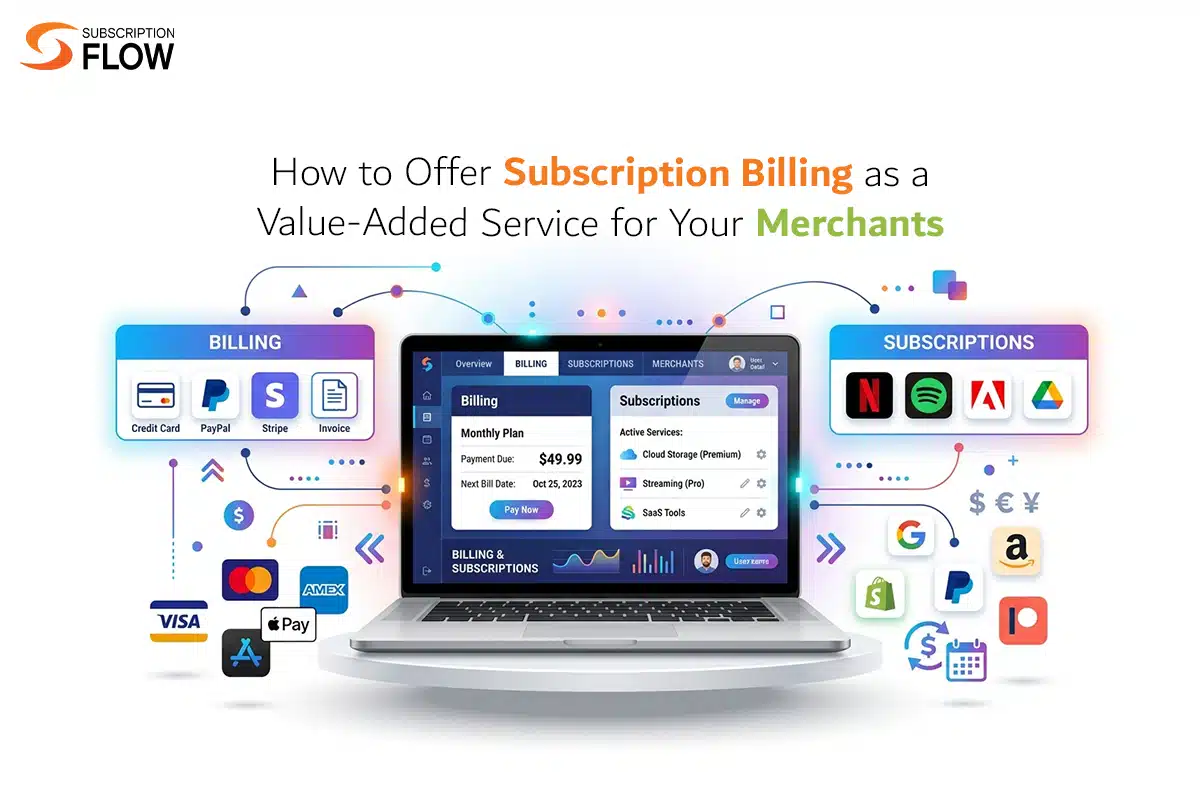
How to Offer Subscription Billing as a Value-Added Service for Your Merchants
If you’re a payment service provider that helps merchants get paid, it’s time you upgrade your services. Merchants are increasingly favoring the subscription model today because it simplifies revenue generation and creates long-term payment rails. However, most PSPs like payment gateways or processors only support one-time payments.
To stand out from the crowd, PSPs today can start offering subscription billing as a value-added service to merchants. Merchants dealing with subscriptions, memberships or installment-based plans can derive greater value from this setup.
SubscriptionFlow lets PSPs offer subscription billing without building it from scratch. You can integrate with SubscriptionFlow quickly, and then offer recurring billing to your merchants to scale both your and their revenue instantly.
This way, payment service providers can not only help merchants collect payments, but also with building predictable revenue.
Why Subscription Billing is a High-Value Add-On
Subscription billing is not just a regular feature; it’s a business enabler in itself. If merchants get access to this feature alongside payment gateway and processing services, they can successfully set up their subscription products. These are the key benefits of this add-on that make it high-value:
Seamless recurring revenue for merchants
By offering subscription billing, PSPs basically enable financial stability for merchants. That’s because subscription billing results in the creation of recurring revenue streams. These streams stay intact for as long as their customers remain onboard. Hence, merchants don’t get help with payments only, they’re also enabled to receive consistent monthly income. This is why this feature becomes so high-value for them.
Increases merchant retention for processors
Payment processors can increase merchant stickiness thanks to this add-on. Once a merchant has built their close-knit recurring billing infrastructure using your services, it becomes difficult for them to switch to a new processor. Subscription vendors tend to be more locked-in. Merchants with one-time payments, on the other hand, find it easier to change vendors.
Opens door to high-LTV verticals
There are some industries that rely heavily on subscriptions. If processors don’t offer subscription billing, they miss out on entire high-LTV verticals. Popular examples are the wellness industry (CBD, supplements), memberships (gym, nonprofit), digital content (online courses, study material) and food and beverage (coffee, bottled water).
Enables upselling premium services
Payment processors can monetize their subscription billing add-on in various ways. They can either charge a fixed monthly fee for it, or define a revenue share, or set up tiered pricing where merchants pay according to their chosen tier. Each tier can have different subscription billing features or can be based on usage. In any case, processors can sell subscription billing as a premium service, and charge beyond per-transaction fees.
Why Most Payment Processors Don’t Offer It
Despite clear benefits, many payment processors don’t offer the subscription billing feature to their merchants. And here’s why:

No native subscription logic
Payment service providers like payment gateways often don’t have the infrastructure to support subscription billing for merchants. They are designed to process transactions only, and mostly one-time transactions. The recurring billing and subscription lifecycle logic is way more complex than simple transaction processing.
High development cost
Subscription billing isn’t like other feature toggles. It’s a full and comprehensive infrastructure layer that’s not easy to build. Building such a system requires billing engines, customer management systems and charge scheduling logic. That’s why its development takes time, and incurs huge costs. It can’t be offered as an add-on quickly.
Operational complexity
There are many systems at work even within a subscription billing system. For example, there’s a system for payment retries, one for proration, one for plan management and one for managing compliance. This takes operational complexity to the next level, demotivating PSPs from offering subscription billing.
What Merchants Actually Need (Beyond Payments)
Payment processing is the basic requirement of every merchant selling online. But for subscription-based merchants, that’s not where the basic requirements end. They need specific subscription billing features to sustain their workflows, and grow their business.
Recurring billing automation
Merchants require automatic charges on schedule. Most payment processors don’t offer this functionality. So merchants have to rely on manually generated payment links or checkout forms to charge customers for the second time. True recurring billing automation, on the other hand, doesn’t need any manual input. It even creates invoices automatically.
Flexible billing cycles
Each merchant sells their services differently and requires varying billing cycles. Some products match annual plans the best while others go well with monthly billing, and so on. Merchants also need hybrid pricing to experiment with billing models that can help them become more profitable.
Failed payment recovery
Payment recovery features are needed to retain revenue. Failed payment retries and payment reminders are the main dunning tools any subscription business will need. When both these features work automatically, customers always receive payment reminders on time, and always get charged again after initial payment failure.
Subscription lifecycle management
Customer experience depends on subscription management. The smoother their lifecycles are, the more likely they are to stay. Merchants need easy plan pause, change and cancellation buttons to keep lifecycles smooth.
Reporting
Business decisions can’t be made without proper insights into performance. These insights are provided by the reporting tools present on the merchant’s dashboard. They help them keep track of their recurring payment progress, revenue and churn rate to name a few metrics.
Support for high-risk industries
Payment processing is more high-risk in some scenarios such as for international payments or high-risk labelled consumer goods. But these industries need recurring payments nevertheless. If your payment processor supports high-risk payments and offers recurring billing too, you can easily tap into these industries.
The Smart Solution: Partner Instead of Building
As discussed above, payment processors can’t realistically build their own full-fledged subscription billing systems from scratch. The smartest solution for them, then, is to partner with an already existing billing platform. They can keep their core services (such as payment gateway capabilities), and add subscription billing as a layer on top of them.
This partnership offers a number of benefits to PSPs:
Faster time to market
If you integrate with a billing software that already operates in the market, you save on the long development cycles. Integrating is far easier than building from scratch, and allows payment processors to launch subscription billing services quickly.
No engineering overhead
With this partnership, PSPs can avoid complex building and maintenance of billing systems. This way, they can avoid major costs as well.
Lower compliance burden
Payment processors get to have low risk exposure since subscription billing is managed by the external platform. That platform is responsible for executing subscription billing accurately, and dealing with all the complicated operations involved. Hence, the most compliance burden falls on the integrated software.
Immediate merchant value
This partnership becomes a shortcut to your and your merchants’ success. Your merchants can start using the subscription billing add-on right away, without worrying about having to develop anything.
How SubscriptionFlow Enables This
SubscriptionFlow adds the needed subscription billing layer to your payment processing services. This combination helps you give a more advanced and high-value payment setup to your business clients. By entering this partnership, you turn your payment processing service into a comprehensive recurring revenue engine.
End-to-end subscription billing
SubscriptionFlow supports everything for a subscription lifecycle from a to z. It allows plan creation, recurring payments, plan renewal, analytics, plan changes, proration, refunds, pauses and cancellations. If you offer SubscriptionFlow as your billing layer, your merchants get to access these advanced billing elements right away.
Support for high-risk merchants
The platform is compatible with high-risk merchants and complex payment environments. Your high-risk clients can accept recurring payments without fearing charge declines.
Seamless gateway integration
This billing engine is capable of integrating with existing payment gateways and setups. The integration doesn’t require lengthy procedures or replacement of current systems.
Automatic revenue recovery
SubscriptionFlow has powerful dunning features that include payment retries and reminder notifications. These features are highly in-demand as they assist subscription merchants in retaining their revenue volume.
White-label / partner-ready capabilities
Payment processors can offer subscription billing as their own service, because SubscriptionFlow supports white-labelling and partner branding. This strengthens your brand image, and keeps the payment setup more unified for your merchants.
Differentiate in a crowded market by making subscription billing your competitive advantage. Sell it as a high-value add-on with the help of SubscriptionFlow and create new revenue streams.

POPULAR POSTS




Think Business!
Related Posts
 Best Practices for Accepting Recurring Payments with SubscriptionFlow
 This is How Subscription Billing Automation is a Game Changer for Subscription Businesses
- Group Subscription Management for Publishers: Increase Readership without Complicating Billing
- Hardware Subscriptions vs. One-Time Purchases SubscriptionFlow
- A Definitive Guide: Top SaaS Billing Models for SaaS Businesses