How NetSuite Integration Simplifies Subscription Billing and Accounting
The consumption pattern has changed worldwide. There has been a significant shift in the way customers now think and perceive products and services. One such consumption practice is getting a subscription service.
While subscription models boost profitability, they also add up to more operational complexity, especially at the end of billing and accounting. When subscription management tools work in silos, the finance and operations teams often lose the pace, which leads to delayed reporting. That’s why there’s a need for seamless integration between subscription billing platforms and enterprise resource planning (ERP) systems become critical.
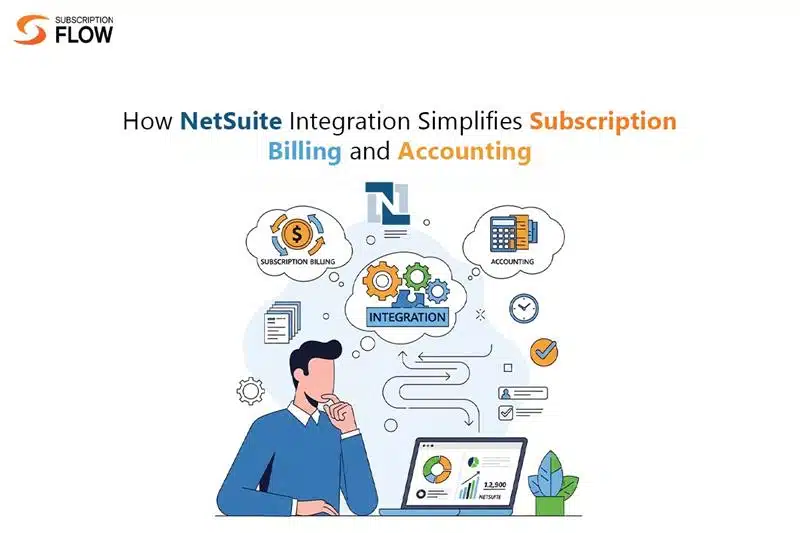
By integrating SubscriptionFlow with NetSuite, businesses can unify subscription management and accounting in an automated workflow that offers a reduction in errors, improvement in visibility, and enables scalable financial operations.
Common Challenges of Subscription Billing and Accounting
A unified system is mandatory to run a successful subscription model business. However, businesses still rely on basic separate systems for billing and accounting. Although this strategy works at an earlier stage, it still becomes a bottleneck when the number of subscribers increases with different requirements.
Individual Systems and Manual Processes
When both billing and accounting software are operated independently, there’s no shared database. Due to this, finance teams have to conduct manual data exportation, CSV uploads, and data entry. Not only is it time-consuming, but it also increases the risks of human error. With an increase in the volume of data, it becomes difficult to keep records and maintain accuracy thoroughly.
Data Inconsistencies and Errors
Another commonly encountered challenge is data inconsistency. Without data synchronisation between billing data and accounting records, discrepancies occur. Invoices issued in the billing system may not match revenue recognised in the accounting system. Payment statuses, refunds, and credits can fall out of sync, leading to unreliable financial data.
Delayed Financial Visibility
When systems work in silos, they cause delayed results across key financial metrics like monthly recurring revenue (MRR), deferred revenue, and cash flow. Finance leaders have to wait days or weeks after the end of the month to receive accurate data.
Complicated Revenue Recognition
It can involve proration, changes in contracts, and recurring invoices that all tie into revenue recognition. Without a combined system, it could be difficult to comply with a specific accounting standard, whether it is ASC-606 or IFRS-15.
Overview of SubscriptionFlow’s NetSuite Integration
Managing subscriptions and finances are two different streams of operations. The integration of NetSuite and SubscriptionFlow is designed to link the two. SubscriptionFlow takes care of your subscriptions, and NetSuite handles your finances, inventory, and sales. This interaction is what lets the two systems do what they do best.
Role of SubscriptionFlow
SubscriptionFlow is your subscription manager and recurring billing engine. It handles:

- Creating and managing subscription lifecycle
- Recurring and usage-based billing
- Updating plans when a subscriber switches to a different tier
- Bill creation and payments monitoring
Role of NetSuite
NetSuite functions as a dedicated software for managing accounts and finances. It manages:
- Subscription account’s data and record of new entries
- Managing receivable and payable cashflows
- Supporting a compliant revenue recognition process
- Delivering financial statements
How the Integration Works
SubscriptionFlow permits the automation of synchronisations for subscriptions, invoices, customers, and payments directly into NetSuite. This confirms that all billing operations have a direct synchronisation with the accounting system, thus creating a single source for all billing operations.
Simplifying Subscription Billing with SubscriptionFlow
SubscriptionFlow is designed to cater for the operational complexities of subscription models. It helps businesses to scale without operational friction.
Automated Recurring Billing
Starting from the invoicing process to payment tracking, SubscriptionFlow provides automated solutions to the entire billing process. SubscriptionFlow reduces the need for manual execution or triggering of billing processes by relying on the subscription conditions, payment intervals, and pricing logic defined for the generation of recurring invoices.
Flexible Subscription Models
Whether it is flat rate plans, tiered plans, usage plans, or customised plans, the SubscriptionFlow supports all the variable subscription plans. It will automatically prorate any variation of the plan and eventually reflect it on the invoice.
Seamless Data Sync with NetSuite
Once the invoices are thus generated in SubscriptionFlow, they automatically sync to NetSuite. This enables a consistent invoice dataset across systems. Additionally, customers’ data sets stay up to date, and billing data flows into accounting in real time. The NetSuite integration results in an error-free billing operation that reduces administrative burden.
Simplifying Accounting and Financial Management
For subscription businesses, it is important to maintain accurate and timely financial data. The SubscriptionFlow NetSuite integration helps you to achieve this end goal.
Improved Accounting Accuracy
Due to automatic synchronisation of billing and payment data, NetSuite always reflects the latest subscription activity. Via such a systematic platform, there are almost no discrepancies between billed amounts, payments received, and recorded revenue.
Reduced Reconciliation Effort
Finance teams will no longer have to perform manual reconciliations to match invoices and payments once the data is in sync. This will save a whole lot of time in dealing with discrepancies and errors.
Smoother Month-End Close
Closing a month-end in a subscription business could be quite stressful as it involves calculations such as deferred revenue, among other charges. The integrated system always makes sure that all subscriptions have been taken into account in NetSuite. The system, therefore, makes it even faster to close a month-end.
Better Financial Reporting
With complete, current data in the system, finance leaders have the clarity into revenue, cash flow, and accounts receivable needed to support more accurate forecasting and compliance-ready reporting.
Benefits for Finance and Operations Teams
The benefits of integrating SubscriptionFlow with NetSuite extend beyond accounting. It remodels how teams work together. Instead of wasting time on repetitive tasks, teams can focus on higher-value initiatives that can contribute to business growth.
Improved Data Reliability
Synchronised data is more reliable and trustworthy. With consistent data across all platforms, teams can believe in the numbers they see, reducing friction between finance, operations, and leadership.
Enhanced Decision-Making
Financial data in real-time enables the team to make the right decision on time. It helps them to align with the growing demands of customers and take strategic steps without unnecessary delay.
Scalable Operations
Integrated systems are capable of effortless scaling. They support increased transaction counts without adding operational complexity or headcount.
Who Should Use SubscriptionFlow’s NetSuite Integration
Businesses whose core revenue model is subscriptions should benefit from integration and use NetSuite as their accounting platform. It is an ideal solution if you are:
- SaaS companies with recurring revenue models
- Digital service providers offering subscription plans
- B2B service providers offering subscription plans
- Enterprises managing complex billing scenarios
Among these businesses, the following teams can get the most out of this integration:
- Finance teams seeking accurate, automated accounting
- Operation teams managing subscription lifecycles
- Revenue teams that need reliable billing data
- Leadership teams need real-time financial insights
Instead of relying on basic independent software, if growing companies handle this integration themselves, it provides the foundation needed to scale without sacrificing control or accuracy.
Getting Started with the Integration
Integrating NetSuite into SubscriptionFlow is a straightforward process. It takes three basic steps to sync all your data.
Onboarding and Configuration
The process starts by mapping key data fields, such as customers, subscriptions, invoices, and payments. Configuration assures that billing rules and accounting requirements match your business needs.
Initial Data Synchronisation
Once configured, historical and active subscription data can be synced to guarantee continuity. This creates a consistent baseline across both systems.
Ongoing Automatic Data Synchronisation
Once setup is established successfully, data flows automatically between SubscriptionFlow and NetSuite regularly. It established a continuous alignment between subscription activity and financial records with minimal maintenance.
Enabling Scalable, Efficient Financial Operations
For businesses working on subscription-based models, it is important to build a strong financial foundation. SubscriptionFlow’s NetSuite integration is a critical step towards doing so. Achieve a unified database and automate critical workflows by integrating SubscriptionFlow with NetSuite. SubscriptionFlow simplifies subscription management and recurring billing, while NetSuite ensures accounting and financial reporting. By working hand in hand, they improve team productivity and help the team focus on strategic priorities.
POPULAR POSTS