
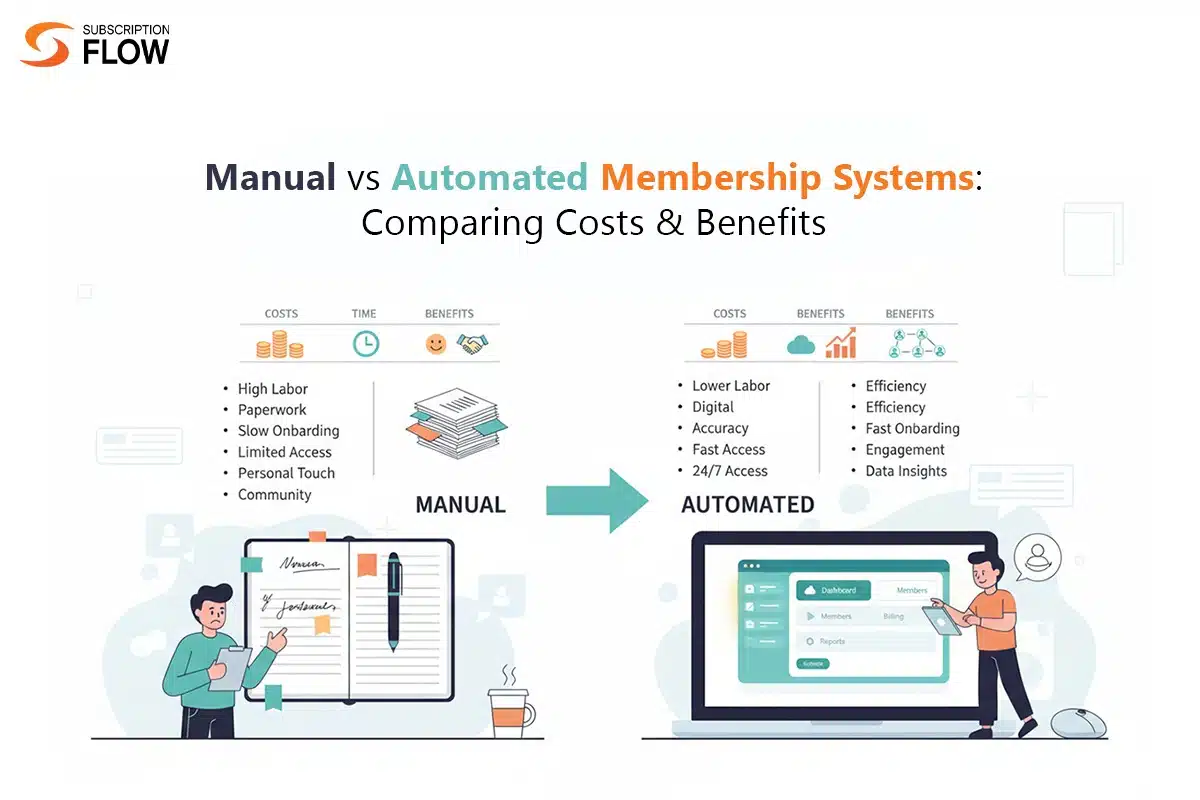
Manual vs Automated Membership Systems: Comparing Costs & Benefits
Many membership organizations still do things the traditional way. Relying on multiple, disconnected platforms, saving data on spreadsheets, tracking emails, and chasing payments. These processes work until they don’t. As member volume increases, memberships often hit a growth wall.
Manual practices don’t let them onboard as many members as they desire. On the other hand, organizations using automated membership systems save a good number of hours each month, and use that time to work on their growth strategies.
If you’re wondering whether automated software truly justifies its costs, that’s a fair question. After all, if manual operations were actually cheaper, then sticking with them would make sense. But that’s where many organizations go wrong.
Manual operations aren’t only not cheaper than automated software, but they also often prove more expensive. The reason is simple. Organizations don’t take the hidden costs of manual processes into account. These costs accumulate over time and weigh down membership success.
Why Organizations Start with Manual Processes?
Managing your organization manually means relying on human-driven processes to operate. For example, keeping member records in spreadsheets, making members’ invoices, reminding them to pay, etc. Memberships often start with manual processes because:
- They are low cost at the start: As associations usually start with very few members, it is easy for admins to handle things initially. They don’t need to hire employees when they can manage everything themselves.
- They require familiar tools: Admins can rely on familiar tools and platforms, such as Excel to manage members. They have the freedom to choose whichever tools they like for different functions. For example, one tool for making invoices, another tool for creating payment forms, and another for tracking renewal schedules. Even if things seem easy at the start, scattered data can cause problems in the future.
- They are suitable for very small member bases: When a member base is very small, say 10-50 members, it is easier to manage operations by hand. Organizations are less likely to overlook payments, neglect communication, or issue incorrect bills. The lesser tasks there are, the easier it is to spot and rectify billing errors.
5 Hidden Costs of Manual Membership Management
As memberships grow, management tasks multiply. Managing everything manually might look like the cheaper option, but it incurs huge obvious and hidden costs that can be prevented otherwise. Obvious costs include those spent on human labor and resources. Each new member acquired means more hours of work for employees, and more staff if current workers are at capacity. This stalls growth at some point.
But even more serious than obvious costs are the hidden costs that weigh memberships down over time. These are some hidden costs that go unnoticed:
1. Human error
Members have to be billed on a recurring basis. If the number of members increases, it automatically increases the number of bills that need to be produced, and multiplies the effort that needs to be put into outreach. This, in turn, increases the chances of human errors as well. That’s because humans don’t have machine-like billing precision. With high bill volume, small errors can go unnoticed, causing revenue leakage.
2. Time drain
The teams spend extra hours tracking payments from the members, as well as keeping track of the payments. They need to communicate with the members using various channels like email and SMS, which makes it challenging to monitor important information.
3. Poor member experience
Even if tasks are managed well manually, it still doesn’t promise members a good experience. That’s because members cannot get anything done instantly, whether that’s making a payment, or changing a membership tier. Even such small tasks require them to contact support teams which can be highly inconvenient. Plus, all contact needs to be done during business hours which often clashes with members’ packed routines.

4. No real-time visibility
Admins don’t have any platform that gives them live insights into their members’ activity. They can’t spot signs of churn, check payment progress in real-time or respond to members’ support requests instantly.
5. Impossible to scale
As a result, memberships can’t scale beyond a certain size. They don’t have enough resources for that. This prevents them from achieving the level of growth that successful businesses enjoy. It also makes geographical limitations more apparent for them, as they can’t get international members on board easily.
How Does Automation Help
Automated systems carry a number of advantages for memberships. Of course, organizations have to pay for them too, but their benefits significantly surpass their costs. The best part is that automation helps you prevent all the hidden costs discussed above. Inefficiency is replaced with:
- Centralized member database
Automated software like SubscriptionFlow acts as an all-in-one solution for memberships. This software handles billing, maintains member data records, produces invoices, manages integrations and a lot more all by itself. Meaning, data is no more scattered across platforms. Instead, it is unified and easily accessible from a single location.
- Automated billing and renewal
With automation, there’s no need to manually create bills. Membership management software accurately follows the members’ renewal schedules, auto-processes their payments and sends thank you emails, leaving admins with minimal workload. Plus, as the payments flow in, invoices are labelled as paid automatically, making it easier to spot the unpaid ones.
- Smart dunning for failed payments
Automated membership systems also take care of payment failures on their own. They deploy dunning workflows to remind customers to pay, auto-retry payments and send requests to update payment information.
- Self-service portal for members
Self-service or member portals are functional 24/7. Meaning, members are no longer forced to manage their plans within business hours, and with the help of support teams. They can handle basic updates on their own, and enjoy instant issue resolution.
- Real-time reporting and analytics
This software allows organizations to analyze their performance in real-time. That includes accessing member activity and cash flow reports to keep business strengths and weaknesses in view.
Why it Makes Sense to Move to SubscriptionFlow
SubscriptionFlow is a leading membership and association management software that serves diverse industries. Whether you’re a gym membership, a startup association, or a gated-content community, it saves you from extra work hours and heavy hidden costs.
Make the switch from manual operations to SubscriptionFlow if you have:
A growing member base
If your member base is growing, that should be good news, not a source of stress for your operations team! With SubscriptionFlow you can handle hundreds and even thousands of members at the same time. So scaling becomes smooth and stress-free.
Frequent renewal follow-ups
Not all members respond to renewals the same way. Some require more reminders and follow-ups. SubscriptionFlow automates such communication, and personalizes messages for each member so that you don’t have to reach out to each one manually.
Multiple membership tiers
Most memberships offer a variety of tiers to choose from, so that they can offer something to each customer. SubscriptionFlow lets you handle all plans harmoniously, and lets members switch between them easily.
Management complexities that take up the most of your time
Manually dealing with support tickets, payment failures, invoice reminders, and of course the actual service provision can pile too much onto your plate. Embracing automation is the only intelligent way to free up time, so that you can focus on your membership’s actual objectives.
Managing members doesn’t need to be complicated or time-consuming. If it feels that way, it’s your sign to level up with SubscriptionFlow.
POPULAR POSTS





Think Business!
Related Posts
 Wix Membership Management: Building Thriving Online Communities
- How to Increase Gym Revenue without Increasing Membership
- Membership Management Software for Nonprofits: Why Is It a Necessity?
- Calendar Billing for Memberships: Bringing Clarity to Payments, and Predictability to Revenue
- Charting the Best Membership Pricing Models for Your Business