
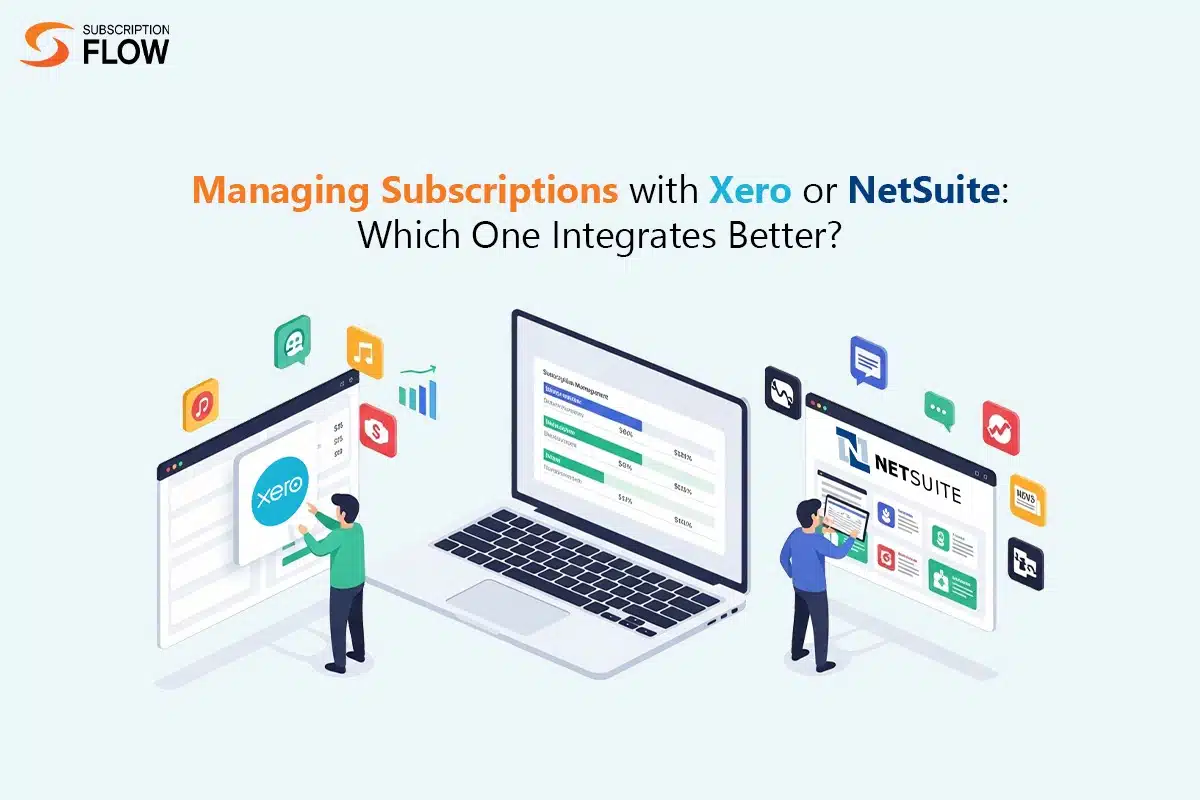
Managing Subscriptions with Xero or NetSuite: Which One Integrates Better?
Subscription business is no longer confined to streaming products and SaaS platforms. From software and e-learning to delivery physical products, recurring revenue models are being implemented by businesses in different sectors. The more complex subscription models are, the more difficult it is to handle billing cycles, renewals, upgrades, downgrades, proration and revenue reporting.
Successful subscription management is built on a fundamental element, which is smooth accounting integration. The absence of coordination between subscription management and accounting software causes businesses to experience invoicing issues, lost revenue, compliance issues, and reporting delays.
Xero and NetSuite are two accounting platforms that are commonly used by subscription businesses. They both provide strong financial management solutions. However, to select the most suitable option for your business, you need to learn how both of them integrate, scale, and work with the type of your business.
Why Subscription Businesses Need Accounting Integration
The subscription models generate recurring financial transactions that require automation and accuracy. Here’s why integration with accounting software is necessary:
Automated Invoice Syncing
Subscriptions usually involve recurring, usage-based, add-ons and prorated billing. Entering invoices manually in accounting systems is ineffective and can be easily falsified. Integration means that invoices that are created in your subscription platform automatically update the accounting platform in real time.
Revenue Recognition
The subscription businesses can’t simply record revenue at the time of payment. Under accounting principles such as ASC 606 or IFRS 15, revenue will frequently have to be recognised over an extended period. The right integration also makes sure that deferred revenue is appropriately recorded and identified.
Tax Compliance
The subscription billing can be multi-region, multi-tax, and multi-currency. Correct rates of tax and compliance are done automatically through integrated systems of accounting.
Real-Time Financial Reporting
Executives and finance departments rely on proper dashboards with monthly recurring revenue (MRR), annual recurring revenue (ARR), churn, deferred revenue and cashflow. In the absence of a smooth integration, financial reporting is disjointed and untrustworthy.
How Xero Supports Subscription-Based Companies
Xero is a cloud-based accounting system that is simple, automated, and user-friendly.
Cloud-Based and Accessible
Xero is fully cloud-based and therefore businesses can manage their accounting from anywhere. It integrates with hundreds of third-party applications including advanced subscription management tools.

Ideal for Small and Mid-Sized Businesses
Xero can best serve startups and expanding small and medium sized businesses (SMBs). It also provides powerful invoicing, bank reconciliation, cost tracking, and financial reporting without overwhelming users with enterprise-level complexity.
Key Strengths
- Automated bank reconciliation
- Repeated invoice abilities
- Support multi-currency
- Extensive integrations with third parties
Xero provides a very lightweight, affordable solution that integrates with billing platforms to subscription companies that are still developing. But its revenue recognition features can be extended by add-ons or middleware for more complex subscription accounting requirements.
How NetSuite Supports Subscription-Based Companies
Oracle NetSuite is an ERP system that is tailored to manage bigger and more complicated organisations.
Comprehensive ERP functionalities
NetSuite is not just another accounting software, it integrates financials, CRM, inventory, and order management among other functions in one system.
Built-In Revenue Recognition
A native revenue recognition engine is one of the most powerful tools available in NetSuite for subscription businesses. It facilitates sophisticated revenue schedules, deferred revenue, and billing based on a contract.
Key Strengths
It has advanced features like:
- Automatic recognition
- Cutting-edge reporting and analytics
- Adherence to international accounting standards
- Multi-entity consolidation
Integration Capabilities: Xero vs NetSuite
To understand the integration capabilities of both systems, here’s a side by side comparison:
Invoice Synchronisation
- Xero: Supports syncing via APIs and third-party connectors. Perfect in case of simple recurring billing.
- NetSuite: It has greater integration with contract-based billing, usage tracking, and sophisticated pricing models.
Payment Reconciliation
- Xero: It excels at automated bank reconciliation among SMBs.
- NetSuite: It offers powerful reconciliation workflows for various subsidiaries and currencies.
Subscription Revenue Tracking
- Xero: It needs add-ons or middleware to conduct enhanced subscription revenue processing.
- NetSuite: It has in-built automated revenue recognition in accordance with accounting standards.
SMB vs Enterprise Needs
- Xero: It is suitable with moderately complex startups and mid-sized subscription firms.
- NetSuite: Targeted at companies that deal with international business, multi-entity, and billing in large volume.
Customisation and API Flexibility
Both platforms offer APIs however:
- Xero: Its API is easy to use and friendly to developers when using lightweight integrations.
- NetSuite: The SuiteCloud platform of NetSuite can be more customised, work-flow based, and automated, though it usually needs specialised training in implementation. NetSuite is more flexible but is expensive and complicated to implement.
Customer Data Sync
The two platforms are capable of synchronising customer data. NetSuite, however, can be customised to a greater level for enterprise account hierarchies.
Deferred Revenue Handling
NetSuite has a built-in ability to provide department structures of deferred revenue, whereas Xero relies on integrative partnerships or custom settings.
Common Integration Challenges
No matter which software you use, subscription businesses may face similar integration challenges:
Data Duplication
Weak mapping of subscription and accounting systems may lead to duplication of invoices and customer records.
Sync Delays
Reporting and reconciliation may be affected by delays in case integrations are not configured correctly.
Multi Currency Complications
The exchange rate and currency conversion also creates another level of complexity, particularly to international subscription-based businesses.
Complex Subscription Structures
Add-ons, downgrades, upgrades, usage-based billing, and tiered pricing may give simple accounting integrations the strain of not being well automated.
Selecting the right integration architecture is as important as choosing an accounting software.
Where SubscriptionFlow Fits In
SubscriptionFlow plays the role of an intermediary between subscription management systems and other accounting systems (either Xero or NetSuite).
Seamless Integration
It ensures:
- Automated invoice syncing
- Instant customer information updates
- Proper reconciliation of payments
- Deferred revenue tracking
Billing to Accounting Automation
SubscriptionFlow fills the gap between complex subscription logic and structured accounting systems. It entirely manages the subscription lifecycle intricacies without forcing accounting software to do subscription management. SubscriptionFlow streamlines billing workflows and pushes clean and structured financial data into Xero or NetSuite. This helps in prevention of errors, data silos, and guarantees financial accuracy.
Which One Integrates Better: Xero of NetSuite?
Choosing between Xero and NetSuite depends highly on the size and complexity of your business.
Xero is Suitable If:
- You are a startup or an SMB.
- Your subscription model is relatively straightforward.
- You prefer simplicity and cost efficiency.
- You depend on middleware for advanced subscription logic.
NetSuite is Suitable If:
- You are a multinational organisation.
- You require built-in revenue recognition compliance.
- You handle complex subscription contracts.
- You need deep ERP-level reporting and analytics.
Move Toward Seamless Billing and Accounting Integration
Managing subscriptions needs more than recurring invoices. Subscriptions work efficiently if your financial systems are well-synchronised, supporting automation, compliance, and real-time reporting. Both Xero and NetSuite offer powerful accounting capabilities, but the right choice is the one that meets your business requirements. To streamline your subscription accounting, explore SubscriptionFlow integrations today and build a future-proof recurring revenue infrastructure.

POPULAR POSTS



Think Business!
Related Posts
 Fitness Evolution: The Pay Per Use Model for Gym Memberships
- Customer Retention Surveys - All You Need to Know
- Peach Payments BigCommerce Integration: Simpler Payments in Africa
- Bookings vs ARR: Understanding Two Key KPIs
- Are You Prioritizing on Customer Success Management? DO IT NOW to Grow Your Subscription Ventures For Consistent Streaming of Recurring Revenue!