
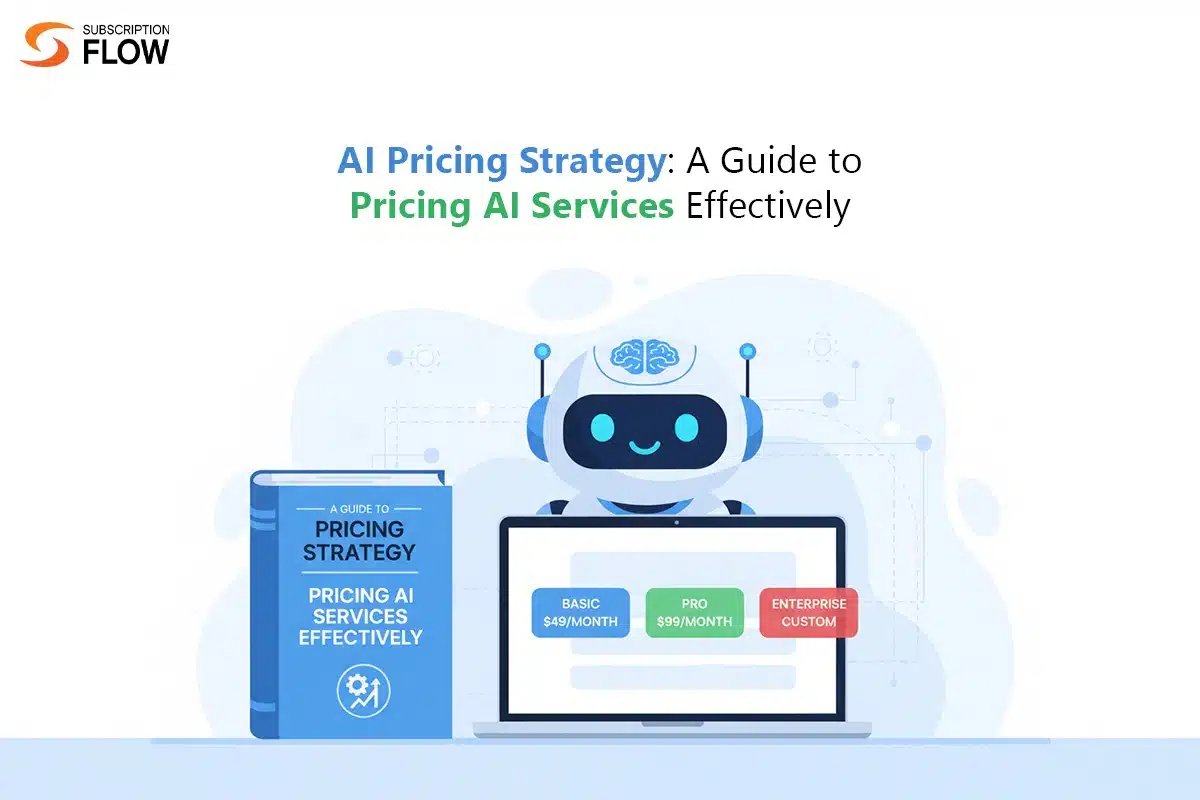
AI Pricing Strategy: A Guide to Pricing AI Services Effectively
Pricing AI products is one of the hardest challenges faced by businesses today. AI-based offerings have moved away from just being add-ons to being the core products driving modern businesses. As their popularity grows, the challenge to assign them the right price becomes more relevant.
Unlike fixed or easily measurable services like cloud storage, AI services are highly unpredictable in their usage. Their dramatically fluctuating consumption levels, real compute costs, and differing value across customers make them difficult to price.
If you charge too little for your AI service, you end up reducing your profit margins. On the other hand, charging too much can turn buyers away. What businesses need is an intelligent pricing strategy that can cover costs and reflect value effectively. Let’s have a look at some effective strategies they can implement based on their service type.
Why Pricing AI is Fundamentally Different
AI services greatly differ form traditional SaaS software. That’s why pricing them is not the same as pricing other standard services. These are some factors due to which AI offerings stand out:
- High R&D costs
AI products are expensive for businesses even before they begin selling to customers. They involve research and development (R&D) costs, training and fine-tuning AI models, cloud compute, experimentation and more. This means that businesses have to invest heavily in refining their services before they are made available for purchase. Weak pricing can overlook these costs, cutting into profits.
- Ongoing compute costs
Businesses don’t stop incurring costs after their AI services are launched. They have to continuously pay to keep them operating smoothly. These costs are variable, and are incurred as the AI system consumes more GPU compute, network bandwidth, cloud storage, etc. This necessitates pricing based on usage, so that heavy service users don’t quietly destroy the profit margins.
- Variable value (by usage, outcomes and accuracy)
The value customers generate from an AI service differs on the basis of their usage, desired outcomes and result accuracy. Compare an AI service model that generates 80% accurate results to a model with 90% accuracy. The latter service helps the customer prevent more errors, proving more valuable.
Similarly, there are AI services that simply assist customers with their operations vs. more advanced solutions that replace human work entirely. Value depends on which service variant the customer uses. Moreover, customers with more per-day service consumption naturally derive more value from it.
By assigning flat prices to AI services, businesses assume equal value, and so do the customers. This misrepresents service value, and makes you lose potential revenue.
- Difficult for customers to pinpoint what they are paying for
There’s a lot that goes into pricing an AI service, such as tokens and GPU seconds. Customers may not know about what exactly drives their costs, leading to fear of unpredictable bills. The only way to prevent this confusion is by making the AI costs explainable and transparent, so clients can know what they are paying for.

Models That Enable an Effective AI Pricing Strategy
AI pricing can’t be one-dimensional. These are some billing models that lay the foundation for smart AI pricing strategies:
Usage-based pricing
Usage-based pricing is foundational to AI-services as it aligns consumption with costs. As users increase their consumption, the computing and inference costs for the service also increase, and so do the user charges. This charging model ensures that the users aren’t over- or undercharged, and that the profit margins are protected from heavy users.
Businesses can calculate their customers’ usage based on API calls, images generated, text generated, documents analyzed, tasks executed by agents, etc. As a user’s consumption scales, their charges increase too. However, this model is rarely used at scale on its own. The reason is that pure usage-based charges can feel very unpredictable to customers and businesses alike.
This model is best when you are offering a service whose usage varies a lot for each customer, and demands fair billing.
Tiered/capability-based pricing
If a business offers different AI service tiers, the tiered pricing model can be the best fit for them. Tiers here mean AI models with differing intelligence, speed, accuracy or depth of automation. Businesses display each AI tier for users, explicitly listing each one’s capabilities and limitations. This helps customers make a better choice between the tiers, a choice that reflects the value they are looking for.
This way, customers can understand the business’s value proposition better, and actively choose to pay for only those services that are of their interest.
Outcome-based pricing
The outcome-based pricing model complements AI services that deliver specific and measurable results. For example, they generate images that are countable, save a certain number of operational hours, automate specific tasks, or generate leads. All these outcomes are measurable, and charges can be driven by these outcomes.
For instance, generating one image costs $1. If a customer generates 10 images in a month, their monthly bill would be $10. This model also ties costs to the value derived, and clarifies charges for customers.
However, it can only be relied upon when outcomes are always clear and countable. If that is not the case, simple usage-based billing is better.
Hybrid Pricing
Hybrid pricing works best for AI services as it takes multiple realistic factors into account. It balances cost and value while also preserving predictability (that usage-based models don’t). A common hybrid billing structure may look like this:
- A base subscription fee (to add predictability)
- Usage-based charges (to satisfy customers)
- Overage charges (to accommodate heavy users)
- Higher tiers for more advanced AI features (for upselling opportunities)
This pricing scheme is useful for scaling AI companies that want to make customers happy but without significant variations in their bills. A hybrid pricing scheme protects customers from bill shocks, and lets businesses grow cash flow at the same time. Businesses can also include fees for usage above set limits (overage fees) to ensure that their operational expenses don’t exceed their revenue.
Choosing the Right AI Pricing Strategy by Business Type
As the nature of each AI offering differs, its pricing approach differs too. Here are some service types and the pricing models that go best with them:
- AI APIs and infrastructure tools
These businesses provide other businesses with the core building blocks needed for creating AI services. These blocks include large language model access, inference APIs, and developer tools. So basically, these businesses help customer companies develop their own AI ecosystems. Since the customers are technical in this case, they expect metered billing for fair charges.
This means that usage-based pricing is the best fit here. However, as mentioned before, reliance on usage-based pricing only can generate unpredictable revenue. Therefore, it is a good practice to layer it with usage caps, allow pre-paid credits and define minimum monthly usage.
- AI SaaS platforms
These products are end-user-facing, and embed AI in their workflows. For instance, AI writing and analytical tools. The optimal billing model for such products is hybrid billing. That’s because end users prefer predictable charges, as they may not understand the pure usage-based ones.
Therefore, hybrid pricing works well in this scenario. Businesses may charge a fixed base fee plus a fee aligned with usage. They may also categorize varying AI capabilities into different tiers so customers can understand their derived value better.
- Agentic AI tools
Agentic AI tools help businesses automate certain tasks, and save hours that would go into manual operations. In this scenario, clients pay for the business impact that agentic AI creates for them. For example, the number of tasks automated., instead of the time or computing power spent on each task.
Since tasks are countable, outcome-based pricing makes the most sense for agentic AI. That’s because normal usage-based billing doesn’t capture the full business impact in this case. Moreover, outcome-based pricing makes the service value easier to justify.
- Enterprise AI solutions
These are customized AI deployments that are built for specific enterprise client needs. They are not like standard, off-the-shelf platforms that work the same for everyone. Instead, these solutions are deeply integrated into an enterprise’s workflows. For example, an AI system built for fraud detection in banks.
For enterprise solutions, contract-based hybrid pricing can be the best billing strategy. The reason is that enterprises often prefer custom pricing contracts over standard fees. They want cost certainty, not granular metering that may incur more and highly unpredictable costs, as they have thousands of customers to tend to.
In this case, AI service vendors can combine license fees with usage allowances and service level agreements (SLAs).
- AI-powered services and workflows
These services include AI-powered operations, as opposed to workflows managed by AI end-to-end. This means that AI assists the human workforce in improving processes but does not entirely do away with the need for human intervention. Examples include a billing system where only some processes are automated, for instance, the generation of invoices.
Such services also benefit from clear outcome-based pricing as customers pay for results, not for the computing power that goes into these services. Businesses can also implement package-based pricing in this scenario, as they can bundle their AI-powered features into transparent packages. For example, the “Automatic Invoicing Package” or the “Monthly Business Analytics Package”.
In a nutshell, each business type benefits from a unique pricing approach. There’s no single best AI pricing strategy that can be copied as it is.
Develop and Implement Your Unique AI Pricing Strategy with SubscriptionFlow
Whether you’re a business offering AI infrastructure, enterprise solutions or AI-powered SaaS products, SubscriptionFlow has your pricing needs covered. With this software, you get to experiment with multiple billing models separately, or combine them for hybrid synergy.
Here’s what SubscriptionFlow does for you:
- Handles usage-based, tiered and hybrid billing
Businesses may either set up these models independently or create a hybrid pricing setup. In either case, their billing is taken care of automatically, and no manual calculations are required.
- Provides real-time metering
Accurate usage-to-bill conversion requires precise metering that is done in real-time. SubscriptionFlow captures even micro-usage to generate accurate bills, so that no room is left for revenue leakage.
- Automates dynamic invoicing
You can use multiple pricing strategies for different products and build multiple AI service tiers. Customer invoices are automatically adjusted according to usage and the billing model deployed. Invoices accurately reflect variable AI usage, and display dynamic charges.
- Manages proration, usage caps, and overage
For more profitable usage-based charging, companies can easily define usage restrictions and overage fees. The system automatically enforces these restrictions and fees, speeding up payments. It also manages prorated charges for customers that enter into a plan in the middle of a subscription cycle, or cancel mid-way.
- Forecasts revenue despite fluctuating costs
SubscriptionFlow assists you with smart revenue forecasting agents that pick up pattens from your past cash flow data. They use their learnings, assess new business conditions and evaluate market trends to predict your revenue, even as it fluctuates monthly.
- Allows self-serve upgrades on usage growth
When users reach their usage allowance limit, the software recommends them to switch to higher tiers, so that they can self-upgrade instantly. Such upgrades don’t require manual approval, making the transition feel more natural, and not forced.
Ready to design your own AI pricing strategy? SubscriptionFlow gives you the flexibility to experiment and the full suite of billing models to succeed.