
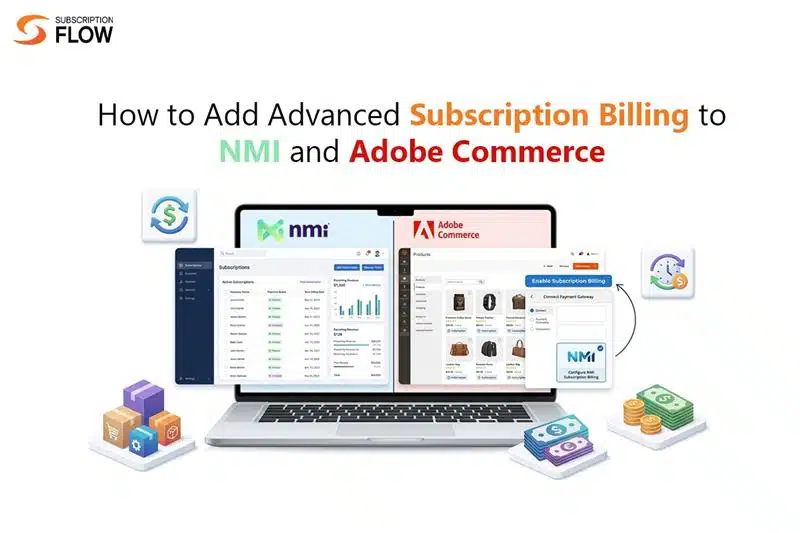
How to Add Advanced Subscription Billing to NMI and Adobe Commerce
NMI combined with Adobe Commerce has been a trendy solution among companies that have been developing scalable e-commerce experiences. This combination creates a high-potential base, as Adobe Commerce provides an adaptable and feature-packed storefront, and NMI offers secure and reliable payment processing. But in the case of business models that rely on subscriptions, this powerful stack starts to show its limitations.
Subscriptions do not imply deducting a specific amount after an interval only. It takes implementing complicated billing logic, managing lifecycles, offering flexible pricing and enacting customer retention strategies to run a profitable subscription business.
To handle basic subscriptions, NMI and Adobe Commerce may be sufficient but neither of them has the ability to oversee the complete subscription cycle. Without a well-dedicated system, subscription-based businesses face challenges of manual workarounds, fragmented systems, and lost revenues.
What NMI Does Well
It is important to understand the strengths of NMI before discussing its limitations.
Secure Payment Processing
NMI is a reputable payment gateway that maintains robust security standards. It promotes tokenisation, encryption, and has infrastructural solutions that are PCI-compliant. Thus, it is a good option to manage sensitive payment information.
Tokenisation
One of NMI’s core strengths is tokenisation. By complying with all safety guidelines, it stores customer card data as encrypted tokens so businesses can deduct recurring payments safely.
Gateway Flexibility
NMI works as a gateway aggregator that can be linked to various processors and merchant accounts. This elasticity enables companies to direct transactions effectively and expand internationally.
In short, NMI is excellent at what it does best: processing payments securely and efficiently. However, subscription businesses do not just require payments.
Where NMI Falls Short for Subscriptions
Although NMI supports simple recurring billing, it is not capable of managing complex subscription operations.
No Subscription Lifecycle Management
Subscriptions have several phases including trial, active, suspended, upgraded, downgraded, cancelled, and resumed. NMI lacks a mental system to control these lifecycle events.

Minimal Recurring Billing Intelligence
Basic recurring billing is not enough. Businesses need:
- Proration handling
- Mid-cycle plan changes
- Usage-based adjustments
- Interoperability of billing in various subscriptions
NMI lacks special billing logic to support these situations strategically.
No Dunning or Automation
Late payments are bound to occur. The absence of automated retry, smart dunning, and customer notification can lead to revenue loss. NMI lacks:
- Intelligent retry schedules
- Automated email workflows
- Payment recovery mechanisms
It implies that either teams need to frequently interfere manually or have to leave failed payment unattended.
Adobe Commerce and Subscription Complexity
Adobe Commerce is highly customisable on the storefront side; however, it is not built to address the complexity of subscriptions. The digital commerce platform is insufficient for subscription management due to:
Dependency on Extensions
In order to facilitate the subscription feature, companies tend to rely on third-party extensions in Adobe Commerce. Although these plugins provide simple recurring functionality, they are rarely configured to support long-term scalability or complex billing functionality. In the long run, it creates conflicts between extensions, particularly when two more plugins are trying to alter the same checkout or pricing processes.
Further, it is necessary to update the plugins regularly to ensure that they are compatible with the core platform, which adds to the development workload. This patchwork solution frequently leads to the creation of a shaky system that is not strong enough to support complex subscription activities.
Scaling Issues with Recurring Products
With the growth of your subscription catalog, it becomes more and more complex to have recurring products. Companies have to balance various pricing regulations, billing periods, and clientele, which can easily end up in a chaotic operation. Adobe Commerce is not initially a solution to support sophisticated subscription logic like usage-based billing or dynamic price levels. Consequently, the scaling of subscription services can create both performance and technical debt issues. This can be fine with a few products, but as soon as you have hundreds or thousands of active subscriptions, it may not work anymore.
Maintenance Overhead
Maintaining several features and customised features makes a significant burden on administrative teams. Bugs have to be fixed continuously, compatibility between updates needs to be maintained, and integrations between various systems have to be managed by development teams.
This does not only raise the cost of operations but also consumes resources which can be utilised in innovations and growth activities. Rather than working on how to enhance customer experience or introduce new products, the teams are usually caught up trying to sustain a complicated and delicate subscription system.
The Real Problem: Disconnected Systems
It is not that NMI or Adobe Commerce are not sufficient, but rather they are not intended to work together as a subscription package.
Processing Payments Alone Isn’t Subscription Management
Processing payments and managing subscriptions are totally different. The payment systems, such as NMI, are structured in a way that they have the capability of handling transactions in a safe manner, while the subscription platforms are designed to handle customer relationships and billing logic.
When such functions are managed on different grounds without an integrating layer, significant gaps arise. As an example, a successful payment does not always imply that the subscription state is updated properly and vice versa. The resulting disconnection may cause discrepancies that directly affect customer experience and revenue monitoring.
Operational Inefficiencies
A system that is not well-connected forces teams to manage multiple systems at the same time. In initial setups, businesses store data in NMI, product and order data in Adobe Commerce, and manage subscriptions via spreadsheets.
Such a disjointed workflow predisposes the risk of human error and slows down daily activities. Teams waste time on data reconciliation other than working on strategic growth. With time, these inefficiencies add up and it becomes more difficult to scale effectively.
Revenue Leakage
In the absence of a centralised subscription system, revenue loss is a major threat. Lost income may be caused by missed renewals, gaps in payment recovery, and inaccurate billing cycles, even minor inefficiencies such as not retrying failed payments, or not alerting customers can be very costly in the long run. The companies might never know how much money they are losing until it turns out to be a big financial issue. Due to a lack of integrated data, it is hard to trace and retrieve these losses.
What a Modern Subscription Stack Should Include
A modern subscription-based business requires more than a storefront and a payment gateway to effectively support it. It must be capable of intelligent automation and flexibility.
Automated Billing Logic
A modern subscription system is one that can handle complicated billing scenarios automatically without any human intervention. This includes the creation of recurring invoices, proration in case of customer upgrades or downgrades, and aligning billing periods across multiple subscriptions. Billing processes face errors and are resource-intensive without automation. Advanced billing logic ensures accuracy, consistency, and scalability as your business grows.
Smart Retries and Dunning
Failed payments are inevitable, but lost revenue doesn’t have to be. An efficient subscription system has intelligent retry software that attempts transactions at optimal times, increasing the chances of success. Moreover, with customisable running processes, it is easy to communicate with customers using automated messages, thereby minimising churn. These features collaborate to regain revenue that has been lost, making them necessary for every subscription business.
Flexible Pricing Models
The modern-day subscription companies need more than just fixed pricing. A modern stack must be able to support usage-based billing, tiered pricing structures, and hybrid designs that integrate various strategies. This flexibility enables businesses to adjust prices as per customer needs and market demands.
Customer Lifecycle Management
The success of subscriptions relies on the successful management of the customer journey. Onboarding and trial periods, upgrades, downgrades, pauses, and cancellations are all aspects that should be smooth sailing. These transitions can be handled smoothly and well-coordinatedly with the help of a dedicated system. This does not only enhance customer experience but also retention and lifetime value.
How SubscriptionFlow Solves This
This is where SubscriptionFlow enters the picture as a purpose-built solution for subscription businesses.
Native Subscription Management Layer
SubscriptionFlow is built to handle subscriptions from end-to-end. It puts the planning, billing schedules, and customer lifecycle events in one platform. This removes the use of dispersed tools and manual processes. It also makes all subscription activities visible and consistent by offering a single system.
Works Alongside NMI
SubscriptionFlow does not substitute your current payment gateway; it improves it. It directly integrates with NMI, leveraging its secure payment infrastructure and adds intelligent billing on top of it. This enables companies to maintain their existing payment system and, at the same time, enhances subscription services. The ultimate result is a more powerful and flexible system without having to completely overhaul the system.
Deep Integration with Adobe Commerce
SubscriptionFlow also works perfectly with Adobe Commerce, which forms a powerful link between your storefront and backend operations. This aligns all systems to work together efficiently. Customers enjoy a smooth experience while businesses gain more accurate data and control over operations.
Advanced Billing + Automation
With SubscriptionFlow, the companies can have access to sophisticated billing features and automation tools that streamline complicated procedures. The platform has automatic recurring billing, smart dunning plans, and dynamic pricing options. Real-time analytics offer useful insight into the performance of subscriptions, which is then used to make decisions. This saves the amount of manual work and enables teams to concentrate on expansion instead of maintenance.
Add Advanced Subscription Billing Now
When you already have NMI and Adobe Commerce in place, you do not need to upgrade your infrastructure to enable subscriptions. What you need is an enhancement. By adding a dedicated subscription management layer, you can access sophisticated billing, automate complex workflows, and scale your business with confidence. Add subscription intelligence to your existing stack today.
POPULAR POSTS



Think Business!
Related Posts
 Subscription Durations to Maximize Monthly Recurring Revenue
- It Is High Time to Work to Attain a Good NPS Score
- How to Come Up with an Ultimate SaaS Pricing Strategy That Can Instantly Increase the Flow of Revenue Stream
- A Guide to Understand Customer Success Playbooks-Grow Bottom Line for Your Subscription Business
- Revenue vs. Turnover: Why They Are Important for Your Subscription Business