
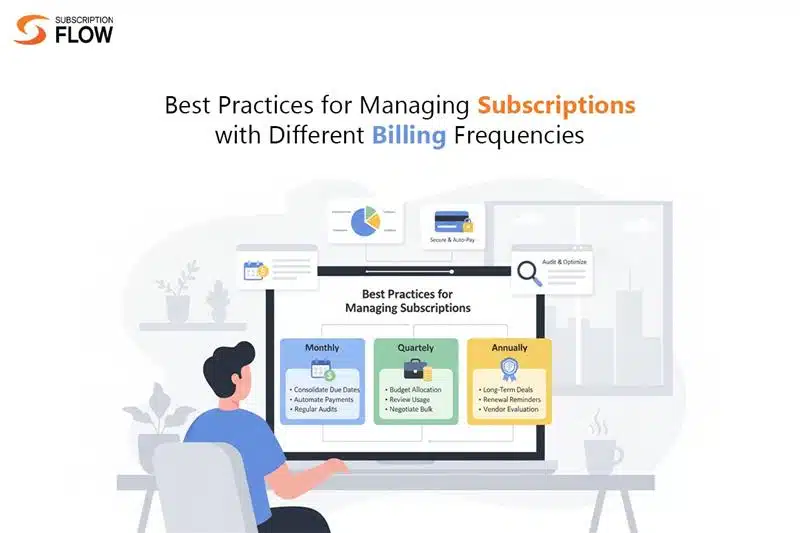
Best Practices for Managing Subscriptions with Different Billing Frequencies
Businesses always seek new strategies to generate steady income while retaining healthy customer relationships. To achieve both goals simultaneously, subscription-based pricing has emerged as an effective model. Such a model promises predictable revenue and a continuous engagement with customers rather than one-time transactions.
Subscription-based pricing is widely utilized by businesses in almost every field of life including SaaS tools, streaming platforms, meal kits, personal care products, magazines, and other e-commerce businesses etc. But one major query remains: what are the best practices for managing subscriptions with different billing frequencies?
There’s no universal rule for that. Managing subscriptions with different billing frequencies needs a thoughtful approach that maintains a balance between customer expectations and operational efficiency.
What is Subscription Billing Frequency?
Subscription billing frequency is how often a customer is charged for accessing a product or service. Daily, weekly, bi-weekly, monthly, and annually are most commonly utilised subscription billing frequencies worldwide.
Billing frequency is highly important as it impacts both the business and its customers. In the case of customers, it brings affordability and budgeting. Customers usually find frequent payments more convenient.
Large payments often come with the benefit of comparatively less charges. However, they also deduct a huge upfront deduction in a single transaction. For businesses, it can hinder cash flow and day-to-day operations.
Choosing the right billing frequency is not only a pricing decision but is an integral part of a subscription management strategy. The billing frequency you choose ultimately affects the perceived value of your product or service and will determine the complexity of billing operations once your business grows.
Common Subscription Billing Frequencies
Daily Subscription Billing
It is among the most frequent deductions and is usually utilized in markets where there is a short customer life. Advantages of daily subscription billing are getting rapid feedback on marketing and acquisition efforts. Additionally, businesses also get daily cash flow visibility through it.
Besides its advantages, there are some disadvantages too. Due to daily deductions, there’s high transaction fees which can erode margins. Moreover, there will be increased operational complexity.
It works best if there’s a usage-based service or an industry where consumers engage for shorter and more intense periods.

Weekly Subscription Billing
Weekly billing is usually for services that are physically utilized. Common examples of such products/services are meal kits, newspapers, and curated boxes, etc.
If you are switching to this subscription billing, payment will feel manageable for many customers. There will also be lower risks of payment defaults.
On the other hand, weekly deduction may feel higher in comparison to monthly or annual pricing. Additionally, it will also require frequent billing operations. Weekly billing will be effective for businesses when product delivery occurs on a predictable weekly cadence.
Biweekly Subscription Billing
In this option, subscription charges are deducted twice a week. It is rather less utilized as a billing option by companies as it creates complexity for both business and customers.
Challenges for biweekly subscription billing include payment alignment issues, accounting complexity, customer confusion, inconsistent revenue flow, proration complexity, and higher administrative overhead.
Keeping these complications in view, biweekly subscription billing is only utilized by businesses whose payroll or usage cycle aligns closely with it. Businesses such as temporary staffing and rentals, health and wellness, and curated boxes, etc., usually adopt it.
Monthly Subscription Billing
The most widely adopted billing frequency is monthly subscription billing. This is highly used in SaaS and digital services.
Switching to this model will make it easier for customers to understand the deduction mechanism and budget. Moreover, there will be predictable revenue without excessive transaction volume. It is also highly flexible for upgrades, downgrades, and proration.
One of the disadvantages of this billing frequency is that if monthly prices are perceived as too high, churn can increase.
Annual Subscription Billing
Businesses whose product life cycle is long and have strong customer retention usually choose annual subscription billing.
By choosing this model, businesses experience enhanced cash flow due to upfront revenue and minimal recurring billing administration. Additionally, long-term commitment of customers can be encouraged by incentivising more discounts.
Some of the risks that come with such a type of billing include high renewal churn, difficulty in adjusting, pricing mid-year, and delayed feedback on marketing efforts. To maximize the effectiveness of this model, businesses should give automated reminders and clear renewal alerts.
How to Choose the Best Billing Frequency for Your Subscription Business
There’s no one-size-fits-all answer to this query. However, businesses can consider several factors to decide which billing frequency will suit them better.
- Product/ Service Delivery Cycle: How frequently does the customer receive value?
- Product/ Service Usage Patterns: How common product/service is used (daily, occasionally, or less frequently)?
- Customer Lifetime: If the business’s targeted consumers are short-term, more frequent billing will be more suitable than for longer billing cycle.
- Price Sensitivity: If there are high subscription charges, they may need frequent billing cycles to reduce friction.
- Industry Expectations: There are different norms for different industries. For example, streaming industry usually follows monthly subscription billing.
Ways to Manage Subscription Billing Across All Frequencies
Here are some key ways to manage subscription billing across all frequencies.
Keep Pricing Simple and Transparent
Try to limit the number of billing options and make them as transparent as possible. If pricing is explained clearly, it significantly reduces the risk of cancellations.
Align Product Usage with Billing Frequency
Select billing schedules that align with the frequency of usage or advantages of your product for the customer. For instance, repetitive usage justifies a shorter billing cycle.
Support Easy Plan Changes
Enable customers to seamlessly modify their plans and switch to any billing frequency through automation. In this case, automated proration helps maintain equity in charges.
Keeping Track of Declined Payments and Retries
Monitor declined payments and retries with the help of automation. This approach will help to reduce loss of revenue for your business.
Monitor Subscription and Payment Data
You need to monitor churn and consistently analyse changing trends of revenue by keeping track of customer behaviour against different billing cycle frequencies with the help of real-time data and analytics.
Best Practice to Manage Billing Frequency is Automation
For businesses, automation is the key to success, irrespective of the billing frequency choice. With automation, businesses can ensure hassle-free payment collection and help reduce errors, missed invoices, and operational problems that occur due to manual integration.
Automation enables businesses to scale efficiently. When businesses grow, the increased number of subscribers makes it difficult to track billing dates, retries, and changes in payment or subscription plans manually. With automated subscription platforms, functions like recurring charges, trial conversions, upgrades, and downgrades are handled with precision so that the workforce can focus on growth instead of managing spreadsheets.
Beyond just managing billing, automated software also helps improve customer experience. This is done through consistent and precise deductions, automatic reminders before renewals, and streamlined plan adjustments.
Hence, your subscription billing should be designed considering both the business philosophy and the customers in mind. Different frequency options are offered for a reason, as each one of them is designed considering the needs of various businesses and customer expectations. But what matters more is formulating a structure that stays clear, adaptable, and easy to manage as subscriptions scale.
POPULAR POSTS



Think Business!
Related Posts
 Why B2B Subscription and Billing Management Software is Now Needed More Than Ever
 Switch to SaaS Subscription Software for Multifunctioning
- Track, Manage, and Optimize Subscriptions with Subscription Tracking Software
- Where is the World headed Technology Predictions for 2025
- How To Migrate Data from QuickFill to Modern Subscription Management System