

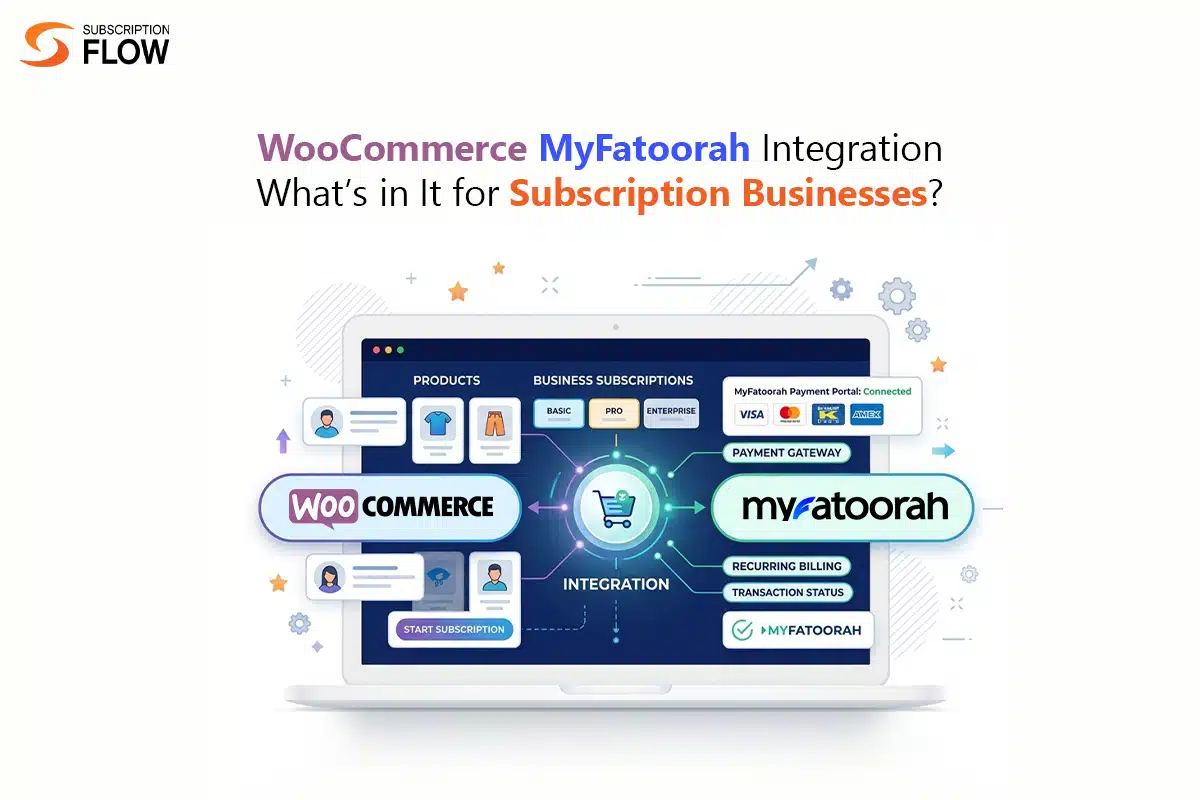
WooCommerce MyFatoorah Integration: What’s in It for Subscription Businesses?
When WooCommerce and MyFatoorah are combined together, it gives businesses a strong foundation to start selling in MENA. WooCommerce handles the storefront, while MyFatoorah manages payment processing. Their combo is advantageous in MENA because MyFatoorah primarily works there. It helps merchants localize payments for Middle Eastern customers.
While WooCommerce MyFatoorah integration is powerful, it’s not very efficient for subscription businesses. The reason is that subscription businesses go beyond one-time payments. And MyFatoorah can’t deal with recurring billing or subscription lifecycle complexity on its own.
This limitation hinders growth for subscription businesses, as they have to carry out most operations manually. The only way to utilize MyFatoorah and access subscription management at the same time is through a dedicated subscription management software. Let’s dive into detail.
Why WooCommerce MyFatoorah Integration is Appealing
WooCommerce and MyFatoorah prepare businesses for early success in the Gulf countries. Their integration provides sellers with a storefront and payment processing. This payment setup makes one-time payments effortless.
WooCommerce is generally considered a good online selling platform. It allows sellers to build their stores without code, and customize storefronts the way they want. MyFatoorah, on the other hand, specializes in payment processing in MENA. It is supported by the local banking networks, and that increases the chances of payment approval for merchants.
Using international payment gateways in MENA is understandable, but it can lower payment approval chances. This is because the other gateways aren’t as well-connected with the local payment network as MyFatoorah.
Another MyFatoorah specialty is that it can localize payments for Gulf customers. It does that by supporting a number of local payment methods in each Gulf country. Customers can choose any method to pay at checkout, and can also pay in their own currency.
However, these benefits are primarily for one-time sales businesses. This integration doesn’t cover the needs of those with a recurring revenue model. We’ll discuss why in the next section.
MyFatoorah Can’t Manage WooCommerce Subscriptions
MyFatoorah is a good payment gateway, not a subscription management system. Even when combined with WooCommerce, payment processing is all it does. So why MyFatoorah can’t help you with managing subscriptions? This is the answer:
No native subscription engine
MyFatoorah doesn’t have the capability of charging the customers itself. Either customers fill the checkout form, or click on payment links to pay. When these actions are linked to MyFatoorah, they trigger it to process the customer’s payment. But there is no possibility of automatic payments. That’s because automatic payments require a system that initiates charges again and again, and MyFatoorah doesn’t do that.

Limited support for advanced pricing models
Merchants can process only basic charges with MyFatoorah. Basic means fixed charges here. Since merchants have to generate payment links manually, it is easier for them to process basic charges. Because advanced charges, like tiered-based pricing, require more complicated calculations. They just add to the admin’s manual workload, making pricing evolution difficult.
Manual subscription lifecycle management
With MyFatoorah WooCommerce setup, subscription management is manual altogether. There is no magic subscription layer working behind the scenes. This is what manual subscription management looks like:
- Manual subscription activation and customer data entry in spreadsheet
- Manual renewal and customer data update
- Slow subscription plan upgrades and downgrades
- Error-prone billing changes and slow invoice generation
Weak payment failure handling
MyFatoorah payment gateway doesn’t help with payment failures. It can only ensure that payment success rate in MENA is high. But if payments fail due to other reasons, like fund shortage, it can’t initiate retries to recover them. The same goes for other dunning techniques. They aren’t supported by the gateway natively.
Lack of subscription-level analytics
Merchants can check all their processed payments in MyFatoorah. They can access their payment history there, but can’t access other subscription-level metrics. For example, they can’t monitor their revenue (to date, or at any point in time). They also can’t measure each customer’s lifetime value or their churn percentage. This highly limits the merchant’s decision making.
How Does This Impact WooCommerce Businesses
If subscription stores keep relying on WooCommerce and MyFatoorah alone, this is what it costs them:
Operational inefficiency
First, they need to put in manual work. Because their subscriptions can’t be managed automatically. Second, they have to rely on multiple external tools to get their operations right. These tools can be as basic as Excel for storing customer data. There is no platform where everything can be managed at the same time.
Poor customer experience
Customer experience suffers as customers don’t get instant plan changes as they expect. An instant plan change involves quick charge adjustment and access to new plan. But if there is no automation, each plan change request becomes just another support ticket for the admin to resolve manually. Due to this, merchants fail to execute customer requests when engagement is high.
Lost revenue
Merchants are more likely to lose revenue to failed payments and customer churn. Because there’s no dunning mechanism in place, failed payments are a big threat to income stability.
Inability to scale subscriptions
Manual processes work only to some extent. Early-stage subscription businesses may not find operations difficult. But as more customers enter the picture, billing and subscription management become a nightmare. They take most of the merchant’s time, hindering actual growth.
How SubscriptionFlow Solves This Problem
SubscriptionFlow complements WooCommerce and MyFatoorah by becoming the missing layer in their setup. This missing layer is subscription management. In other words, SubscriptionFlow ties WooCommerce and MyFatoorah together through subscription management.
First, it offers a plug-and-play integration with WooCommerce. And second, it supports MyFatoorah as a payment gateway. This means that if merchants link WooCommerce with SubscriptionFlow first, they can easily connect their store to MyFatoorah from within SubscriptionFlow.
This makes the integration easier, and the systems more close-knit. Your WooCommerce customers are given a smooth checkout experience, and this checkout is backed by SubscriptionFlow. At checkout, these two things happen:
- Customers’ payments are processed through MyFatoorah
- Customers’ checkout details are stored by SubscriptionFlow
Successful checkout completion activates a customer’s subscription in SubscriptionFlow.
What Your Ideal Subscription Payment Setup Looks Like
When SubscriptionFlow is added to the WooCommerce MyFatoorah mix, it unlocks automatic subscription management for merchants. This is what your subscription-oriented payment setup looks like:
Dedicated subscription engine
Subscription payments are charged to customers on their own. These recurring payments follow set schedules, and are processed right on time. Merchants don’t need to lift a finger to renew plans. This is because plan renewal takes place automatically as soon as a payment succeeds.
Advanced pricing models
SubscriptionFlow natively supports advanced pricing models that are based on usage or tiers. It lets merchants adopt any billing model they want, and then calculates charges according to the adopted model. The final billing amount is then processed through MyFatoorah. Because billing calculations don’t have to be done manually, it becomes easier for sellers to experiment with new pricing models.
Automated lifecycle management
All the plan changes and pauses become instant for customers. They don’t need to wait for lengthy procedures to access their new plan. Just one click, and their bill is updated, and they are given access to the new plan.
Improved revenue recovery
Payment retries become possible. Merchants no longer lose revenue because of stubborn payment failures. They also don’t need to resolve each and every failure through manual communication. As the very first step, they can automatically retry payments. Retries have higher payment recovery chances. Then, merchants can combine retries with other dunning strategies to fetch payments faster.
Actionable insights
Merchants are given subscription-level insights that WooCommerce or MyFatoorah don’t provide them with. They can view their MRR, most and least profitable plans, average revenue per user, churn rate, and many other valuable metrics.
No need to replace existing payment gateway
Perhaps the best thing about this setup is that it doesn’t involve any building from scratch. SubscriptionFlow makes integrations easier and faster. What’s more, it doesn’t ask you to replace MyFatoorah with another gateway to access subscription payments. It just makes subscription payments possible through MyFatoorah. This especially facilitates businesses selling in MENA.
Do you also use or aim to use MyFatoorah with WooCommerce? Make your integration easier with SubscriptionFlow, while also adding subscription management to your tech stack.

POPULAR POSTS



Think Business!
Related Posts
 How to Maximize Your Product-Led Growth (PLG)
- The Game-Changing AI-based ChatGPT—Revolutionizing the SaaS Marketing, Sales, and Customer Services
- Data-Driven Strategies for Achieving Customer Success as B2B Business
- Quote-to-Cash Automation with SubscriptionFlow and Fortnox
- Managing Subscriptions with Xero or NetSuite: Which One Integrates Better?