

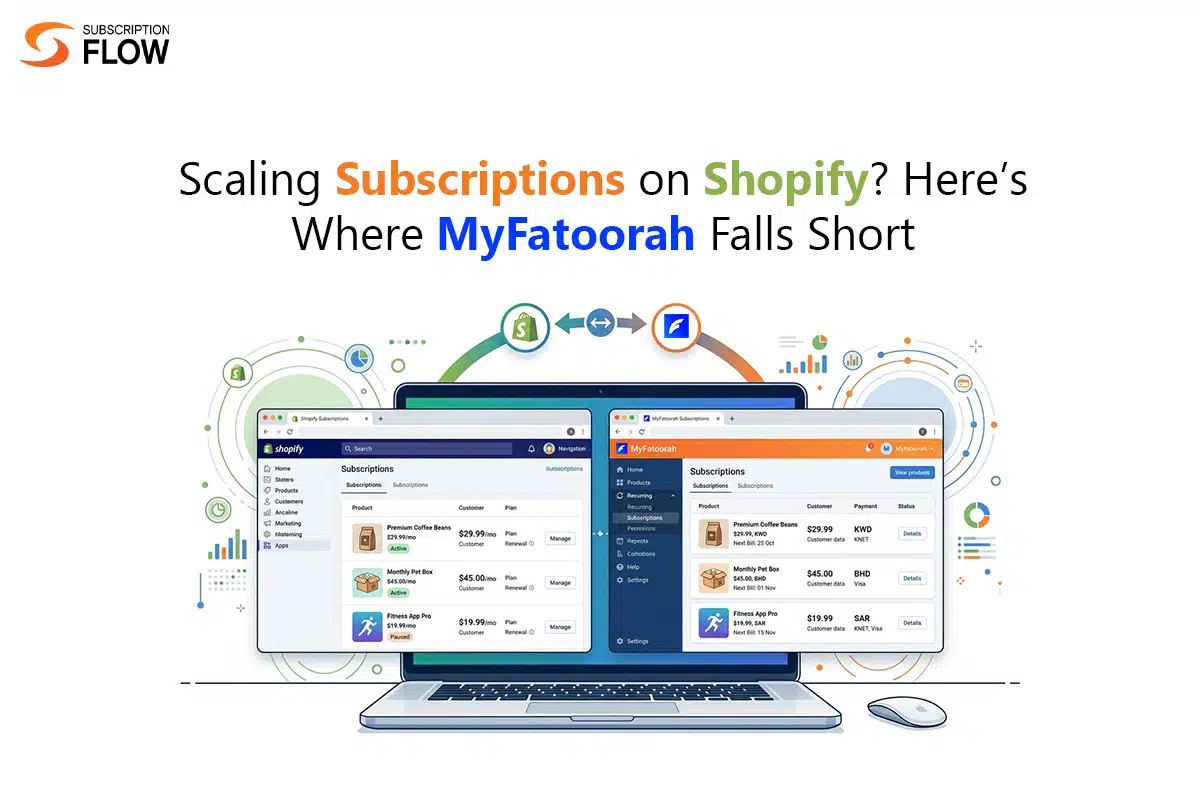
Scaling Subscriptions on Shopify? Here’s Where MyFatoorah Falls Short
Shopify makes it incredibly easy to launch an online store. When it is paired with MyFatoorah, the renowned payment gateway operating in MENA, it opens up many revenue opportunities for merchants. This combination gives merchants access to local payment options that they can provide their Middle Eastern customers with.
However, this setup works well only for one-time transactions or when you have a negligible subscription volume. As soon as the number of your subscribers grows, the game changes. Recurring billing and customer lifecycle management introduce a level of complexity that can’t be taken care of manually.
As a result, Shopify stores begin to struggle with even simple subscription payments. Let’s explore in detail why this happens, where MyFatoorah falls short, and what can be the most suitable solution to this.
Why Businesses Choose Shopify + MyFatoorah
Early-stage businesses gain a lot of benefits from the combination of Shopify and MyFatoorah:
Quick setup for online stores
With Shopify, setting up an online store remains no difficult matter. Users don’t need any technical expertise to start selling. MyFatoorah makes the selling process even more easy by allowing merchants to receive payments from the Middle East almost instantly.
Strong local payment method support
KNET, MADA, Benefit etc. are some from the wide range of local payment options that MyFatoorah supports. These payment methods cater to multiple countries in the Gulf region, so that customers in each country can have a localized payment experience.
Suitable for single purchases
This payment setup is really seamless when it comes to single payments. The customers buy your product and make payment using any method supported by MyFatoorah to get their order fulfilled. And that’s where it ends, as there’s no recurring billing commitment involved.
Early-stage convenience
Early-stage businesses benefit from this payment setup the most, as they have a low subscription volume which can also be managed manually. However, when scaling enters the picture, the processes that seemed simple at first start spiraling out of control. And the Shopify-MyFatoorah combination, even though it is great at first, can’t handle subscriptions and recurring payments on its own.
The Shift from Simple Payments to Subscription Complexity
Simple payments become complicated to handle when there’s too many of them. Subscriptions demand repeat billing, which means that even for a single customer there are many payment cycles. So when customer volume increases, the number of payment cycles increases too, making it difficult to bill manually.
When Shopify stores move from one-time sales to subscriptions, these are the three main changes that occur:

One-time sales change to recurring revenue
In a subscription setting, customer relationships become ongoing. Merchants have the responsibility of delivering products or services to their customers on a repeat basis, in exchange for consistent payments.
So each customer generates revenue multiple times which creates long-term value. To get recurring billing cycles right, merchants need consistent billing accuracy which isn’t possible through manual calculations.
There’s an increasing need for automation
Because manual processes become insufficient, the need for automation becomes apparent. There are many pricing models to take care of, and billing cycles also become more complex. They may involve plan and hence invoice changes. These changes need to be taken care of automatically so that plans can be adjusted without friction.
Subscription cycles become hard to manage manually
Relying on manual efforts means keeping, updating and tracking subscribers’ data in spreadsheets. The more subscribers there are, the more data that needs to be handled, making errors more likely to occur. When billing errors increase, customer experience naturally suffers.
Where MyFatoorah Falls Short for Subscriptions
MyFatoorah isn’t your solution to the subscription payment and management challenges. It’s simply a gateway that facilitates payment processing, so it can’t take charge of more than that. As a result, businesses face these shortcomings:
1. No recurring payment functionality built in
As MyFatoorah is not a subscription billing service, it lacks any kind of recurring billing functionalities. It can’t process payments on its own or convert them into recurring payments. It just becomes a gateway for one-time payments. For recurring payment operations, a dedicated system is needed.
2. Billing model limitations
Today’s merchants need much more than a simple pricing structure. An online store managed using Shopify can introduce various subscription pricing options, as well as pay-as-you-go services or volume pricing structures. None of these features can be supported by MyFatoorah, making businesses unable to experiment or evolve their pricing models.
3. Inefficient payment failure handling
Failed payments can’t be avoided, but the way you handle them matters a lot. Because MyFatoorah doesn’t have built-in payment retry features, merchants are stuck with manual solutions. That involves back and forth conversation with customers where they have to be persuaded to pay their dues quickly. This is as inefficient as it sounds.
4. Manual subscription lifecycle management
Lifecycle management includes every process that takes place from when a subscription starts to when it ends. Subscriptions need to be registered and activated, renewed, paused or changed (if the users wish that), and cancelled or suspended. Each of these processes require changes in billing too. Without automated subscription management, teams have to handle these tasks manually.
5. Lack of subscription analytics
Growth depends on visibility. Business owners learn from their past mistakes, but only if they can access their performance. MyFatoorah only provides insights into the payment processes. Merchants can’t view their subscription metrics or revenue (collected or pending). This makes improvement difficult, and decisions turn into guesswork.
What a Scalable Subscription Setup Should Look Like
A successful subscription setup includes many core features that are not supported by Shopify or MyFatoorah alone.
Automatic recurring billing
The most important thing for subscription-based stores is that they need to have error-free and automatic billing cycles. Otherwise, handling customer payments manually can become quite a headache. Modern billing software such as SubscriptionFlow makes billing effortless. It allows billing on multiple schedules and frequencies.
Flexible pricing models
Flexible pricing models are important to accommodate products and plans of various types. Not every product you offer fits flat-rate billing.
Smart payment recovery
Payment recovery becomes smart with intelligent customer communication, automatic payment retries and efficient dunning tools. Store owners can use payment retries to re-attempt charges if their initial charge attempt fails. Moreover, they can update customers on payment failure automatically by setting up dunning emails, and ask them to resolve their payment issues as soon as possible.
Real-time analytics
Merchants should have a 360-degree view of their operations: how much cash flow is coming in, what are their revenue patterns, how much revenue they can expect this month, which is their most profitable plan, which of their customers are non-responsive and at the risk of churn, etc. Real-time analytics answer all these questions for them.
Seamless Shopify integration
By now, it’s apparent that Shopify business owners need a subscription management software to grow their sales. But which software to go for exactly? They should choose a software that can integrate with Shopify with ease, as well as connect them with MyFatoorah just as easily. Easy integrations ensure smoother frontend and backend operations.
How SubscriptionFlow Fills the Gap
SubscriptionFlow doesn’t ask you to replace MyFatoorah with another payment gateway. It becomes the middleman that links Shopify and MyFatoorah together while handling your blackened subscription tasks. This software is perfect for your growing Shopify business because:
It is built for subscription complexity
SubscriptionFlow can’t only manage complicated subscriptions, it is especially built for them. Meaning, it equips you with all those powerful features that are needed for smooth-running billing cycles, customer lifecycle automation and advanced pricing models.
Enables flexibility and growth
Merchants can experiment with different kinds of pricing models, and update their prices as their needs change. They can also adapt to changing customer needs, for example, if customers wish to change their subscription plan, pause their plan or require a refund. Furthermore, merchants can also use SubscriptionFlow to set up and sell product bundles.
Works with Shopify and MyFatoorah
This platform works smoothly with Shopify and MyFatoorah, letting you keep your original payment processor. It supports recurring billing through MyFatoorah, and lets customers choose from all the payment options that MyFatoorah supports, so that your customers in MENA still get localized billing experiences.
Removes operational bottlenecks
As subscription lifecycle management is automated, your teams aren’t burdened by routine tasks. Customers also enjoy instant services, such as payment processing, plan and profile changes, because manual teams aren’t involved, and changes are registered by the system automatically. Your revenue also becomes trackable and scalable.
Starting your business with Shopify and MyFatoorah is easy. However, as your business grows, dedicated subscription management becomes a must-have. Complete your payment setup with SubscriptionFlow and enjoy seamless subscription operations in MENA.

POPULAR POSTS



Think Business!
Related Posts
 Venmo vs Zelle: Which Platform is Superior for Small Businesses
- Leveraging Inbound Marketing for SaaS Price Optimization: Strategize and Optimize Your SaaS Pricing
- How to Maximize Your Product-Led Growth (PLG)
- Power Your Shopify Subscriptions with Ifthenpay Using SubscriptionFlow
- Scaling Online Payments with Authorize.net and Webflow Integration