
Why Choose Paystack WebFlow Integration for e-commerce Business
eCommerce business owners know the struggles of selling subscriptions online. No matter how well-designed their storefront is, it’s only enough for showcasing products, not enough for selling them smoothly. To offer a good subscription experience, merchants need to make sure that every step of their customer’s journey is seamless: from cart to checkout, payment to renewal, and beyond.
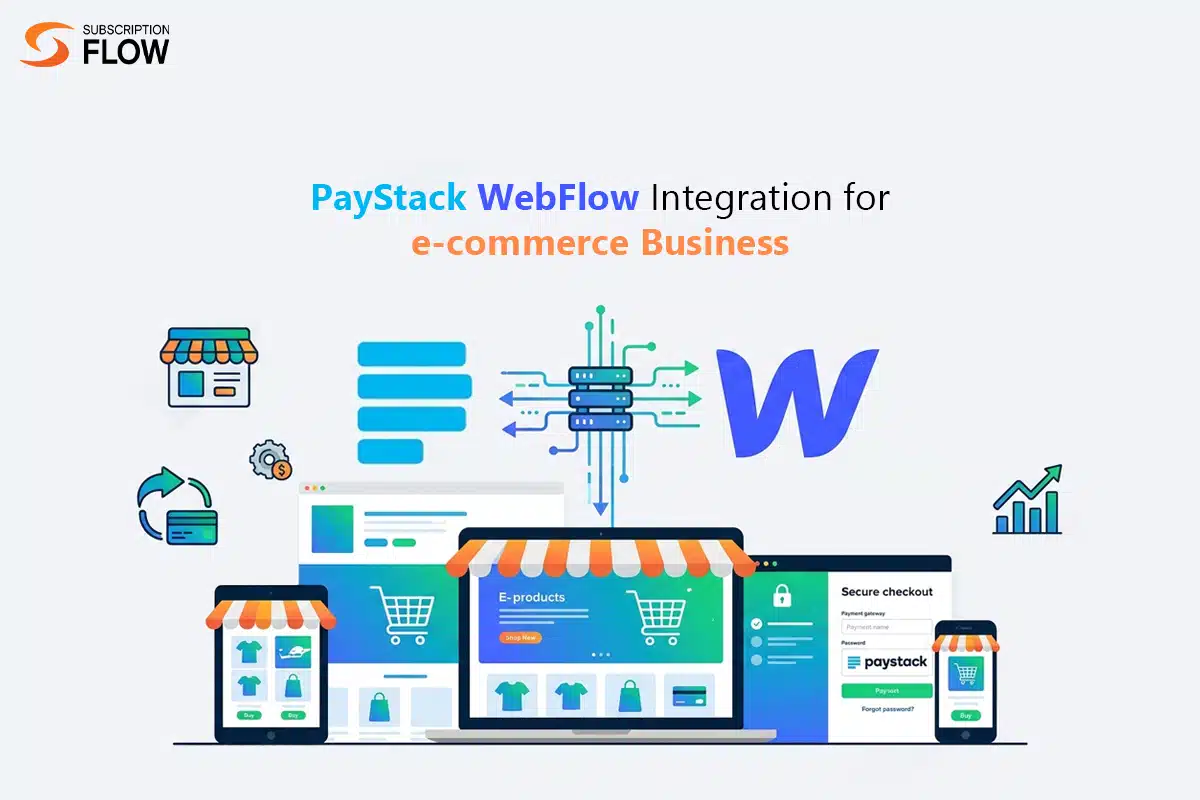
WebFlow is a store designer that lets merchants build creative stores with ease. But they still need to pair their store with a payment processing and subscription management solution to complete their stack. That’s precisely where Paystack enters. With the help of SubscriptionFlow, merchants get to connect WebFlow with Paystack to access their dream subscription setup.
Challenges of Managing Payments in WebFlow Stores
WebFlow is a great store-builder option for those who want to set up shops faster and more flexibly. But the main challenge arises when payments come into the equation. WebFlow can’t process payments itself, it requires a payment gateway to be paired with it. Although WebFlow provides some native gateway integrations, it still lacks significant flexibility in the following aspects:
- Limited native payment flexibility
Many ecommerce stores operate in different countries. They naturally need options that cater to their international customers as well. With WebFlow, they don’t get the global payment flexibility they need. The face a shortage of payment options, regional payment gateways and international currencies.
- Managing recurring payments
WebFlow offers a basic commerce setup. It is more suited to one-time transactions. Businesses that sell subscriptions in any form (memberships, replenishment, subscription boxes or SaaS products) have recurring billing needs. They need a mechanism to auto-charge payments on a repeat basis, and to create invoices for each recurring charge.
- Payment visibility and reporting
To gauge the financial performance of your business, you need organized and accurate payment data. Without a centralized payment system, merchants have to track data manually. For example, they need to check their payment gateway dashboard to see who has paid and who hasn’t. Then, they need to update their spreadsheet database accordingly. The same needs to be done for reconciling transactions, tracking refunds, and reviewing payment histories.
Overview of Paystack for eCommerce Payments
Paystack makes payment processing simple, especially for merchants in South Africa. It differentiates itself from the other gateways due to features like:
Africa-centric coverage: Paystack is deeply integrated with Africa’s local payment ecosystem. It supports many local options like Nigerian cards, pan-African bank transfers, Ghanian mobile money, etc. Merchants find it easier to use in Africa compared to global options like PayPal, as this gateway is more familiar with the local payment rails.
Global acceptance: While it is built Africa-first, it can be used to accept payments from the other countries too. So it offers flexibility to the merchants that operate primarily in Africa but have a global customer base as well.
Easy integration: The gateway is popular for its easy integration capabilities with ecommerce sites such as WebFlow and Shopify. It is also unique in that it supports native checkout, meaning users are not redirected away from your store.

Security: It offers you a security level that is comparable to that of global payment gateways; features include tokenization of cards and fraud protection.
These features make Paystack a practical choice for ecommerce stores. However, the problem of subscription billing still remains which will be addressed shortly.
Why Businesses Use WebFlow for eCommerce
Since we talked about why Paystack is a good choice for ecommerce payments, let’s highlight why merchants like to use WebFlow in the first place as well. This way, we can understand the joint power of both the solutions better.
WebFlow gives store owners more creative freedom to set up their shops. They can design their storefronts more freely and also more easily as they don’t need any developer expertise for that.
Online businesses like WebFlow because of its:
Design flexibility: WebFlow allows more flexible designing than most ecommerce sites. As a result, businesses can build very customizable, unique-functioning stores.
Fast website performance: Store pages are fast-loading, making them super-responsive. This is helpful in increasing conversion, otherwise slower pages annoy customers and become an obstacle between customer and payment completion.
Built-in CMS capabilities: WebFlow’s CMS helps businesses organize their store content like product catalogs and blogs for marketing etc. They can manage all content without reliance on a third-party CMS tool.
Greater control over customer experience: Merchants have full branding freedom, as they don’t have to follow strict templates. They can even design their shopping flows as they like, letting customers experience more personalized purchases.
Why Use Paystack and WebFlow Together
WebFlow is made for handling storefronts and customers’ shopping cart experience. The checkout and payment experience responsibility falls onto payment gateways like Paystack. By using these two together, WebFlow stores can build a modern payment-enabled platform.
They can:
Accept payments using native checkout
Customers can complete their purchases within the store. They are not redirected to another page, and they are also not asked to pay through payment links shared by email, or some other manual method. This speeds up purchases.
Expand payment accessibility
Customers can be offered multiple payment channels for payment. Since different customers prefer different ways to pay, it makes sense to offer a variety of channels like debit cards, bank transfers, mobile wallets and other Africa-specific payment options.
Reduce manual work
Because payments can be collected through checkout automatically, merchants don’t need to ask customers for payment personally. They can allow customers to choose from the various payment methods supported by Paystack to pay automatically.
Scale
Paystack can take care of high payment volumes with ease, so stores can onboard more buyers with ease as well. Their payment processor doesn’t break and works smoothly for hundreds of customers at the same time.
Role of SubscriptionFlow in the Integration
As seen above, even if merchants connect their WebFlow store to Paystack, it doesn’t do anything to help subscription payments and management. To fill that gap, SubscriptionFlow steps in. It connects WebFlow and Paystack in such a way that enables subscription management as well.
As customers purchase from your store and payments are processed by Paystack, SubscriptionFlow adds these core subscription management functionalities to your setup:
Automatic billing cycles
Paystack simply processes a payment when it is triggered to do so. Therefore, there needs to be a system to trigger the gateway to pull recurring payments from customer accounts. SubscriptionFlow becomes that system, allowing recurring payments on an automatic basis.
Management of customer accounts
Customer profiles being managed in spreadsheets? Not anymore. SubscriptionFlow lets you keep a safe and comprehensive customer database. In this database, all the customer payment history, subscription status, payment status, billing information, etc. is present and is updated constantly as their lifecycles progress.
Handling of billing changes
Your customers can change their plans easily, no manual permissions or bill changes involved. SubscriptionFlow makes plan change one-click and instant, and prorates customer’s charges according to the new plan if needed. So the customer instantly receives the new invoice, or is charged the new amount directly.
Generation of invoices
Another benefit of using SubscriptionFlow with your WebFlow-Paystack setup is that you don’t have to create invoices by hand. All invoices are system-generated and automatic, and are even sent to customers on fixed schedules automatically.
Complete financial reports
Each and every crucial business metric can be accessed from SubscriptionFlow dashboard, and tracked in real time. Merchants can check their revenue performance, payment collection trends, and customer activity all in the same place.
What Does Paystack, WebFlow and SubscriptionFlow Enable
The combined synergy of Paystack, WebFlow and SubscriptionFlow enables everything that a subscription-selling merchant may need. Merchants get a smooth storefront through WebFlow, a secure payment processer i.e. Paystack and a full-fledged subscription billing solution i.e. SubscriptionFlow. These three platforms power a recurring payment ecosystem that:
Allows frictionless checkout
Checkout is made smoother than ever for customers. They only ever need to fill in their payment details on the checkout page once. The rest of their subscription experience is checkout-free due to automatic renewals. So there’s zero effort your customers have to put in to keep the subscription going.
Automates subscription management
Every stage of a subscription lifecycle is made automatic. Whether it’s renewals, payment retries, subscription status updates or invoices, no task requires manual involvement.
Gives flexible payment options
Customers can get a variety of payment methods to choose from, all of which Paystack supports. Each customer can choose what they prefer, lowering entry friction.
Centralizes customer payment data
Customer payment data doesn’t need to be tracked in the payment gateway dashboard separately. All payment data is accessible through SubscriptionFlow, and is continuously updated for consistency and accuracy. Merchants can view past and pending bills and customer payment behavior patterns in general among other things.
Paystack and WebFlow are great together for ecommerce payments, and are made even greater with SubscriptionFlow. Integrate them together using SubscriptionFlow and get effortless subscription management for your store.

POPULAR POSTS


Think Business!
Related Posts
 Recurring vs Reoccurring Revenue: What are the Key Differences
- How to Come Up with an Ultimate SaaS Pricing Strategy That Can Instantly Increase the Flow of Revenue Stream
- Webflow vs Squarespace vs Wix: Choosing the Best Website Builder for Your Ecommerce Platform
- Seat Based Pricing: Boosting Revenue One Seat at a Time
- Foster The Relationship With Clients Through Connection Building For Relation-Based Selling