
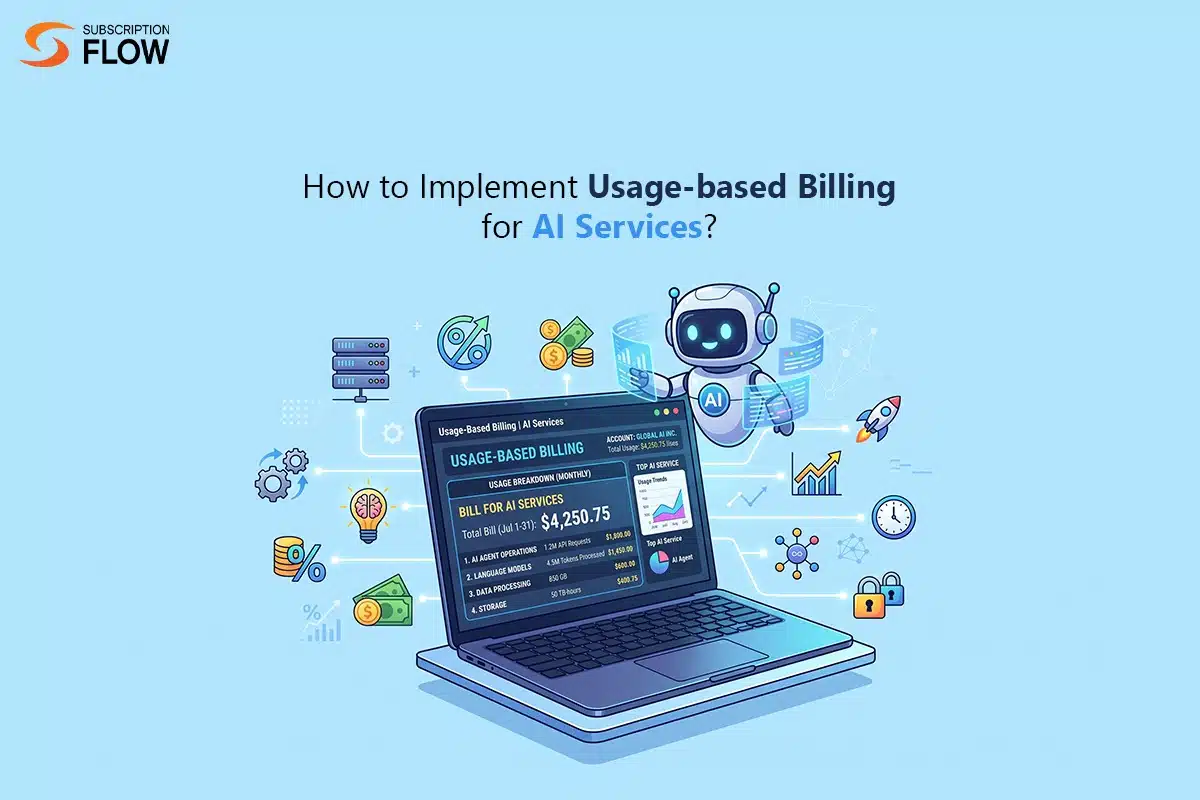
How to Implement Usage-based Billing for AI Services?
AI products work differently from traditional softwares. The difference lies in how aggressively customers consume AI. One may send three API calls one day and three million the next. Token consumption can spike unpredictably when a user runs a complex agentic workflow and computes costs scale directly with how much a model is actually used. Flat-rate subscriptions, which have been working well for SaaS for the last two decades, simply don’t map onto this reality.
That’s why usage-based billing has become the most suitable monetization model for AI companies. This helps companies charge customers on the basis of the value they extract, such as tokens, API calls, compute minutes, or documents. But implementing usage-based billing is harder than it sounds. To execute it successfully, companies need a reliable way to track customer usage and convert it into accurate, easy-to-understand invoices while maintaining predictability and invoice transparency.
Common Usage Metrics
Before implementing usage-based billing, you need to first establish the usage metrics. These metrics are decided on the basis of how you define usage and what actually drives your costs. Commonly tracked metrics are:
API Calls or Requests
This is commonly used where deterministic AI actions are involved. This works well when the computational payload is predictable per call. It is the simplest metric, useful for tools where each call carries roughly similar cost.
Tokens Processed
The standard metric for LLM-based products is processed tokens since input and output tokens map closely to compute cost. Many providers separate input tokens from output tokens, since generation is typically more expensive than ingestion.
Compute Time or GPU Seconds
Common for fine-tuning, training jobs, or heavier inference workloads where duration matters more than request count. This is preferable if you host open-source models on your own infrastructure.
Actions or Outcomes
Some AI products bill per completed task, such as the number of documents summarized, per image generated, or per lead scored, rather than per underlying technical unit, since this maps more directly to customer-perceived value.
Seats Plus Usage (Hybrid Metric)
Many B2B AI tools combine a per-seat base fee with usage overages, especially when the product has both a collaborative workspace element and an AI feature layer.
Selecting the right metric is a strategic decision, not just a technical one. It should be easy for customers to understand, predictable enough that they can budget for it, and closely correlated with your actual infrastructure costs.
Core Pricing Models for AI Services
After finalizing the usage metrics, you need to decide how to package that usage into a price. Most common pricing models for consumption monetization are:

Pay-as-you-go
Customers are charged purely based on consumption, with no upfront commitment. This is common for API-first products (LLM inference, embedding APIs), where usage can vary wildly month to month. It’s the most transparent model and the easiest to understand, but it can make revenue harder to forecast and gives customers less price certainty.
Tiered Pricing
It involves creating different tiers such as basic, plus, premium, etc. Customers map their usage and pay for their preferred tier. This brings predictability for both business and customers. B2B SaaS companies with an AI layer usually adopt this model.
Credit/ Prepaid Model
In this model, bundles of credits are purchased upfront. Customers then align their usage as per the number of credits available. This pricing model is preferred by companies with image/video generation products. It helps to avoid aggressive AI usage and control users’ spending.
Hybrid Model
Involving more than one pricing model to monetize consumption refers to the hybrid model. It combines a base subscription fee and adds usage-based coverage on top. Most enterprise AI products are priced using this model, as it helps companies to establish a predictable revenue while still scaling with consumption.
There’s no one-size-fits-all pricing model for AI services. The choice of pricing model is influenced by the customer base, cost structure, and how much you prefer predictable revenue in your business.
Step-by-Step Implementation for Setting Up Usage-Billing
To successfully implement usage-based billing, there’s a need for careful architectural design.
Define Your Usage Metric
Select the defining metric that aligns with your computational costs and user value. Avoid overly complex multi-variable metrics early on. Pick one or two clear metrics that are easy for customers to understand.
Set Up Real-Time Metering
This is the technical foundation of usage-based billing. Every billable event including an API call, token processed, and action completed, needs to be captured, timestamped, attributed to the correct customer/ account, and stored reliably.
A metering system typically needs:
- Event-level granularity: Capture raw events rather than pre-aggregated totals so you can audit, dispute, and re-aggregate as pricing logic changes.
- Prevent duplicate charges: Internet disruptions and retry attempts shouldn’t result in customers being charged twice. Give each usage event a unique ID so your system can recognize and ignore duplicates.
- Track usage in real time: Customers want to see their usage as it happens. Your metering should update usage data almost instantly instead of processing everything at the end of the month.
- Durability: Every usage event represents billable activity, so losing it can mean lost revenue. Instead of relying only on temporary in-memory counters, store usage events in a durable event stream so they remain safe even if a service crashes.
Separate Metering From Pricing Logic
Your pricing logic should not be trapped in the product code. This means that your core application should only care about metering. The raw event stream should be dispatched to an external billing engine that handles the rating. This separation enables product managers to adjust pricing tiers or launch promos without being forced to deploy code changes.
Design Your Billing Plans
Define your pricing model, such as pay-as-you-go, tiered pricing, credit, volume-based, or hybrid, etc. Clear billing plans are highly significant as it helps companies to align costs with revenue, lowers the barrier to entry, enhances customer trust, and enables cost containment.
Onboard Customers to Plans
Every customer needs to be explicitly assigned to a plan, and that assignment needs to be easy to change as they grow. Use a system that supports self-serve plan selection and upgrades for smaller customers, offers custom contract terms for enterprise accounts, and implements clear proration logic when a customer switches plans mid-cycle.
Auto-Generate Invoices
After a customer’s billing cycle ends, the billing engine locks the usage aggregations for that period, converts the raw counts into a line-item financial payload, applies relevant regional taxes, and generates the final invoice, which then automatically charges the credit card on file via your integrated payment gateway.
Handle Edge Cases
In some cases, usage-based billing also involves:
- Mid-cycle upgrades/downgrades: Prorate both the base fee and any included usage allotment.
- Refunds and credits: Build a clear process for issuing goodwill credits or correcting metering errors without manual database edits.
- Usage spikes: Decide whether to hard-cap usage, soft-cap with notifications, or bill through with no limit, and make sure customers know which policy applies to them.
- Failed or disputed events: Have an audit trail so you can explain any charge on a customer’s invoice down to the individual event level.
- Currency and tax handling: Usage-based billing across multiple regions adds complexity to tax calculation, since taxable amounts change every billing cycle rather than being fixed.
Best Practices for AI Consumption Monetization
To successfully implement usage-based billing without alienating customers, adhere to these principles:
Maintain Absolute Transparency
The primary reason for churn in usage-based pricing is bill shock. If a customer receives an unexpectedly high invoice at the end of the month without warning, you lose their trust. Provide real-time, customer-facing dashboards showing exactly how many tokens or credits they have consumed to date, paired with an estimated projection of their end-of-month invoice based on current usage velocity.
Decouple Data Tracking to Prevent Duplicate Billing
Network drops, database timeouts, and application crashes happen. If your billing endpoint is down, your core AI features must not break. Ensure your metering ingestion layer is completely decoupled from your main inference loops. Use unique event ids for every event to guarantee idempotency, meaning that even if a network retry delivers the exact same usage event three times to your billing, it is only counted and rated once.
Set Hard Guardrails and Spending Limits
Allow users to set spending limits or hard ceilings on their accounts. This control gives your customers the confidence to scale up usage without fearing unbounded financial exposure. You should also notify customers as they approach plan limits so they can limit usage instantly.
Implement Robust Metering Infrastructure
Precise metering lays the foundation for success. Errors in tracking can cascade into billable revenue or customer disputes. Implement robust metering that streams usage data into your billing platform with minimal latency. Moreover, ensure your system can manage massive event volumes without data loss or lag.
How SubscriptionFlow Automates AI Consumption Tracking
SubscriptionFlow provides a purpose-built infrastructure designed to handle the scale, elasticity, and complexity involved in AI monetization.
Built-In Real-Time Tracking
SubscriptionFlow offers a robust billing engine designed to process thousands of distinct consumption events per second. You simply stream your raw token counts, credit deductions, or GPU runtimes directly via our secure API. The system handles deduplication, high-performance queuing, and accurate chronological aggregation automatically.
Flexible Plan Builder
SubscriptionFlow supports a variety of pricing plans, including pay-as-you-go, tiered, volume-based, prepaid, and hybrid, etc. Configure your preferred plan through a visual interface, without barcoding rates into your application. Additionally, you can spin up new experiments, run promotions, and adjust tier thresholds instantly without any alteration.
Automated Invoicing
Invoices are generated automatically based on real usage data, removing manual billing work and reducing disputes. SubscriptionFlow continuously updates each account’s running balance. When a billing period closes, it compiles historical usage into an updated invoice, interfaces seamlessly with your global payment gateways, and routes localised digital invoices directly to your clients.
Customer-Facing Usage Dashboards
SubscriptionFlow provides embeddable, real-time consumption dashboards that enables customers to look at granular breakdowns of their consumption by model type or feature set. These intuitive dashboards also track their remaining credit balances and set up automated alerts before overages kick in.
Align Your System Value with Computational Cost
Usage-based billing isn’t just a pricing trend for AI companies; it’s the model that actually matches how AI products create and consume value. However, the successful implementation of usage-based models depends entirely on the reliability, speed, and clarity of your metering and billing infrastructure. Don’t let a billing engine become a bottleneck that stalls your core product roadmap.
Ready to transition your AI service to usage-based monetization? Schedule a demo with SubscriptionFlow.

POPULAR POSTS


Think Business!
Related Posts
 How SubscriptionFlow Can Help Small Businesses Manage Their Usage-Based Billing Needs?
- How SubscriptionFlow Helps Businesses Implement Tiered and Volume
 Overpricing Can Turn the Subscription Business Upside Down—Get Your SaaS Pricing Right!
- Important Strategies for Enhancing SaaS Renewals Using SubscriptionFlow
- Finding the Differences Between Usage-Based and Quantity-Based Strategies for Optimal Business Value