
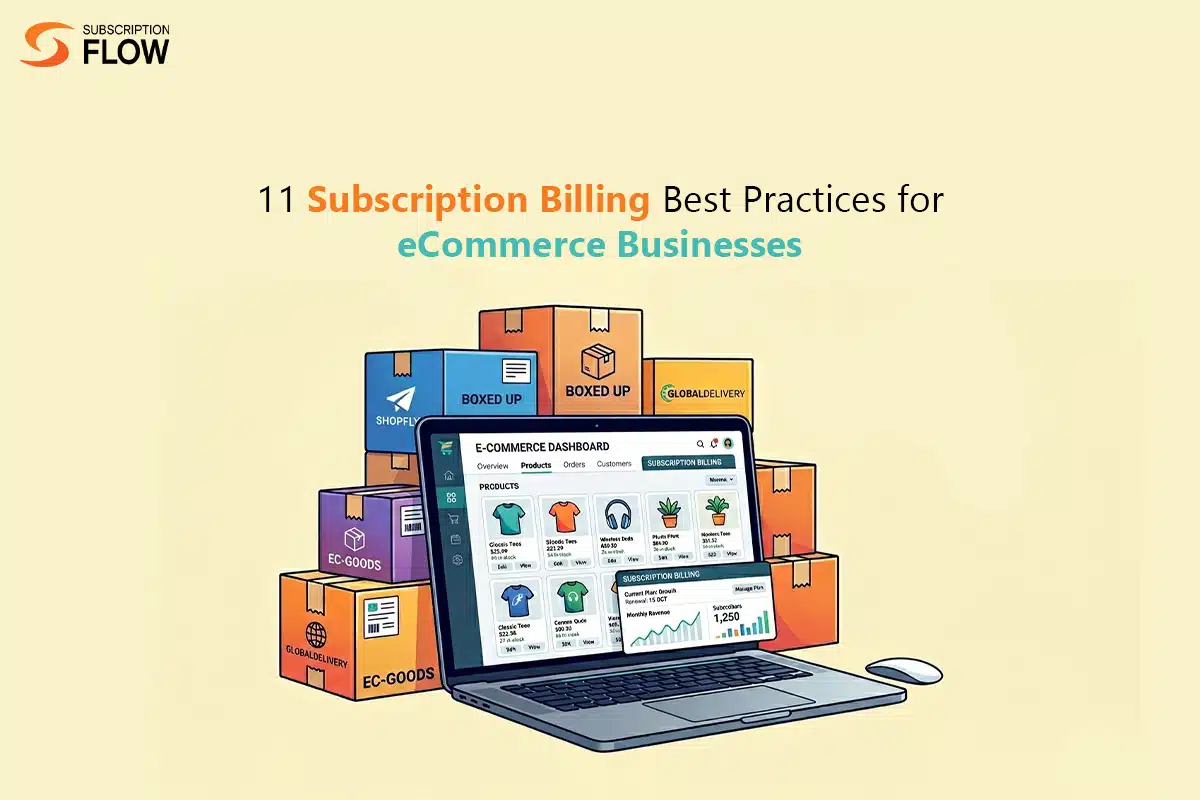
11 Subscription Billing Best Practices for eCommerce Businesses
For ecommerce businesses, convenience is the top factor that makes customers stay for a long time. It’s often the primary motivation that turns one-time clients into subscribers. Saved payment details, multiple plan options, automatic product delivery these are all features of subscription billing that take customer convenience to the next level.
But how well these features are implemented makes the real difference. It is easy for ecommerce stores to launch subscriptions. Managing them, and scaling without hurting customer experience is the real struggle.
In order to grow successfully, businesses first need to get their fundamentals right. For instance, selecting the right subscription model, managing payment failure, and fulfilling customers’ billing needs.
Following is the list of subscription billing best practices for ecommerce businesses that you can follow to achieve growth:
1. Select the Right Subscription Model
Selecting an appropriate subscription model should be your priority. Make sure that the subscription model fits your product, and doesn’t look forced. Forcing the model where it doesn’t belong can hurt adoption.
There can be multiple products an ecommerce store owner deals with. Examples include perishable items (such as coffee and grocery) that need to be replenished on a regular basis. Merchants can offer monthly subscription to these items.
This model is also called ‘subscribe & save’ where users simply sign up for replenishment cycles and then forget about it. Their payments are automatically deducted and shipments reach them monthly.
Another product type are bundles. Bundled products follow a more complicated subscription model, and may involve fee variations and tiers. Memberships are also another subscription type that unlock premium access to a service (such as online learning) and invite users to become part of a community.
Additionally, there are certain products that can be sold flexibly: they have both one-time purchase and subscription options available. Such as seasonal items, snack boxes or luxury goods. The bottom line is that merchants should first identify the nature of their offering, and then fit a suitable subscription model on it. That’s the only right way to boost sales.
2. Keep Pricing and Terms Crystal Clear
Keeping prices and invoices clear is an important way to build trust with the customer. These are some ways to do this right:

- Clearly show price per billing cycle. Each invoice should include a proper breakdown of charges (actual product cost, shipping fee, taxes, platform fee, etc.).
- Write the total cost clearly. For example, if you’re offering annual or quarterly plans, then mention both their total costs and monthly cost breakdown. This not only helps your customers choose according to budget, but also aids better value perception.
- Mention the current and the next billing date explicitly. For example, if you’re billing on a monthly basis, don’t write “next bill due next month” in your invoice. Vague invoices create confusion and mistrust. Avoid this by mentioning the exact future billing dates.
- Be explicit about shipping fees, frequency and delivery dates. Build trust by being fully transparent about all the charges the customer will be subjected to. If the charges come as surprise, they damage brand reputation. Customers should also clearly know about their billing cycle frequency.
3. Make Signup and Checkout Frictionless
Your focus should be on reducing drop-offs. That’s also why it’s so important to maintain a smooth working checkout. Because checkout is the point where many customers drop off due to slow loading speed, account creation requirement, foreign currency and payment options or other reasons.
- Make it easier for customers to subscribe by making your checkout forms simple and one-step. Multi-step forms can tire out buyers and make them lose interest.
- Don’t force account creation. Let users use their pre-existing email address or enter their email address in the check-out page directly, without having to go through the process of signing up first.
- Provide the customer with the option of autofilling all their details when they visit your website for a second time. But do ask for their consent prior to storing their data.
- Localizing the payment page to make it convenient for your visitors is important. Provide your customers with payment methods they can use, and not something completely unfamiliar to them.
4. Automate Recurring Orders and Shipments
Automating your billing processes, order receipts and shipment schedules is the best way to reduce errors. If you handle these tasks manually, it becomes impossible to scale beyond a few customers, and errors become increasingly difficult to avoid.
That’s why you need a subscription billing system that automates your billing cycles and generates each invoice proactively. Your billing should also be aligned with your fulfillment schedule. As your customer payments are confirmed, your billing software should automatically create a fulfillment task for each payment.
If this setup is implemented, merchants don’t need to confirm each payment manually to start preparing the order for shipping. A good billing software also helps you keep your sales aligned with your inventory so that you don’t over- or undersell.
5. Communicate Proactively Around Billing and Delivery
Good customer communication is invaluable for smooth subscription billing. If customers have no idea when their charges are deducted, how long the shipping takes or if their payments were a success or failure, this reduces engagement. It also increases payment confusion as your business simply becomes one of the many that the customer has subscribed to. You fail to stand out.
This can pave way for earlier cancellations. To avoid this, merchants must keep customers engaged with billing. They should send early billing reminders so that their customers expect a charge deduction and prepare for it. Then, after the payment, a confirmation receipt should always be sent as reassurance for the customer.
All the emails and notifications must be personalized and branded, so that the customers can identify their pending charges easily. Also, the delivery dates should be communicated transparently to prevent false hopes and customer disappointment. Any shipping delays must also be communicated proactively.
6. Handle Failed Payments and Card Updates
It is inevitable to come across payment failures, because customers commonly face card issues. And ecommerce merchants must be equipped to handle these. The key feature they need to combat failed payments is ‘payment retry’. Choose a software that lets you follow smart retry schedules.
Retrying payment only once is not enough. For higher recovery chances, you should be able to make retry attempts multiple times. Sending dunning emails is another good way to bring payment failures to the customer’s attention. For example, in the case of card expiry when only the customer can resolve their issue.
To make things easier for customers, businesses should let them update their payment method easily. There shouldn’t be complicated steps or support tickets involved in that.
7. Make Pausing, Skipping and Cancelling Easy
Customer commitment shouldn’t be forced. Forcing it simply increases churn and earns your business bad reputation. It’s a bad practice to make subscription cancellation hard or confusing, and may cause chargebacks as well. On the other hand, honesty and flexibility are retention drivers.
So merchants should make it easy to opt out of subscription, and use cancellations as a feedback loop. They can offer special incentives at the time of cancellation so that customers are motivated to continue, but this also shouldn’t be overdone.
The pause and skip buttons are two more things that are indispensable for retention. They offer paths other than cancellation to customers, and keep them on board. Customers can easily skip a month’s delivery if they don’t want it instead of abandoning the subscription altogether.
8. Secure Data and Comply with eCommerce Regulations
eCommerce subscription businesses must follow customer data protection laws. Their payment systems should also be PCI-compliant. Meaning, they should encrypt sensitive customer data, and shouldn’t share that with either the merchant or any third party. Merchants should also avoid storing customer payment details manually as that can lead to data breaches. Secure payments earn customer trust faster.
9. Track Subscription-Specific Metrics
Make sure to keep yourself updated on your subscription performance metrics. Your billing software should become your single source of truth. Also ensure that what you track is actually actionable. For example, your churn rate that tells you how long your customers stay on average.
Other examples are renewal rate that tells you how many users choose to continue subscription, AOV (average order value) that helps you compare the value of recurring and one-time orders, and your fulfillment rate that tells you whether you are delivering consistently.
10. Optimize for ‘Subscribe & Save’ and Bundles
Concentrate on optimizing revenue. Discounts may be offered with subscribe & save plans so that more consumers buy those plans. However, ensure that the discounts do not affect your bottom line. Early bird discounts have proven useful since they encourage early renewal while also improving perceived value.
Another revenue optimization strategy is offering bundles. Merchants can group complementary or most-sold items together, and sell them on a discounted overall price. This gives sales and order value per customer a boost.
11. Choose the Right eCommerce Subscription Billing Tool
This is the final step, and the one that makes all the previous steps possible and efficient. A good subscription billing tool is invaluable for your ecommerce operations. How you conduct billing depends upon your payment infrastructure, after all.
SubscriptionFlow is a leading billing platform in this regard. It optimizes your recurring revenue processes, and lets you implement the above-mentioned best practices with ease. It offers all the features a subscription business should look for:
eCommerce platform integration: SubscriptionFlow is available by default on popular ecommerce platforms like Shopify and Wix. It integrates with your store effortlessly, making it easier to start selling and managing subscriptions.
Subscription flexibility: You can easily add the pause, skip and cancel functionality, create subscription bundles, offer grace periods, allow plan changes and do much more to increase customer convenience.
Inventory syncing: The software syncs your billing cycles with your inventory so that you can keep your sales balanced, and maintain ideal product quantities.
Multi-currency and payment gateway support: You can make your payment pages more friendly by accepting multiple currencies, activating regional payment gateways and allowing the payment methods that your customers want.
Reporting tools: Get instant access to informative performance reports that refresh automatically. Get a bird’s-eye view of your subscription-based business model, measure key metrics, and apply the findings to optimize your business processes.
Want to unlock convenient billing for your customers? Use SubscriptionFlow for implementing best subscription billing practices, and pave the way for healthy business growth.

POPULAR POSTS


Think Business!
Related Posts
 Subscription Model vs. Transaction Model: A Comparison
- Do You Need To Automate The Recurring Billing Process? The Most Convincing Answer To This Frequently Asked Question
- Hardware Subscriptions vs. One-Time Purchases SubscriptionFlow
 How To Prepare Your SaaS Business To Go Global
- The Difference Between Subscription Billing and Invoicing Software